
≡ Menu

Dynamic asset allocation and withdrawal in retirement

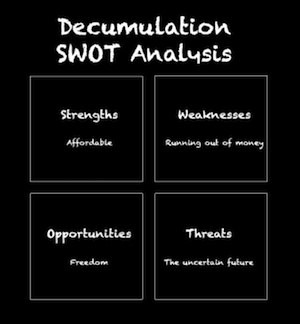
A SWOT diagram showing the sitrep that dynamic asset allocation and withdrawal seeks to overcome

Before we get into the sexy sounding business of dynamic asset allocation, a quick mid-series recap.

You’ll remember from my previous post that I’m on the eve of early retirement and I have my decumulation plan in place.

Please go read that article if you’ve not done so already.

Do you think there are risks to my strategy?

Yeah, me too.

Some risk is inevitable. As The Investor once wrote:

“Investing risk cannot be created or destroyed. It can only be transformed from one form of risk to another.”

With that admitted, I have back-up plans. We’ll get to those in the final installment of this series, so please don’t protest too loudly before you’ve caught them all.

Now let’s get into how exactly we’ll get money out of the portfolio.

What is dynamic asset allocation?

With a dynamic asset allocation strategy, you don’t automatically rebalance your equities and bonds to a favoured allocation, such as 60:40.

Instead you use a system that mitigates against selling equities when they’re down, or rebalancing back into them when they’re still dropping like a lift with a snapped cable.

Research indicates that a well-designed dynamic asset allocation strategy outperforms fixed allocations in most decumulation scenarios.

The trade-off is you could find yourself 100% in equities if the market doesn’t recover for many years.

That could happen deep into your dotage. Not a time traditionally associated with voluntary risk-taking.

Still, some octogenarians love motorbikes. Your appetite for risk in retirement is likely to depend on your own personality more than time-of-life stereotypes.

Prime directive

I’m going to use a dynamic asset allocation strategy called Prime Harvesting.

Prime harvesting was devised by Michael McClung. It is fully explained in his book, Living Off Your Money.

The main rules are:

  • Sell bonds once a year to fund your annual expenses.
  • Sell equities to fund your expenses if you’ve run out of bonds.
  • Rebalance into bonds only after a significant run-up in the value of your equities. For example: 20% beyond an inflation-adjusted baseline.
  • You don’t rebalance into equities, although your equity allocation (as a proportion of your portfolio) will rise as bonds are sold.

Otherwise, you rebalance between asset sub-classes as you normally would.

For example, you’d rebalance annually to maintain your ratio of linkers to conventional bonds.

McClung’s historical backtesting showed that an initial 50:50 equity:bond portfolio veered from 30% to 70% equities on average.

Commentators such as Early Retirement Now, EREVN, and The Bogleheads have all independently tested Prime Harvesting. They also found it fared well historically.

You can read more about Prime Harvesting via a free sample from Living Off Your Money.

McClung provides full details on how to use it in his book. He has also provided a spreadsheet to handle the calculation for you.

In my portfolio, Prime Harvesting would also mean I’d sell down cash and gold before equities to fund my expenses.

I’ll annually rebalance between my preferred defensive asset allocations as if they were all bonds in McClung’s system.

The risks of withdrawing on auto-pilot

A major cause of portfolio death in decumulation is jacking up spending by inflation every year, regardless of market conditions.

A combination of portfolio losses, equity sales, inflation, and escalating withdrawals over a few years can quickly take a toll.

For example, let’s say you withdraw 4% from a £1,000,000 portfolio for an income of £40,000 at the start of Year One.

Then imagine that – thanks to weak markets – your portfolio falls further to £672,000 by year-end.

Year Two’s mandated withdrawal is £41,200, after 3% inflation. Your withdrawal rate is now over 6%.

The portfolio then goes down to £536,180 by Year Two end, after a 15% loss. Unlucky.

Year Three’s withdrawal is £42,848 after 4% inflation. The withdrawal rate is now 8% and the portfolio balance has plunged more than 50% to £493,332 inside two years.

Just a few more years of bad luck and your withdrawal rate could be well into double figures. You need equities to bounce back – but that won’t happen if you sell too many.

Gulp.

Dynamic withdrawal rate

This is where a dynamic withdrawal rate can show its strengths.

  • Dynamic withdrawal rates are responsive to the amount of fuel left in your wealth tank.
  • They’ll ease your pedal off the money accelerator when the equity gauge flashes red.
  • That can mean living on less, for a time, so your portfolio doesn’t run out of road.
  • But dynamic withdrawal rates can signal that you can spend more, too.

If market conditions indicate full-speed ahead, then a dynamic withdrawal rate sends you up the gears, so you can live life in a faster lane.

This deals with a little-discussed drawback of conservative Safe Withdrawal Rate (SWR) strategies, which is that most people do not live through a nightmare scenario.

You could easily die with piles of loot unspent if you stick to rules calibrated to avoid the worst case. A worst case scenario that rarely happens.

In contrast, sophisticated dynamic withdrawal rates take into account market valuations and/or mortality.

The downside of dynamic withdrawal is your income may be curtailed for years if your sequence of returns proves ugly.

But the upside is you can choose a higher initial SWR – because your financial bungee cord prevents you from spending your portfolio off a cliff.

Dynamic withdrawal rate: which one?

There a number of dynamic withdrawal methods that are well-documented and designed for DIY decumulators.

They include:

  • The Bogleheads Variable Percentage Withdrawal (VPW) method.
  • Early Retirement Now’s CAPE-based withdrawal formula.
  • Michael McClung’s Extended Mortality Updating Percentage Failure (EM) rules. See his book: Living Off Your Money or read my review.

Which is the best? None of them, really.

I eventually realised that I was searching for the perfect system. One which let me spend like my wallet was on fire, but also saved me from Armageddon.

That system doesn’t exist.

You always face the same compromises:

  • Spending more upfront, risks cutting back more later.
  • Saving your portfolio from a financial face-plant may mean cutting expenditure.
  • Different systems outperform at different times, but you can’t know what conditions you will face.

How to decide between them? Here’s my own dynamic withdrawal rate criteria:

  • The system should account for market valuations. We live in an era of high valuations, which I believe signals subdued returns ahead.
  • The system shouldn’t front-load with an overly optimistic SWR, only to risk a severe spending cutback later.
  • Mortality is recognised so you can up the spending ante as your candle burns low.
  • There should be evidence that the system works during the historic nightmare situations that we all fear.
  • The author(s) are open about the trade-offs.
  • I need to be able to live with it. In other words, I need to understand how the system works, make the necessary calculations, and know what demands it could make if we’re unlucky.

Ideally the system comes with resources such as an active community – or at least a book’s worth of backtesting (including non-US scenarios), use cases, and advice on how and when to bend the rules.

McClung is the man

I could easily live with ERN’s or The Boglehead’s systems, but McClung’s Extended Mortality (EM) withdrawal rate formula ticks the most boxes for me.

Not least because he’s tested EM against historical returns for the UK and Japan, and because he considers the global portfolio, not just US.

Whichever system you choose, make sure you are comfortable flexing your spending down. (I guess we’re all comfortable flexing up.)

Mrs D. Accumulator and I could drop spending 15% and live happily.

We could drop 25% and still cover our bare essentials.

Dynamic duo

Dynamic asset allocation and dynamic withdrawal are additive, SWR-optimising partners.

They’re not panaceas but both tip the odds further in your favour.

I only have to make the calculations once a year and McClung has provided a spreadsheet to do the hard work for me.

I will have to stick to more complex rules under pressure, which is a risk, as is cognitive decline.

If that sets in then I’ll switch to Vanguard LifeStrategy and annuities.

So what is my SWR?

Taking into account our life expectancy, ‘failure’ tolerance, asset allocation, and high market valuations, McClung’s formula awarded us an SWR of 4%.

Or a real SWR of 3.8% after investment fees.

That’s much less than the 4.7% I previously got using Michael Kitces ‘layer cake’ SWR improvement method.

I backtested the 4.7% SWR using the brilliant Timeline SWR tool that uses historic global investment returns.

4.7% passed the test of history with a 99% success rate, although it cut spending drastically in 10% of scenarios.

Nevertheless I’m happy with a 3.8% SWR.

It was actually 4% (after investment fees) when I ran the numbers two years ago. Higher market valuations today have cost us two pips but rising share prices have also buoyed our portfolio in the accumulation phase. We’re better off overall, but it’s still a warning to beware of trouble ahead.

That’s why I’m not buying into the 4.7% that I can coax out of Kitces and Timeline.

No, 3.8% it is for us.

State Pension SWR bonus

Although a younger version of me would never have believed it, one day we’ll be drawing our State Pension. That will add fresh horses to the portfolio in a couple of decades.

The State Pension reinforcements bump up our SWR by 0.64% (along with Mrs A’s DB pension), according to Early Retirement Now’s superb Social Security and Pensions formula.

Note: UK investors should only use Early Retirement Now’s pessimistic Minimum Value table. His wider work is underpinned by those world-beating US historical returns.

Fortunately, we don’t need to front-load our SWR in order to live, so I’ll leave the State Pension bonus in reserve.

I prefer to think of the State Pension as the cavalry, ready to charge in to save us if our portfolio is battered by our late sixties.

Whether it will arrive resplendent as heavily-armoured cuirassiers or more like a few starving peasants on nags is debatable.

I’m relatively sanguine about it. If you’re not, bear in mind it’s only one of our decumulation back-up plans.

To get a gander at our belts and braces in full – and to conclude this mini-series of decumulation posts – tune in to the third installment.

Working title: Decumulation: A Better Finale than the Return of The Jedi.

Subscribe to make sure you see it.

Take it steady,

The Accumulator

{ 146 comments }
Weekend reading logo

What caught my eye this week.

Bit of a higgledy-piggledy digest this Saturday, which is right in keeping with a week in the markets that was all over the place.

If you sensibly follow The Accumulator’s advice to watch your paint drying and wash you’re hair a third time before you check out how your portfolio is doing again, you might not know things have gotten a little tasty.

As Merryn Somerset-Webb put it in the Financial Times:

Bonds are supposed to be boring. When they are not, you should pay attention.

That makes this week a good time to do just that. Bond yields are on the up: on Thursday the 10-year US Treasury yield hit 1.6 per cent.

That might not sound like much — and it is very low by historical standards — but it has tripled since the summer, with much of the action happening in the last few days.

It’s also not the direction we are used to bond yields moving in: for the past 40 years they have mostly gone down.

Inevitably share prices are readjusting as the prospect of negative (nominal) interest rates recedes – and as inflation twitches to life, just out of frame.

As yields on the theoretically safest asset in the world rise, more money will want some of that. You might scoff 1.6% won’t butter many panfried parsnips, but remember pension funds and others were buying safe bonds all the way down through zero.

At 2% or more, fixed income managers would be loosening their neckties and doing the graveyard dance from Michael Jackson’s Thriller.

Remember, too, that some high equity valuations have been predicated on very low interest rates persisting indefinitely.

As I wrote a few years ago:

Discounted cash flow models try to estimate the cash due from a company or property. They then compare this to the yield you could get from the lowest risk asset – a government bond.

Plug a historically low risk-free rate into such a model and you can get extreme valuations.

It’s possible to argue that everything from shares to housing is cheap.

That proved a good lens through which to see the future of equity returns over the subsequent years. Most shares – especially growth shares – rose from often already high valuations, unburdened by the gravity of interest rates.

Well, if yields rise a lot, it’s inevitable some of this will reverse.

Extreme growth share valuations will be harder to rationalize.

And income investors will move out of ‘bond proxy’ stocks and back into the real thing.

Market returns could be sluggish as a consequence. Some share prices will probably fall.

Pick your poison

We’ve long warned investors not to expect the unwinding of what they’ve decried as ‘a bond bubble’ to happen without any impact on share prices.

Super-safe government bonds yields are the gravity that permeate all valuations. It is all connected, in the long run.

But what to do about it now? Probably nothing if you’re a passive investor.

Merryn restates the case for shifting from a 60/40 portfolio on the grounds that bond prices could fall even as shares do. You’d possibly get no support from your bond cushion in a market decline, in other words. She suggests holding a bunch of other assets, including more cash.

Well, maybe. If you’re an active investor like me, knock yourself out. Even for passive investors, for years I’ve been suggesting you hold some of your bond allocation in cash as a response to low yields.

Cash – and the treatment of interest income – is a far more attractive to us little guys than to institutions.

But please don’t go crazy. If you own bonds in a well thought out asset allocation, you should probably keep most of them.

Check out the graph in the links below. It shows how a 70/30 portfolio has consistently matched or outpaced returns from the top 25% of – complicated and actively managed – US university endowment portfolios.

Those endowments are invested widely for various reasons (including career risk) but the result is the same.

Some of the best – and the majority of their lesser-performing brethren – could have just owned a couple of index funds, fired most of their staff, and seen better returns, at a lower cost.

What edge do you have that they don’t?

Markets don’t go up without going down. If you’re ten years from retirement, tweaks to de-risk may make sense. But really you should have been adjusting already, not just because yields are climbing off the floor.

Money is still super-cheap and abundant. The adjustments so far are small, and may yet – like the first signs of inflation – be mostly a head fake.

Or the regime of 40 years of declining bond yields may be changing. But please proceed in a calm and orderly fashion towards the exits.

Watch out for missing Monevator emails

Finally a couple of quick housekeeping notes.

The first is I’m going to sign us up to a proper email distribution service.

The one we use is free, creaking, and on deathwatch. Paid-for plans are surprisingly dear but should give us more flexibility in how we email you.

I’m just mentioning this in case you only read us via our email newsletter – rather than on the website, which some people don’t even know exists.

If our emails disappear, it won’t be because we’ve won big on the less-than-1% paying Premium Bonds, after all. (If I won the jackpot on the Premium Bonds, then Monevator’s future would be assured!)

No, it’ll be that something technical has SNAFU-d. You might want to check your spam folder, for example. If that’s empty, please get in touch.

Vastly more people get the email than read the site via RSS nowadays. But the several hundred RSS diehards should stay alert, too.

I hope to make the change soon. We don’t want to lose anyone!

Nominated under the influence

Finally, we’ve been nominated for a British Bank Award, run in conjunction with Smart People Money.

Monevator is in the running for Online Influencer of the Year – and it’s not even on account of @TA’s side-project of modelling onesies on Instagram.

You can read about all the nominations at the British Bank Awards website.

There were some new blogs on there to me. You might just find a gem.

When you’re done, you can vote for us if you’d like to, or for one of our worthy competitors. It’s a public vote, so I guess the most influential influencer will win.

Have a great weekend. Hopefully not long now before that won’t sound quite so tired, if like me you’ve been feeling the lockdown blues.

[continue reading…]

{ 51 comments }

Decumulation: a real life plan

SWOT analysis for a decumulation plan

Living off your investments is the ultimate goal of financial independence (FI) and the trickiest part to get right. This phase is known as decumulation and it’s the part of the journey I’m about to embark on.

My objective is simple:

  • Drawdown enough income so that Mrs Accumulator and I can live without needing to work.
  • Maintain a decent quality of life.
  • Not run out of money before we die.

The key is to allow plenty of margin for error.

Our decumulation plan needs to cope with volatile market conditions, flawed assumptions, and the fifth law of thermodynamics: Grit happens.

What I’ll present – over three detailed articles – is our genuine, all-our-skin-in-the-game plan to meet this challenge.

This is no longer theoretical for me and Mrs A..

It’s the rest of our life.

My plan rests on the best practical research I’ve found over many years, fitted to our personal situation.

It’s resistant to the main threats that bedevil many decumulation strategies:

  • A long life – also known as longevity risk.
  • Inflation risk.
  • Living off volatile assets – sequence of returns risk.

I’ve built in multiple safety features. But I know there are no guarantees.

Decumulation: time to get personal

My plan’s core components will be relevant to other decumulators, FIRE-ees, and near-retirees, regardless of our different circumstances.

Customisation is critical though, so here’s a list of our particulars:

  • Time horizon: 45 years
  • Chance we both live another 45 years: 8%
  • Decumulation method: annual withdrawals based on a sustainable withdrawal rate (SWR) from a portfolio of volatile assets such as equities and bonds.
  • Capital preservation required: No
  • Legacy required: No
  • Back-up sources of income: State Pensions due in approximately 18 years. Small Defined Benefit (DB) pension for Mrs A in the future. Ability to work if required, or as desired.
  • Inheritance: No

I’ve decided not to share our personal numbers. This plan scales regardless of wealth or income. I’ve left clues all over the Internet, anyway.

It may be helpful to know that we got here on relatively modest five-figure salaries and plan to live on less than the annual median household income.

That’s quite tight, which is why the plan is bold in some respects.

I’d love to take a ‘safety-first’ retirement approach. To rely more heavily on less volatile instruments such as defined benefit pensions, annuities, and index-linked government bonds.

Sadly, that route is unaffordable for us. But it’s definitely worth investigating if you have greater means.

My final, overriding, set-up point: my job has been fairly all-consuming for more than two decades. I’d like to live a fuller life now.

That entails risk.

That’s life though, so I’ll try to offset the risk via:

  • Multiple back-up plans
  • Awareness of the failure points
  • Conservative assumptions
  • Not believing this is fire-and-forget

Living life now means not waiting until we can live off the dividends or fund a conservative 3% SWR.

But a naive 4% SWR is too risky, in my view.

So how can I use more sophisticated decumulation techniques to deploy our wealth more effectively, without turning retirement into a decades-long tightrope act?

The first step is understanding what an acceptable failure rate is.

Failure is negotiable

Standard SWR studies define failure too narrowly.

If the simulated portfolio’s wealth hits zero before the end of its time horizon then it’s a fail.

But we humans can run out of life before we run out of money. If I flatline before my wealth does then… success!

Well, sure. Kinda. Sorta.

The point is that SWR failure rates are less risky when you factor in your own mortality.

If Mrs A and I have a 10% chance of both being alive in 45 years, and our portfolio has a 10% chance of giving up the ghost in that time (at our chosen SWR) then our actual failure rate is:

0.1 x 0.1 x 100 = 1% chance of running out of money and both of us being alive to worry about it.

That’s a 99% success rate! Always look on the bright side of death.

I’m assuming here that the portfolio will more easily support one person than two.

That matters, because there’s a 49% chance that at least one of us will be around in 45 years.

One person won’t be able to live half as cheaply as two, but the portfolio will definitely last longer if it isn’t financing my chocolate habit.

The upshot is I’m comfortable picking a higher SWR – based on a 10% failure rate – when it’s twinned with a reasonable life expectancy for both of us.

Remember, we only stand an 8% chance of both being around in 45 years, so I’m still choosing an optimistic life expectancy. There’s a 2% chance we’re both here in 50 years time.

Also, SWR sims don’t account for humans noticing when the bank balance is draining at an alarming rate.

In real life people put the spending brakes on years before their portfolio sparks out. (More on this later.)

Next!

Decumulation diversification

SWR research is generally based on single-country portfolios split fifty-fifty between equities and conventional government bonds.

In a nutshell, US-based historical studies may be too optimistic. But non-US studies don’t account for the contemporary advantages of global diversification.

Research into asset-class diversification generally shows a modest uptick in SWR.

As a UK investor I’m not going to bank on history repeating the stellar US asset returns of the past century.

But I’m happy that a diversified global portfolio could replicate historical developed world returns. Those were scarred by two world wars, after all.

Here’s my de-accumulation asset allocation:

Growth – 60%

  • 20% World equities
  • 15% World multi-factor (Size, Value, Quality, Momentum)
  • 10% UK equities
  • 10% Emerging Market equities
  • 5% REITS

(Note: there’s approximately 2% more UK exposure in the World funds.)

Defensive – 40%

  • 15% UK gilts (long, intermediate, and short durations)
  • 15% World index-linked government bonds (Hedged to £, short duration)
  • 5% cash (currently it’s 10%)
  • 5% gold (I don’t own this yet)

Most of my holdings are in cheap index trackers, though I will use active funds when I don’t have a good passive investing alternative.

I won’t use high-yield funds because I think that a total return strategy beats an income investing strategy.

Decumulation portfolio rationale

Here’s a short (ish) explanation of my decumulation portfolio choices. Happy to debate any of it in the comments after.

Growth

The expected returns of our equity holdings should provide the real returns we need to sustain our income over the decades. A strong equity allocation along with our State Pensions is our best protection against longevity risk.

It’s that or troughing out on deep-fried Mars Bars and cigarettes for the next 30 years. YOLO!

Adding a multi-factor holding to my equity split increases diversification at the price of higher fees, mitigated by the hope of slightly higher returns. This is debatable, optional, and may well be a slim hope.

Threats

The volatility of equity returns exposes us to sequence of returns risk. That is the chance that a poor run of market conditions sends our portfolio into a death spiral we can’t escape.

Another threat is high inflation whittling away the value of our defensive assets over the long-term.

Defence

Our defensive assets reduce our sequence of returns risk – as well as the stress of watching our main income source collapse during a market crash.

Conventional government bonds are likely to outperform other assets during a steep market decline.

Short duration bonds and cash guard against rising interest rates but they are much less effective than longer bonds when equities bomb.

(Cash sometimes outperforms bonds, especially in inflationary scenarios. It’s also easier to get change from a tenner than a 10-year gilt at Tesco.)

Index-linked government bonds are best against runaway inflation. Equities do badly in these scenarios. Equity inflation protection asserts itself in the medium to long-term, but linkers can pay your bills today.

We’ll hold linkers and conventional bonds in a 50:50 ratio.

Structural problems with the UK’s index-linked gilt market explain why I use developed world linkers.

For conventional bonds, choose a global government bond fund or total global bond market fund if you prefer. Just make sure it’s hedged to the £ (to eliminate currency risk) and that it’s overwhelmingly concentrated in high-quality bonds.

Match your bond fund’s duration to your time horizon to reduce interest rate risk.

Gold is a wild card that can perform when nothing else works. It’s typically uncorrelated to other assets and, in recent years, has spiked when people think the financial system is circling the drain.

I see gold as a one-shot wonder. It’s a shotgun blast in the face of some crisis occurring during the first 10-15 years of decumulation.

That early period is when we’re most exposed to sequence of returns risk. After that gold will be discarded like an empty weapon because its long-term returns are poor.

Triple threat

Does the age of negative interest rates, QE, and government bazookas mean we’re in for secular stagnation, rampant inflation, or stagflation on steroids?

Your guess is as good as the next clairvoyant. I’ll hedge my bets with that mix of equities, linkers, and gold.

In times past, I’d probably have been 50:50 split across bonds:equities on the eve of decumulation. Now I won’t go below 60% equities. I believe I can tolerate the extra risk.

If I couldn’t handle this large (ish) equity allocation, I’d need a bigger portfolio to sustain the same income. I believe high equity valuations and low to negative bond yields heighten the risk of anaemic returns over the next 10 to 15 years.

A diversified portfolio in itself is only worth a small SWR raise, so I’ll also use a dynamic asset allocation strategy to try to squeeze a bit more juice out of my pot. This means my equity allocation could hit 100% if the market stays down for years.

Before I check out

In my next post I’ll explain how I plan to employ dynamic allocation – and dynamic withdrawals – to finesse my plans. Subscribe to make sure you see it.

Take it steady,

The Accumulator (though not for much longer)

{ 145 comments }

Weekend reading: Where to stash the cash in a crazy world

Weekend reading logo

What caught my eye this week.

I sold a six-figure shareholding last week for a phenomenal capital gain – over 1,000%.

For historical reasons the shares were held outside of an ISA. This means I’ve got a big capital gains tax bill coming, despite years of defusing.

The sheer size and hence risk of this single position – and the awkwardness of trading it outside an ISA – meant something had to be done. Rumours that Rishi Sunak might raise capital gains tax rates tipped me over the edge.

Like most taxpayers I remind myself I support an accessible health service and a welfare safety net. My sister is a nurse.

Thank you NHS.

But not to the tune of a mooted 45%!

To stash or not to stash the cash

The lessons of this investment – and of getting rid of it – will be fodder for a future post. As will be my specific findings from what happened next.

Which was deciding what to do with it.

Remember, I’m running a big interest-only mortgage, which through one lens is borrowing to invest. So somewhat risky.

Euphoria abounds in the stock market today – and elsewhere. Bitcoin just breached $56,000. Bulletin boards are blowing up hedge funds. Growth stocks seem unstoppable.

Even with nominal yields on government bonds sneakily rising, real yields remain very low and confidently predicting an imminent bust is folly. But it hardly seems imprudent to take some money off the table.

The trouble is where to put it?

I knew, of course, that rates were very low. I sort of assumed if I dug around I’d eek out something decent across multiple savings accounts.

But no, not to the extent it’s worth the hassle.

Long story short, Premium Bonds seem about as good a place as any for the maximum I can put in them.

I will keep a further chunk in cash, despite inflation eroding its value. I’ve felt too light on cash ever since I bought my flat, and I love Jamie Dimon’s description 1 of having a fortress balance sheet. It’s time to rebuild my walls.

Otherwise, I’m thinking I might actually throw a few pennies at that big interest-only mortgage that half of you hate so much!

I’d presumed I’d run my mortgage full tilt for a decade, at least. But it is looking like some of my expected investment gains have probably been front-loaded.

What’s more, my bank’s rates have already floated off the floor. I have two years left of my very low five-year fixed rate to run. Given the odd way I got this mortgage, the end of this term could be a non-trivial event.

It’s still tempting to stash the cash rather than lock it away forever by paying down some of my mortgage. Even at a cost of lower returns from savings. The set aside cash could cover several years of monthly mortgage payments in a pinch. Sunk into the mortgage, it only reduces monthly payments by less than £100.

Also it’s entirely possible I’ll never be able to get a mortgage of this size again. Not without buckling down and ramping up my earnings, and even that hasn’t helped in the past. (I’m self-employed, one way or another.)

On the other hand, repaying debt charged at 2% looks sweet in a world that barely pays you for lending it cash and expects every share to go to the moon.

Lucky bastard

I’m aware this problem is plucked from the box marked Nice Problems To Have. Despite vast State support, many people and businesses have been hit hard by the pandemic – including several unlisted companies I’ve invested in.

How they’d love to have the headache of where to stash thousands of pounds in cash.

All I can say is I planted the seed of this windfall many years ago, when times were good and most people were spending freely. Now my investment has matured and blossomed. We all have to manage our own finances as best we can, whatever is going on in the world.

Luck won’t always go my way. That’s why I – like you – save and invest for the future. I fully expect to be hit by future tax rises, too, to pay for furlough and other breaks I didn’t get a penny of (but nonetheless supported).

But that’s more article fodder, I guess. Another dividend from reshuffling my assets!

Where would you stash the cash – or would you just save it for the mother-of-all post-lockdown parties? Let us know in the comments below.

Otherwise have a great weekend.

[continue reading…]

  1. Possibly pinched from Warren Buffett.[]
{ 97 comments }