≡ Menu
John Lee, Investor and Lord

One of the UK’s most famous – and famously successful – private investors is John Lee (aka Lord Lee of Trafford).

Thanks to more than a decade of writing about his portfolio for the Financial Times, Lee has became one of the handful of go-to guys when it comes to navigating the woefully under-covered UK small cap scene.

Lord Lee also made headlines when he revealed in 2003 that he was an ISA millionaire – an impressive sum to amass in just 16 years, given that he made this million by compounding the mere £126,000 he was allowed to put into ISAs in annual contributions by that date.

And Lord Lee hasn’t just shared his wisdom with investors. The House of Lords peer and former MP also gave his time to agitate for regulatory changes, in particular having a key role in a tweak to the law to allow AIM shares to be held in ISAs.

At a time when many in government seem almost hostile to private investing, we’ve been lucky to have him on our side.

John Lee’s 12 rules of successful investment

Lord Lee eventually tried to distill more than 50 years of his experiences as an active investor into his own book, How to Make a Million – Slowly, which was released in late 2013.

It’s not a definitive textbook on the dark art of active investing, but it is a very agreeable summary of the principles of investing in small caps, from an amiable, generous, and enthusiastic practitioner.

Read my review of his book if you’d like to know more.

As a taster, here are Lord Lee’s 12 guiding principles to successful investing:

1. Endeavour to buy shares at modest valuations – hopefully with an attractive yield and single-figure price earnings ratio and/or discount to net asset value / real worth.

2. Ignore the overall level of the stock market. Don’t make judgements on the macro outlook – leave that to commentators and economists. Focus on your particular selection.

3. Be prepared to hold for a minimum of five years.

4. Have a broad understanding of the PLC’s main business activity – one which makes sense to you.

5. Ignore minor share price movements. Looking back years hence you will have either got it right or wrong. Whether you originally paid, say, 55 pence rather than 50 pence will be totally irrelevant.

6. Seek out established companies with a record of profitability and dividend payments – avoid start-ups and biotech and exploration stocks.

7. Look for moderately optimistic or better chairman’s/CEO’s most recent comments.

8. Focus on preferably conservative, cash-rich companies or those with low levels of debt.

9. Ensure the directors have meaningful shareholdings themselves in the PLC and ‘clean’ reputations.

10. Look for a stable Board – infrequent directorate changes. Similarly with professional advisers.

11. Face up to poor decisions. Apply a 20% ‘stop loss’ – sell and move on. However, ignore the stop loss if there is a major overall market fall.

12. Let profitable holdings run. Don’t try to be too clever, i.e. selling and hoping the market will fall to buy back at a lower price.

It sounds straightforward, doesn’t it?

You just try being so sensible for 50 years!

A slow and steady way of active investing

I’ve been lucky enough to meet Lord Lee a couple of times, and he’s just as genuine in real-life as he comes across in his book – both in terms of his passion for investing, and in his surprisingly down-to-earth nature (especially for a multi-millionaire peer of the realm…)

As always the ‘house view’ of Monevator is that most people will do best by passively investing.

But if like me you’re one of life’s inveterate stock pickers, then I think you’ll find Lee’s sensible, business-focused investment rules are worth more than any number of bulletin board tips and irrelevant CNBC headlines.

{ 5 comments }
Weekend reading

Good reads from around the Web.

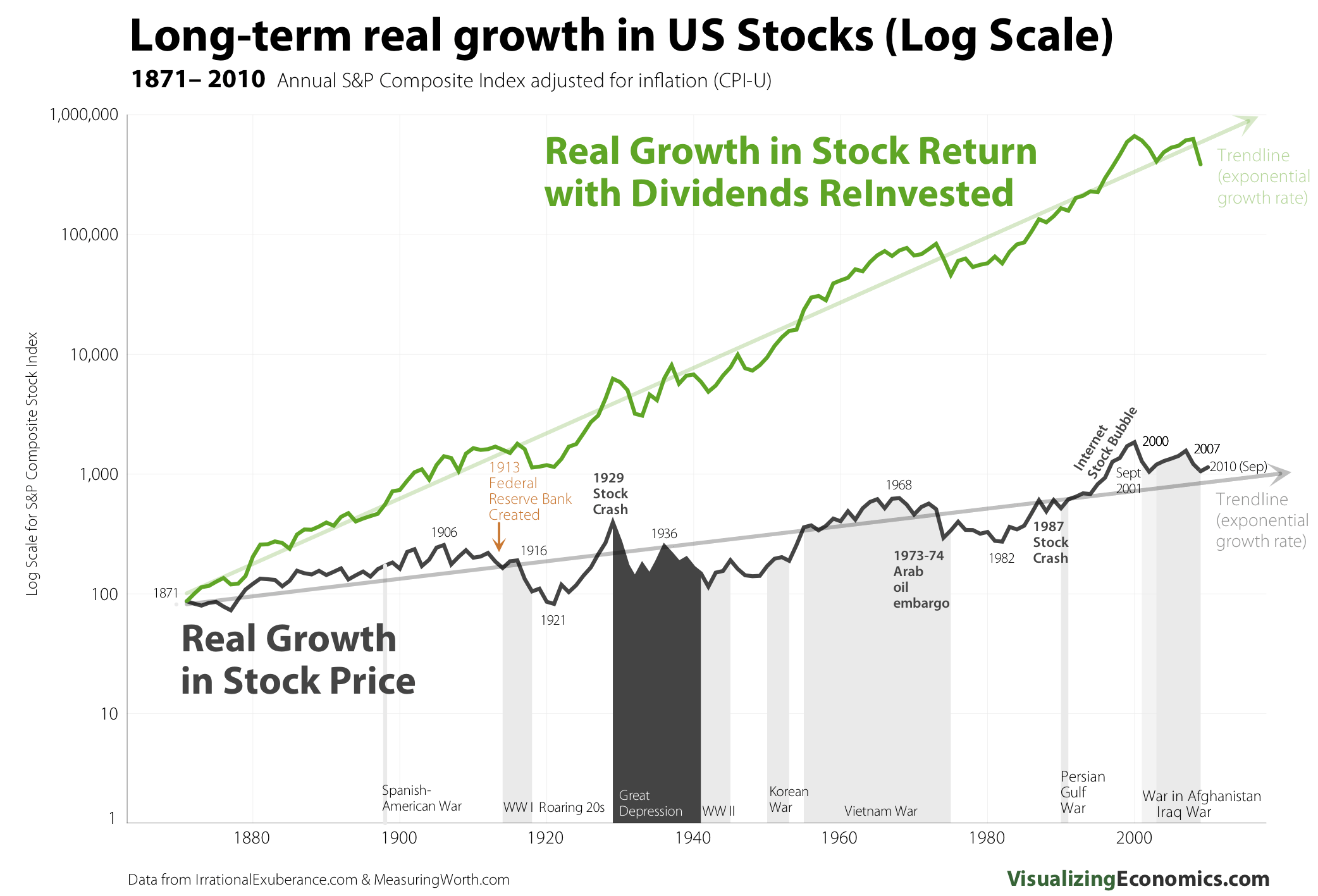
Most of us know that investing works best when it’s a long-term project.

But too many people don’t appreciate that a long-term view doesn’t mean you’re guaranteed to do well, especially with an equity-heavy portfolio.

I’ve written before about sequence of returns risk, which is the danger that you’ll be unlucky and see your share portfolio plunge just before you’re set to stop contributing and to start living the high life.

What’s so hateful about this risk is that you can spend your life being the smuggest sensible investor on the block – admirably tuning out the market noise and boasting about your puny fees at parties, if you’re lucky enough to go to those sort of parties – and then wham…

…the market crashes. Overnight that annoying cousin who pumped all his money into buy-t0-let gets the All You Can Eat Deal at the retirement cafe, and you’re left hunting for bargains at Aldi. 1

The incomparably consistent Morgan Housel expanded on this risk for the Motley Fool US, with the following striking graph:

US data from Robert Shiller and Morgan Housel (Click to enlarge)

US data from Robert Shiller and Morgan Housel (Click to enlarge)

Housel writes:

What amazes me is that these hypothetical investors would be considered some of the smartest around, investing steadily every month no matter what the market was doing, for decades on end.

Doing this is emotionally taxing, and few investors can keep it up over time.

In the real world, investors are more likely to buy after stocks have boomed, and to sell after a crash — which devastates returns.

Yet even with hypothetically perfect behavior, the difference in results between investors born in different generations can be the difference between no retirement and a lavish retirement.

And it’s mostly a factor of luck.

It is indeed striking to see the big differences in outcome, and it demonstrates exactly why different generations talk so variously about a particular asset class.

For instance, most people who invested through the 1980s and 1990s know little of the 1920s or 1930s – the UK market went up roughly sevenfold over the former period, and bonds did well too. Anyone who retired in the mid-to-late 1990s is likely to be an evangelist for long-term investing, but if you retired in 2008 you might have a different view.

Similarly, London property has been a winner for so long that people have forgotten it once fell in value. And people forgot in the 1990s that gold sometimes shines, to the extent that few people cared less when the UK government started flogging it off for a pittance.

Don’t be a loser

The only way to avoid being at the mercy of this rollercoaster ride is diversification across asset classes.

In particular, to avoid a catastrophic outcome you need to temper down any full-on enthusiasm for equities at least a couple of decades before you stop contributing money and start to make withdrawals.

That doesn’t mean abandoning equities or market timing, or anything like that. It means that a 100% equity portfolio should be at most a 50-80% equity portfolio say 20 years before your ‘date’, and you should rebalance from there as required.

I think rough bands are fine, incidentally– it’s better to be approximately right with this stuff then precisely wrong. And as far as I’m concerned the rest of the money can be in cash, given the weird situation at the moment, provided you’re prepared to chase higher rates. But of course classically it should be in bonds, and that’s the way to head if and when rates normalise.

Either way, you’re protecting yourself from the risk of a stock market that crashes and takes 15-20 years to get back to where it was.

If that seems fanciful, look at a graph of the FTSE 100 or Japan’s Nikkei 225.

Aim for a good result, not the best result

Sometimes diversification and rebalancing actually increases your returns, as an article from A Wealth of Common Sense this week showed:

diversification

But more often you’ll do slightly worse because you diversified. That’s the price of ensuring that you don’t do really, really badly.

Rebalancing is key, as Common Sense author Ben Carlson concludes:

In almost half of all annual periods you had a loser in the group. Each of these losses created opportunities to rebalance to boost future returns. And even though there were plenty of down years for each fund, the portfolio as a whole was still positive over 70% of the time.

[continue reading…]

  1. Okay, so I already hunt for bargains at the supermarket. But it’s fun because it’s a choice![]
{ 20 comments }

How to invest in small caps

One problem with investing in small cap trackers 1 is that there is no consistent definition of small. Like ancient market traders before the invention of scales and Trading Standards, some people’s idea of small turns out to be quite big.

For example, if you want to invest in UK small caps then you might consider any of the following indices:

  • The FTSE SmallCap Index – the bottom 2% (i.e the smallest 2%) of the UK market.
  • The MSCI UK Small Cap Index – the bottom 14%.
  • The FTSE 250 Index – the 16% (or so) slice that sits below the FTSE 100 and above the FTSE SmallCap.

The disparities in size can be enormous. The largest firm in the FTSE 250 is worth £4,047 million while in contrast the big kahuna of the FTSE SmallCap weighs a mere £591 million.

Theoretically, the weenier the firms held by your index tracker, the more likely it is to benefit from a small cap boost – due to the size premium.

But you won’t find a tracker that follows the FTSE SmallCap, the FTSE Fledgling, or even the Numis index.

That leaves you to fish about in the active fund murk, or to compare trackers that take their lead from the beefier FTSE 250 or MSCI Small Cap indices.

Comparing small cap trackers

Firstly, drop the name of your tracker into Morningstar’s search box and click through to its overview page. Click on the Portfolio section and you’ll see something like this snapshot:

Key small cap metrics

Compare the tracker’s Average Market Cap figure (see the red circle on the pic) versus its rivals to understand which product packs the most pygmies. The smaller the market cap, the better.

The Market Capitalisation section (green circle) gives you further insight into how the fund’s holdings breakdown into large, medium, and small cap firms.

Note, in this instance iShares MSCI UK Small Cap ETF is only 28% invested in firms that Morningstar actually rates as small cap or below.

As such the Morningstar Style Box (red arrow) rates the ‘small cap’ tracker as a mid cap product. That’s because it follows the MSCI UK Small Cap Index, which smells a lot like the FTSE 250.

The final section that’s worth a shufty is Valuations and Growth Rates (blue arrow). These metrics offer a small but smeary window into the fundamentals of the equities held. The lower the numbers, the more the tracker tilts towards the value premium.

If the numbers are low enough then the product would register a hit in the left hand column of the style box.

In other words it would be a value fund.

Historically, the sweet spot has been in the bottom left hand corner: small value returns have outperformed the other spots on the grid. The one to avoid is the bottom right hand corner: small growth.

Remember, just because small value funds have outperformed in the past, there’s no guarantee they won’t crash and burn in the future.

Moreover, to earn that premium, small cap value investors have at times had to endure many years of beating themselves around the head as their small cap funds plunged the depths and trailed the market. Such is the price of reaching for higher returns.

Although I’ve only discussed UK small caps so far, the same principles apply to any region’s small cap offerings. You can use this system to compare the small cap chops of active funds, too.

Naturally, kicking the tyres like this doesn’t mean you’ll pick next year’s best performing fund. But it does mean you’re marrying up the academic evidence with publicly available data to give yourself a good shot of earning decent long-run returns.

A small cap hitlist for UK passive investors

Here’s a handy selection of small cap trackers and the occasional active small cap funds, organised by asset class:

Global Small Cap Funds Index Average market cap (£ mil) OCF (%) 2
Vanguard Global Small Cap Index Fund MSCI Small Cap World 1,340 0.4
SPDR MSCI World Small Cap ETF MSCI Small Cap World 1,608 0.45
Dimensional Global Targeted Value Fund  N/A 1,440 0.66
Dimensional Global Small Companies Fund N/A 1,096 0.6
  • Global usually means developed world.
  • The Dimensional funds don’t follow indices but use a passive methodology.
  • Dimensional funds are only available through qualified IFAs.
US Small Cap Funds Index Average market cap (£ mil) OCF (%)
db x-trackers S&P 500 Equal Weight ETF S&P 500 Equal Weight 12,006 0.3
db x-trackers Russell 2000 ETF Russell 2000 Not available 0.45
iShares S&P SmallCap 600 ETF S&P SmallCap 600 905 0.4
  • Equal weighted funds aren’t true small cap funds. Instead they overweight smaller companies in a broad market index because they invest equal amounts into every constituent stock, regardless of actual market capitalisation.
Europe Small Cap Funds Index Average market cap (£ mil) OCF (%)
Ossiam STOXX Europe 600 Equal Weight ETF STOXX Europe 600 Equal Weight 6,197 0.35
db x-trackers MSCI Europe Small Cap ETF MSCI Europe Small Cap 1,534 0.4
PowerShares FTSE RAFI Europe Mid-Small ETF FTSE RAFI Developed Europe Mid-Small index 1,530 0.5
  • The PowerShares index does not rank companies by market cap (as traditional indices do) but by fundamental metrics that give the ETF a value-ish tilt.
UK Small Cap Funds Index Average market cap (£ mil) OCF (%)
HSBC FTSE 250 Index Fund C FTSE 250 2,018 0.19
iShares MSCI UK Small Cap ETF MSCI UK Small Cap 1,555 0.58
Aberforth Small Companies Fund Numis Smaller Companies 486 0.85
Dimensional Small Companies Fund N/A 1,520 0.66
  • The Aberforth Smaller Companies fund is an active product with a mandate to beat the Numis index. It also has a near identical (but slightly cheaper) investment trust twin.
Emerging Markets Small Cap Funds Index Average market cap (£ mil) OCF (%)
iShares MSCI Emerging Markets Small Cap ETF MSCI Emerging Markets Small Cap 462 0.74
SPDR MSCI Emerging Markets Small Cap ETF MSCI Emerging Markets Small Cap 531 0.65
Dimensional Emerging Mkts Targeted Value 3 N/A 837 0.97

Note: All table data researched in July 2014.

The small print

It’s easy to read the evidence for historical small cap and value returns and to feel a little giddy with excitement. Especially because these asset classes have performed extremely well over the last few years.

Yet that very success has raised valuations well beyond their historical averages. That’s a situation which often portends a period of underperformance.

Before you dive in, remember that investing in the return premiums is a long-term game that requires a steady hand and stout heart.

Take it steady,

The Accumulator

  1. Index tracking funds or Exchange Traded Funds (ETFs) that invest in companies with a small market capitalisation.[]
  2. Or TER. Learn more about the difference[]
  3. Full name: Dimensional Emerging Markets Targeted Value Fund[]
{ 30 comments }
Weekend reading

Good reads from around the Web.

I have mentioned before that I think I am wired differently to most people I meet, and I believe that this makes me a better investor. 1

I don’t think that I’m smarter or wiser than the smartest or wisest person in the room.

Far from it!

But I do think I am close to what some people have described me as: Contrary, difficult, stubborn, argumentative, self-centered, arrogant, a loner, and a little bit heartless. (I prefer “coolly logical”, but then who wouldn’t?)

So the following passage concerning Bill Bernstain’s new book jumped out at me when I read a review at MorningStar:

In Rational Expectations, Bernstein painstakingly explains what was mostly implicit in his first book: Emotions destroy investment performance.

Somehow, some way, investors must suppress them.

The suppression might come from the blessing of nature; from ongoing investment education; through shielding mechanisms such as holding a blind trust; or, most commonly, by cutting back on stocks and holding a lower-volatility asset allocation. One way or another, though, it needs to happen.

Paradoxically, writes Bernstein, the task is hardest for people who are otherwise admirable.

He states, “The most emotionally intelligent and empathetic people I know tend to be the worst investors. After all, the very definition of ’empathy’ is to feel the emotions of others, which is deadly in investing.”

Bernstein relays the story of hospital patients who have brain lesions that disconnect their sense of fear; in investment simulations, those patients handily outperform the general population.

For most people, investing successfully is a deeply unnatural act.

Thinking about the people in my own life, this rings true.

Most of the ‘people persons’ I know are terrible investors. I do know some self-made warmhearted wealthy people, but they all got there through entrepreneurship, not investing.

Where the big empathetic hearts are doing okay as investors, it’s generally been because they are utterly disinterested in the subject but see its importance. They set up tracker funds and automatic contributions and then forget all about them.

Are you nuts?

In the wider world, I can’t think of a famous stock picker who you’d describe as the life and soul of a party. Few Whoopie Goldbergs, many Christopher Walkens.

(Don’t be fooled by the bonhomie of Buffett or Soros. It’s clear from their biographies that the social veneer came later).

This is a blog about investing, so perhaps some of you are thinking hopefully: “Oh yes, I’ve got the rational, obsessive, borderline aspergic mindset of a born contrarian!”

To which I say: Be careful what you wish for.

There’s much more to life than investing. 🙂

On that note, I loved this quote from a very cautionary Guardian article:

You remember that kid in elementary school, the one who would argue during a game of tag:

“You said you have to tag the person. Well you only touched my clothes. That isn’t a person.”

Remember that kid? That kid is Wall Street.

Ouch!

[continue reading…]

  1. Of course, this could just be a behavioural bias – over-confidence – that shows I’m exactly like everyone else…![]
{ 9 comments }