≡ Menu
Weekend reading

A few good reads from around the web.

When a politician goes one way on an investment, it’s very often a good idea to run the other:

Politicians are not investors or traders

Consider Gordon Brown’s sale of Britain’s gold, which marked the bottom of the market ahead of a decade in which it rose five-fold.

Politicians first priority is to get reelected

Maybe that’s fair enough in a democracy. But it inevitably leads to short-term gains and long-term pains.

Politicians usually put national interests ahead of individual investors

Again, as it should be. But don’t say you weren’t warned!

For example, let’s imagine you’d done the right thing, saved for your old age, and bought an annuity with your retirement pot, while keeping some cash back for emergencies.

Instead of rewarding your good behaviour, governments across the Western world have chosen to bail out the indebted and feckless via ultra-low interest rates, as a byproduct of staving off an even worse financial downturn.

I don’t think they’ve made the wrong decision, from their point of view, and perhaps the nation’s, especially in the short-term, when moral hazard can be conveniently chucked out the window. But if you’re a pensioner living on a fixed income – or indeed anyone without debts to be eroded by inflation – you’re paying for it.

It’s in this spirit that we should consider Chancellor George Osborne’s plans for the UK to issue 100-year government bonds (gilts).

The BBC reports:

In his Budget next week, Chancellor George Osborne will announce that he will consult on creating a new “super-long” gilt that could even be issued with no set redemption date.

The theory is that these super long-term gilts would allow the government to lock in the current record low interest rate for a very long time.

If the bond proved popular with investors, future governments would pay less debt interest for years to come.

I think this is a great idea, from George Osborne’s perspective. In fact, I’ve been suggesting to friends for months that governments (and companies for that matter) should take full advantage of the past three years of bearish fear and insecurity that has driven bond yields to record lows.

“When the ducks quack, feed ’em,” as they used to say on Wall Street.

I should think bond yields being higher at some point in the next 100 years or so is one of the best bets you could make, just after “always back the broker.”

An even better bet is that 100-year bonds will provide a derisory return, once inflation is taken into account, although we do not know the coupon yet so it’s hard to be entirely confident. (Even I’d consider putting some money into a 100-year bond paying over 6%, but that’s nothing like what will be offered!)

Of course, accurately valuing the returns due from a 100-year bond is the stuff of fantasy. It relies on benign expectations for interest rates that hold for a century.

Consider all the events of the past 100 years – that’s going back to before World War 1, remember – and you’ll see how barmy it would be to buy such a bond at any sort of low yield.

There are already undated long-term gilts on the market that prove my point, as The Telegraph also warns:

Gilts – or bonds issued by the British Government – may appear to be as safe as the Bank of England. But they are vulnerable to any increase in inflation in the period before they are redeemed because this will reduce the real value or purchasing power of both the coupon or income they pay and their maturity value on redemption.

There is nothing theoretical about this – as patriotic investors who bought gilts issued to pay for the First World War found to their cost. Andrew Bell, chief executive of the giant Witan Investment Trust, calculated that £100 invested in War Loan stock nearly a century ago would be worth little more than £2 today.

That calculation takes account of the reduction in the purchasing power of money since 1914.

For nearly as long as I’ve been investing, undated government bonds have been presented as a sort of curiosity piece, showing how silly investors were in olden times. Only recently has this image been undone, as the price of Consols and other irredeemable bonds have soared in the wake of the financial crisis.

Funny how purportedly obvious, inarguable truths are turned on their head if you hang around long enough in investing.

In that spirit, I should note that it’s not impossible these 100-year bonds will be a great buy. But I don’t think it’s remotely likely.

The end of the great bond bull market?

Perhaps I’m one of the last acolytes still infected by the ‘cult of equity’, and I’m ignoring for instance the persistently low bond yields that followed Japan’s bubble bursting in the late 1980s.

If so, I’m in good company. Only a few weeks ago Warren Buffett warned that these ultra-low bond yields were dangerous assets ready to blow.

The Economist also saw signs this week that the bond cycle may finally be turning, asking:

Are we witnessing one of those historic turning points in markets, on a par with March 2000 (when the dotcom bubble burst) or March 2009 (the post-Lehman low)?

The issue is not so much with equities which are continuing the stop-start recovery that has lasted for three years. The interesting issue is the bond market.

Remember, these are extraordinary weird times. Look at the blue line in this graph (from The Finance Blog):

Flatlining

That blue line – representing flat near-zero interest rates from the Bank of England – is bizarre. It’s so odd that you could stretch that graph back 300 years, and you wouldn’t see another period that looks remotely like it.

In contrast, you only need to go back as far as the lifecycle of a typical Hollywood trilogy to see interest rates over 5%.

I wouldn’t be surprised if these 100-year bonds prove to be as blatantly signalling a change in the market as the P/E of the NASDAQ in the dotcom boom, or Gordon Brown offloading our gold reserves in the depths of its bear market.

Many semi-active investors like me have already voted with our feet, and long ago moved money out of government bonds accordingly. That proved a terrible decision in 2011, when gilts soared, but I’m confident it’ll prove the right decision in the medium to long-term.

Passive investors face a dilemma. Many portfolios have a set allocation of fixed interest in bonds.

If they decide to hold and face the music, I wouldn’t blame them. The whole point of the strategy is to avoid being wrong-footed by ‘obvious market calls’.

An alternative for the more flexible might be to cut your government bond exposure, but increase your allocation of special bonus interest rate chasing cash.

Institutions can’t move a few tens of thousands into special fixed rate savings bonds paying say 4%, but we can. I’d suggest you consider using that flexibility, and avoiding the low-yield bond menace.

True, cash isn’t equivalent to bonds, and it won’t rise if the stock market crashes. One response might be to hold more cash than you otherwise would, to reduce your risk in that way instead.

By George, I think he’s got it

As usual, The Daily Mail is utterly wrong on these bonds. It argues Osborne is trying to offload our debts to future generations.

The truth is we’ve already incurred these massive debts, whether explicitly or implicitly (such as through State pension commitments). The question is what interest rate we pay for those debts.

If George Osborne can get suckers to buy his 100-year promise at a multi-century low interest rate, I salute him as a taxpayer.

[continue reading…]

{ 28 comments }

House prices versus earnings

House prices have risen higher, relative to salaries, over the past few decades

Like an Empty Nester cocooned in equity in a four-bed detached house overlooking the Green Belt who frets about what his daughter will do to afford a £200,000 bedsit in Brixton, I’ve got a split mind when it comes to UK residential property.

  • UK houses still feel expensive, not least by the traditional measure of the house price to earnings ratio.
  • On the other hand, I agree there’s a shortage of houses in the UK – or at least of property for sale of the type people want to buy (within reason), where they want to buy it, at prices they can pay.

I was therefore able to post in late November 2011 that given the various attempts to prop up the ailing property market (especially the latest NewBuy mortgage indemnity scheme) shares in house builders looked a better bet than the houses themselves.

As a group, the UK’s seven largest listed house builders are up more than 30% since I posted. Not bad for middle-class dinner party chat turned into an investment thesis!

But I’m not gloating. While shares in house builders have done well in double-fast time, my investment has barely dented the opportunity cost of missing out on six-figure gains from London property over the past decade.

More importantly, there’s a flaw in my two-handed view of the market as glaring as a three-story extension without planning permission in the Antarctic.

The contradiction: Prices are set by supply and demand, so if there’s a shortage of houses and strong demand, then houses can’t be too expensive. Can they?

A quick recap on higher house prices

Most people – even most homeowners – seem to think UK house prices are pretty high, even after the falls of recent years.

But a commonplace view isn’t necessarily correct – and a knee-jerk ‘sticker shock’ reaction to a very large number is a dangerous way to judge value. Before you know it, you’re an 80-year old grannie who complains about the menu at Pizza Express, on the grounds that a meal with a decent bottle of wine used to cost 50p, plus a quick snog at the end of the night.

To illustrate my point, check out this graph of house prices since the 1960s, courtesy of Nationwide (via Finance Blog):

The 1960s: Flares were big but house prices were not

More clued-up grannies are well aware that inflation means 50p isn’t what it used to be (although I’m sure a snog remains welcome). The prices of many things rise a great deal over time – sometimes far faster than inflation.

We saw when we looked at historical house prices that price growth isn’t quite so shocking when viewed in inflation-adjusted money (i.e. in ‘real’ terms).

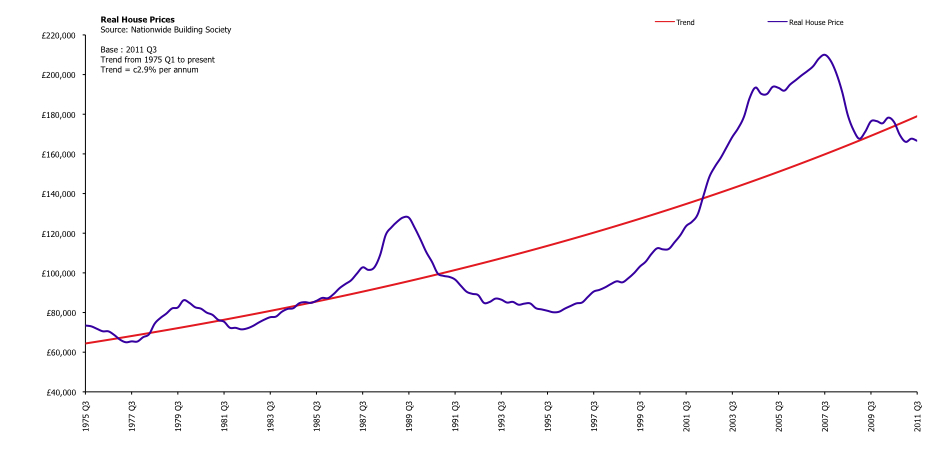
Indeed, real house price growth has recently fallen a little behind trend:

(Click to enlarge this graph of UK house prices in real terms)

Real house prices have been growing at about 2.9% per year since the mid-1970s. In other words, houses have been getting more expensive relative to the average basket of goods for most of the past four decades.

Now, the official RPI basket includes a nearly 24% weighting towards housing costs, so there’s some element of circularity to this.

It’s probably more useful therefore to look at the cost of houses relative to earnings, since that’s where most of us find the money to pay for one.

House price to earnings ratio

Comparing house prices to earnings was what scared me out of buying in London around 2003/2004. And on the historical measure of the house price to earnings ratio, UK property still looks superficially expensive.

Here’s a recent-ish graph of house prices to earnings from The Telegraph:

Don't look down!

The house price to earnings ratio approached 6.5 before the property slump – a level unthinkable just a few years before. You can see that even though it then declined sharply towards its long run average, by 2011 the ratio was still above the level at which the last property boom peaked in 1989.

The price to earnings measure in the graph is also higher than when I first got cold feet about buying a house, partly due to graphs like this one. That decision cost me at least six figures as prices continued to rise regardless, so be warned about putting too much store in this ratio.

Since 2008 the house price to earnings ratio has been coming down, partly as wages have increased a little despite the recession, but mainly because prices have been falling.

But can we really say the ratio ‘should’ fall below some average level, as per the graph above, before we can call houses fair value?

I don’t think so, for the simple reason that this ratio has been rising for years. I plotted my own graph setting the latest house price data from Halifax against the UK National mean full-time wage for men (same source) and added a trend line as follows:

House price to earnings ratio for UK houses (Click to enlarge)

The black line shows that over the past 20 years, the house price to earnings ratio has been creeping higher. In fact, houses now look slightly good value on this single measure.

Of course, you can quibble.

Firstly, the bigger the boom – or bubble, if you prefer – the more the trend line is potentially distorted.

Also, it clearly matters where you start and end your graph. I’ve used the two decades of data Halifax makes available, but the trend line would look very different over say 1990 to 1995, or from 2007 to 2011.

I seem to remember that when I started closely watching this statistic around the turn of the century, 3.5 was said to be the ‘natural’ level of house prices versus earnings. Looking at the graph above, it now seems this view came about largely a result of the depressed prices of the mid-1990s.

Another criticism might be to ask why the ratio should be based on male full-time earnings, when so many women have entered the workforce over this period.

I think that’s true – but it’s also another reason why the ratio may have moved permanently higher. More women bidding for houses against (or in partnership with) men will clearly increase the ratio for single male salaries, too.

All this – and other weaknesses, such as the fact that the ratio is based on gross income, not mortgage affordability, for example – means I now think the ratio should be taken as just one of several factors in judging whether house prices look too high.

If somebody had tried to bet on the long-term trajectory of food prices based on the average household’s grocery bill in the 1950s versus wages, they’d have ended up bankrupt.

If food spending can decline over five decades as a percentage of our spending, then might we not spend more on housing? Or cars? Or smartphones?

I’m not saying spending more money on houses is desirable either individually or for society. I’m just pointing out that we have been on a long march from subsidence living to buying the latest iPad.

Perhaps housing has become a luxury item for many, in that they’re prepared to spend more of their discretionary income to get the best they can?

But… salaries do influence mortgage sizes

There’s one important caveat to all this.

Before the lending was relaxed over the past couple of decades, mortgages used to be rationed out by banks on a much stricter basis of salary.

One repeatedly hears that 3x your salary was the limit, though I can’t remember ever seeing concrete figures.

If banks do go back to old-fashioned lending as a result of the credit crisis, as some suggest, then perhaps this lending ratio will come down again to reflect tighter access to mortgages, rather than the demand for housing.

Indeed, in London the price to earnings ratio remains more elevated – by my calculations it’s turned higher again, in fact – partly because so many properties are bought with a far higher proportion of cash, or no mortgage at all.

That in turn means the technical constraint implied by bank lending is less relevant in London. Mortgages don’t matter so much. 1

Household income and inflation

I’ll probably get hate mail from property bears for suggesting the price to earnings ratio isn’t written in stone.

Before my email server blows up, I should stress that while I now believe the ratio of house prices to average earnings is a bit of a moveable feast, I agree there’s a commonsense relationship between how much people earn, and how much they can then spend on their largest single asset in most cases, their home.

Whatever multiple banks happen to apply, salaries remain the key criteria they use to decide how big a mortgage to grant, which in turn (partly) determines how much money is chasing property at any given time.

Mortgages aren’t everything, especially in the current depressed market – a record 40% of homes were bought with cash in early 2011, more than double the rate of five years before, for example.

But in most of the UK, cash-rich buyers are in the definite minority and mortgage finance drives the market.

Even in a world without mortgages where we saved up to buy a home, salaries would still ultimately dictate house prices (alongside inheritances and winnings from spreadbetting, presumably).

And the fact is salaries have not gone up at the same pace as house prices.

This lagging is captured in the elevated house price to earnings ratio. But a closer look at inflation-adjusted earnings is also revealing.

Using data from Measuring Worth, I created the following graph of nominal and real wage growth in the UK between 1982 and 2010, which neatly covers the same period as the house price to earnings graph above:

A graph of real earnings in the UK (Click to enlarge).

Over the period from 1982 to 2010:

  • The increase in nominal earnings in the UK from around £5,600 per year to £23,500 is an impressive 320%.
  • But in inflation-adjusted terms, the rise in earnings is much more modest – just 52%.

Eye-balling the graph of real house prices above suggests real prices rose by around 200% from 1982 to their peak in 2008. Far faster than earnings!

This couldn’t continue forever – and it didn’t.

Earnings aren’t everything

So what have we discovered? Nothing definitive, which is why house prices remain an enduring subject of conversation at a certain kind of dinner party, just ahead of “no, those aren’t my car keys…”

It’s clear growth in real earnings has massively lagged real house prices, and that’s partly captured in an increasing house price to earnings ratio.

If you accept the rising trend over three decades to spend more of our incomes on property, then the ratio no longer looks so stretched, especially outside of London. This might indicate house prices are closer to fair value.

However by itself, the house price to earnings ratio doesn’t seem to be a solid indicator as to whether house prices are cheap or not, or whether they will rise or fall.

In particular, the simple ratio overlooks a vital component of mortgage affordability – the very likely reason why prices didn’t fall as much as they might have in the downturn.

That key missing variable is of course interest rates, which determine how much of your earnings will actually be gobbled up paying off your mortgage.

As anyone who has read this far will know, interest rates have plunged over the past 30 years, which you’d think must be a big factor in driving house prices.

I’ll therefore look at house prices and interest rates in my next post in this series.

(Subscribe to make sure you get it!)

  1. The London property market is really a beast in itself. I may do a separate post on the other factors that drive it, which range from foreign buyers and bank bonuses to true scarcity and, recently, the Olympics[]
{ 49 comments }

Many Brits are going to be playing their accordions for pennies well into their old age if dire prophecies about the state of UK pension savings are any guide.

But there’s no need to pray for the invention of ever-lasting youth pills – not when you can employ compound interest to help you live the life of a wrinkly Reilly.

Barely got two brass wazoos to rub together? Then you need a pension option that won’t gouge you with high fees, and requires minimal outlay.

And this is where a cheap stakeholder pension can be a smashing solution.

Stakeholder pensions are a low cost way to start saving for retirement.

Why choose a cheap stakeholder pension?

With a stakeholder pension you can invest in a diversified portfolio for as little as £20. A £20 lump sum gets you started, after which you can:

  • Never pay in anything ever again, and die poor.
  • Pay in £20 or more on a weekly or monthly basis.
  • Pay in £20 or more whenever you feel like it.

Indeed, it’s almost too flexible from an iron-willed, saving disciplinarian’s viewpoint.

Stakes alive

Most summaries of stakeholder pensions talk about annual costs of 1.5% for the first 10 years and then 1% thereafter.

But you can do much better than that!

Discount broker Cavendish Online offers a very cheap stakeholder pension from Aviva for a one-off set-up fee of £35.

After that, you’ll just pay the annual management charge (AMC):

  • 0.55% AMC up to £49,999
  • 0.50% AMC up to £50 – 99,999
  • 0.45% AMC £100,000 +

Your contributions can then trickle into a diversified portfolio carved out of the 40 or so pension funds available, which includes a range of index trackers.

True, that’s small beans compared to the choice you get in most SIPPs. Then again, excessive choice is precisely the kind of overkill that sends many running for the hills. Most people are better off with a few decent choices that enable them to spread their risk across key asset classes and be done with it.

Stake charmer

The index trackers in the Aviva stakeholder pension enable you to rustle up a portfolio that includes the following asset classes:

Equities Bonds
UK UK Long Gilts
US UK Index Linked Gilts
Europe UK Corporate Bonds
Japan n/a
Pacific ex Japan n/a

UK Gilts and UK Property are also available, although not as trackers. As there is no additional charge, we can allow a bit of active fund management this time.

The obvious absentee is an emerging markets fund. There’s an ‘International Index Tracking fund’ available that is 10% in emerging markets.

You can find the fund factsheets by clicking through on the fund names here. Choose the Series 2 (S2 funds). Save the factsheets to your desktop as PDFs if they don’t work in the browser.

You can also check out Aviva pension funds on:

Morningstar > Life & Pension > L&P quick rank > Manager: Aviva Life & Pensions UK Limited.

Choose ‘Pension Funds’ instead of ‘All Funds’.

Switching and rebalancing between funds is free, or else you can keep things super simple by using an all-in-one mixed asset fund.

Stake eyes

Another advantage of a stakeholder is that the provider isn’t allowed to charge you an exit fee. So you can always move on to a better pension once you’re able to save more.

The Best Invest Select SIPP is the cheapest pension I’ve found for self-directed investors, but the minimum contributions will put it out of reach for some.

Remember that if you have access to a contribution-matching pension at work then you should probably take it, and all the free money that comes with it.

Otherwise, a cheap stakeholder pension is an excellent option if you’re poorer than a chimney sweep in a smokeless zone. There’s simply no other way you’ll get the same diversification for merely £20.

Take it steady,

The Accumulator

{ 35 comments }
Weekend reading

Some good reading for the weekend.

While blogging has turned out to be much harder than I expected when I set up Monevator in 2007, I am proud of what I have achieved so far.

Woody Allen once said “90% of success is just showing up”, so to that end I’m proud to be still blogging five years on!

I’m very proud of my co-blogger’s passive investing articles, which I think can fairly claim to be the best single repository of such information on the Internet for UK investors.

I’m also very pleased that as the world slid into financial meltdown, Monevator was reminding readers to look to the horizon, to remember their long-term goals, that people have been scared many times before, and that such times have tended to precede the best returns.

I wouldn’t be human if I wasn’t slightly pleased that three years on from the bear market low, I can point to a post of 11 March 2009, where I wrote:

The global stock markets have suffered their worse declines for several generations.

Ultimately, if you’re not trickling money into the markets at these levels then I think you might as well forget stock market investing altogether.

To be perfectly honest, the timing was lucky: I am certainly not The Messiah!

But then again, you make your own luck, and to that end I am proud of the various articles I wrote around that time (before and after the low) on the value of investing in bear markets.

New readers may not appreciate how contrary that view was in 2008 and 2009.

Horror stories attract readers of blogs just as surely as they sell newspapers. And while Monevator had relatively little traffic in 2008 and 2009, I’d regularly get into ding-dongs on the comment sections of other gloomy blogs who claimed investing in shares was dead.

These ill-informed writers have probably cost their readers a lot of money.

The Internet is full of voices, and it’s ever harder to stand out. No wonder so many websites scream wolf, and urge passing traffic to take shelter from a falling sky.

I only hope readers remember which blog was urging them to consider the very positive outlook for shares in 2009 – which blog suggested they think more about where the market would be in 2020 rather than in 2012.

To be clear, I did not claim shares would bounce back as hard and fast as they have done. I just knew for a stone-cold fact that the FTSE 100 at less than 4,000 was a far better buy than when it was approaching 7,000.

Falling share prices are your friend, especially if you’re buying long-term income.

Three years on, two posts of the week

Fun as it is to sing your own praises once in a while, two other websites have done a far better job than I think I could in celebrating the three-year birthday of the post-2009 bull market.

Every passive investor should read Canadian Couch Potato for a magnificently different take on the past three years:

“You were in a terrible car accident: you were hit by a bus,” the doctor says gently. “You’ve been in a coma.”

“How long?”

The doctor glances nervously at her colleagues. “A long time, I’m afraid.” She pauses again. “Three years.”

It takes a few seconds for this to sink in. Three years? Your mind is filled with just one urgent question. “I gotta know, Doc. Give it to me straight. How have the markets been doing?”

Genius stuff, and it just gets better from there.

As this excellent recap from The Motley Fool‘s Morgan Housel points out, rumours of the death of long-term investing back in 2009 were much exaggerated:

With the crash of 2008, and ensuing rebound, came a widespread belief — presented as almost axiomatic — that the practice of buy-and-hold investing was dead. More volatility allegedly meant investors could no longer just buy companies and wait indefinitely; you had to be able to get in and out to score good returns.

“When will Wall Street and the financial media admit it? Probably never,” Sy Harding wrote in Forbes. “But buy-and-hold as a strategy is dead and gone, if ever it was a viable strategy.”

But buy-and-hold only looks dead if you start investing when stocks are expensive. Yes, if you purchased stocks in 2000, when the S&P traded at 40 times earnings, you suffered a lost decade. That’s how investing works. […]

Buy-and-hold still works if you buy good companies at good prices. That has always been true; it’s just easy to forget during boom years. The higher valuations are when you begin investing, the lower your returns will be afterward. Nothing about the past few years has changed that.

If anything, the explosion of volatility has been a blessing for smart buy-and-hold investors, providing some of the best buying opportunities of the past century.

All of us – whether stock pickers, passive investors, or something in-between like me – need to realise that the past three years have been truly remarkable. In fact, we’re unlikely to see a similar three-year run again in our lifetime.

I loved investing in 2009 and 2010. Things will only get harder from here.

[continue reading…]

{ 16 comments }