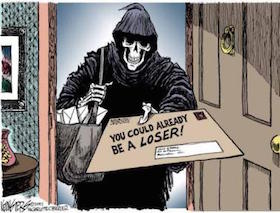
I assume every investment I make could leave me with nothing.
I don’t expect it – in the case of cash and UK gilts I think it’s extremely unlikely – but I don’t bank on 100% guarantees.
Apparently sensible people complain on TV watchdog shows about losing all their money on corked wine funds or punts on plots of greenbelt land or timeshare apartments without plumbing or an airport within 50 miles.
And we who-know-better feel sorry for them…
…but we also snicker a bit at their gullibility.
Didn’t they see the risks?
Wasn’t it obviously a gamble?
Well, yes. Yet you still see supposedly sophisticated investors calling for criminal investigations when any old high stakes blue sky penny share goes bust.
Or retired people on Radio 4 admitting they lost half their net worth when their shares in RBS or Barclays went into the dunk tank in the financial crisis.
Very often such people were employees at the companies during their working lives.
They’d never normally dream of putting so much money into one company. But their familiarity with its logo and the office wallpaper of yesteryear makes them contemptuous of the risks today.
I even see smart passive investors putting all their money into one fund, or one broker, or into the hands of one adviser.
Sure the risks of something going wrong seem tiny.
Yes your money should be ring-fenced, segregated, held in your own name if everything is properly in order.
But why take the risk that it isn’t?
Every investment can fail you
When I buy individual shares, I assume the company can go bust – even if it is one of the largest companies in the world.
But my prudent paranoia goes much further than that.
Here are just a few examples of how seemingly safe and widely-used financial products could conceivably damage your wealth:
- Stock markets can and will crash. (Obviously… but people seemed to forget it during the last crash).
- Inflation can devastate long-term bond returns. (Obviously… but people today are buying German 30-year bonds yielding 0.65%).
- ETF providers could get into trouble, putting ETF investments into jeopardy at worst, or at least disrupting their smooth trade.
- Banks who are not members of your country’s compensation scheme can go bust or suffer a bank run.
- Investment companies can perpetuate fraud, from dipping their hands in the till right up to a Madoff-style Ponzi scheme.
- Banks and other financial companies can fail, with knock-on consequences for the investment products they stand behind.
- Electronic brokers or registrars could get into difficulties or suffer some form of collapse that destroys or renders inaccessible a record of who owns what.
- Ring-fenced assets might not have been properly – legally – ring-fenced.
- Safeguards against these or other failures can break or be unable to deliver. Or – more likely – there can be big delays in getting restitution.
- Insurance schemes set up to compensate you can run out of money.
- You may not even be as well-protected as you thought because that harmless-sounding ETF you bought was actually domiciled overseas.
- Cash under the mattress can be stolen.
- A government could appropriate the money in government-backed bank accounts, or default on repaying its own bonds, or make holding gold illegal.
- Your country’s currency could be devalued, so that even though your nominal net worth remains the same, your wealth is diminished compared to your overseas peers.
- Your country could suffer an economic collapse, even if the rest of the world chugs along fine.
- The communists could take over and outlaw all private property.
Clearly some of these events are far more likely than others – most are very unlikely – and there are some real Black Swans
(Good luck guarding against a revolution that starts in Surbiton!)
But it’s vital to consider all risks – however vanishingly remote – in order to appreciate the potential value of the safeguards against them.
How then can we protect our wealth?
Everything from portfolio diversification and investing overseas to dividing your cash savings between different banks are sensible steps towards protecting your wealth.
I use a few different stock brokers, for instance, and have cash in several different bank accounts.
However I know I am running risks.
I only have a paper share certificate in one company (a non-listed one). Everything else is held electronically with online brokers in nominee accounts.
If the electronic record system collapsed for some reason, my share investments could be in peril.
I have also held synthetic ETFs in the past – and would do so again in moderation – despite the risks of synthetic ETFs versus physical ones.
Indeed I have very few physical or real-world assets.
I don’t even own my own home – the one kind of asset that almost all flavours of government tend to treat more reverentially than they do ‘fat cat’ assets like shares, bonds, and cash (at least until you reach genuine fat cat levels and your house has a front lawn they can really park their tanks upon).
I do have a pitifully small amount of gold tucked away in a vault, but despite my best intentions I haven’t added to it.
I think there is a case too for keeping a few gold coins or similar fungible assets somewhere secure near to hand that you can access in a crisis.
Don’t be a loser
Ultimately, you have to be pragmatic and live in the real world.
Accept that every time you invest, you take a risk with your money.
Do all you can to minimize those risks. Work through the alternatives. Spread your wealth around. Look for antifragile
If you do all that then hopefully we’ll never have to hear on the radio how you lost the lot, never have to sigh, and never have to feel guilty for snickering at your foolishness.