


Our in-house passive portfolio is having a distinctly average year: up 7.8% so far in 2026, or about 4.7% after inflation.
The tale is one of double-digit equity gains, dragged down by bond fund ankle weights:

Actually, the story of 2026 is the story of the portfolio’s lifetime.
The equities bloc (in the green zone below) has performed creditably to amazingly. The 13.7% annualised return of Developed World ex-UK going back well over a decade is extraordinary:

However nominal UK government bonds have almost single-handedly stolen the icing on the cake. The gilty party has lost 3% per year, leaving the Slow & Steady with a 7.6% annualised return since launch.
(Which I’m happy with, to be clear. The objective was only ever to be average.)
The Slow & Steady is Monevator’s model passive investing portfolio. It was set up at the start of 2011 with £3,000. An extra £1,360 is invested every quarter into a diversified set of index funds, tilted towards equities. You can read the origin story and find all the previous passive portfolio posts in the Monevator vaults. Last quarter’s instalment can be found here.
All returns in this post are nominal GBP total returns unless otherwise stated. Subtract about 3% from the portfolio’s annualised performance figure to estimate the real return after inflation.
Too good to last
There was a plot twist in the story that led us to this chapter.
You may recall bonds had a remarkable ten-year run from 2010. But they then fell off the cliff, down 39% from the high point:
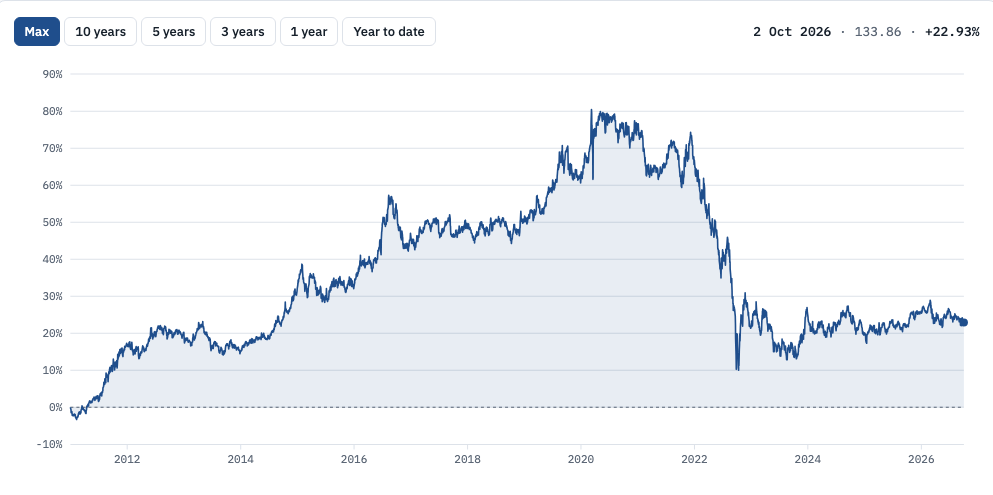
Data: Vanguard U.K. Government Bond Index Fund: 31 Dec 2010 to 02 Oct 2026.
Here’s an action-replay of the upward leg of the chart above:

Vanguard’s gilt tracker racked up 6.6% annualised returns from 2010 until its peak in March 2020.
Now for the shocker:

The same fund has dished out a -5.7% annualised loss in the six-and-a-half years since.
Bonds have recovered a little since their October 2022 trough – picking up 2.8% annualised to-date since then. Still, that’s little consolation when inflation has averaged 3.4% and World equities 13.5% in the meantime.
Are bonds broken? Is it a buying opportunity? I’ve read commentary that cuts both ways.
But…
I wouldn’t start from here
If I were starting a similar passive portfolio from scratch, then nominal bonds would be allocated a reduced role compared to the Slow & Steady, given what I know now.
I’d likely split the defensive allocation evenly between gold, commodities, short index-linked bonds, and nominal bonds.
If I rerun the historical tape from the end of 2010, that alternative Slow & Steady earns 8.2% annualised instead of 7.6%.
The difference isn’t huge. The portfolio is about 10% bigger. So it’s less about what could have been and more about what may come next.
A multi-layered defensive array is better fitted for the range of threats that menace passive investors. Not least the storm clouds of inflation and economic uncertainty.
This portfolio only has four years to run, so I should think about making those changes anyway.
New transactions
Every quarter we blow another £1,360 on the market dice and hope to roll sixes. Our stake is split between our seven funds, according to our predetermined asset allocation.
We rebalance using Larry Swedroe’s 5/25 rule. That hasn’t been activated this quarter, so the trades play out as follows:
Emerging market equities
iShares Emerging Markets Equity Index Fund D – OCF 0.18%
Fund identifier: GB00B84DY642
New purchase: £108.80
Buy 39.4804 units @ £2.76
Global property
iShares Environment & Low Carbon Tilt Real Estate Index Fund – OCF 0.18%
Fund identifier: GB00B5BFJG71
New purchase: £68
Buy 27.9077 units @ £2.44
Developed world ex-UK equities
Vanguard FTSE Developed World ex-UK Equity Index Fund – OCF 0.14%
Fund identifier: GB00B59G4Q73
New purchase: £503.20
Buy 0.5395 units @ £932.72
UK equity
Vanguard FTSE UK All-Share Index Trust – OCF 0.06%
Fund identifier: GB00B3X7QG63
New purchase: £68
Buy 0.1833 units @ £370.90
Global small cap equities
Vanguard Global Small-Cap Index Fund – OCF 0.29%
Fund identifier: IE00B3X1NT05
New purchase: £68
Buy 0.1188 units @ £572.42
UK gilts
Vanguard UK Government Bond Index – OCF 0.12%
Fund identifier: IE00B1S75374
New purchase: £285.60
Buy 2.1336 units @ £133.86
Royal London Short Duration Global Index-Linked Fund – OCF 0.27%
Fund identifier: GB00BD050F05
New purchase: £258.40
Buy 237.9374 units @ £1.09
New investment contribution = £1,360
Trading cost = £0
Average portfolio OCF = 0.17%
User manual
Take a look at our broker comparison table for your best investment account options.
Or learn more about choosing the cheapest stocks and shares ISA for your situation.
You might also enjoy a refresher on why we think most people are best choosing passive instead of active investing.
Take it steady,
The Accumulator


Can I suggest that, with a duration of close to 13 years, the ‘All stocks’ gilt fund was barely ‘intermediate’ in 2020 and, hence, the large and rapid increase in yields was bound to cause the large losses seen from 2021-2022. It is noteworthy that this nominal loss was the largest seen since 1900 (when dated gilts were first introduced – undated gilts, i.e., consols, had a very tough couple of years in the early 1970s) – a consequence of low yields, low coupons, and the issue of gilts with longer maturities.
Perhaps a lesson to be learnt is that controlling the duration of the fixed income held by not letting it get ‘too large’ is an important consideration (at the expense of complexity, this can be done by combining a ‘short’ fund or cash with a longer one). Of course, defining ‘too large’ needs some thought!
Yep, going to say the same. A duration issue more than a bond issue I reckon. Didn’t TA write a article about matching duration to life time, ie duration equals half horizon…….
@TA:
Always interesting, and FWIW I can live with average.
The overall S&S performance remains remarkably similar to our Pots – albeit ours is/was constructed and used rather differently.
As it approaches its 16th birthday, any thoughts about what you might do with the S&S when it reaches 20?
Despite everything, this year has been ‘so far, so good’.
First half of the financial year, the portfolio has gained 8.7%. It is not easy to pull apart the threads, as I have taken cash out for a new grandchild and rebalanced a fair bit. But total to total, before inflation, I can’t complain.
I understand your argument for a different defensive split, but have we witnessed a permanent shift, and is it worth the hassle for a slightly better outcome?
Ive been reading fir years the 60/40 portfolio is dead. Bonds are over..long bonds forget it. What worked in the past will not work in the future we are heading. So many advisors dont see this. Like you say the new was forward is gold. Short dated bonds , cash..commodities and maybe even crypto for those daring enough. You got to move with the times. Fiat is going..digital will be rhe new currency. Those holding bond funds only as a defensive will loose out massively. .
I’m still trying to get my head round inflation-linked bonds. Even short duration linkers had negative real yields a few years back didn’t they? Not sure @TA if you are saying you would have put them in the portfolio back then with those yields?
“Those holding bond funds will lose out massively”
Ok, so let’s dig into that a bit. If we say ‘losing massively’ is another fall equal to that we’ve seen from 2022 to now, so say another 35% fall. Where would interest rates, or yields on gilts, have to get to for that to be the case? And is the other fear here an actual default?
@old_eyes (#4):
OOI, are you still broadly 60/10/10/10/10 as discussed last time round? I only ask as you mentioned re-balancing “a fair bit”.
@ Rhino.
Money printing is devaluing the currency. They have to money print, theres no way out of the debt UK and USA . I doubt a default but they will pay you back with newly printed money that’s worth hardly anything as inflation due to money printing would have devalued the cash so much. This is why holding 40 % bonds particulary longer than 5 years is now becoming very risky. I have learned any cash holdings need offsetting with possibly, gold ETC , crypto . morgan Stanley suggested 20% gold 20% short term bonds 60% equities as a modern alternative.
Then there’s the development of CBDCs . What will the exchange rate be ?
1 cbdc = £1 but they may only give you 50p for it. The world is changing fast what worked in the past may not work in the future.
The 40 year bond bull run may be coming to its end.
@Rhino (#6)
“Ok, so let’s dig into that a bit. If we say ‘losing massively’ is another fall equal to that we’ve seen from 2022 to now, so say another 35% fall. Where would interest rates, or yields on gilts, have to get to for that to be the case?”
Good question – for a single 10 year bond with a 5% coupon (roughly equivalent to a bond fund with a weighted maturity of 10 years), yields would need to go from 5% to 10.8% for the price to drop from 100 to 65. For a 5 year bond (roughly equivalent to an under 10 year bond fund), yields would need to go to 15% before the price fell to 65. Obviously, more gradual rises in yields would lead to a slower change in price and coupons being received in the meantime, and the issue of bonds with higher coupons bought at higher yields would increase returns.
Of course, gilt yields that high have been seen in the past (the 1970s and 1980s say hello), so it is possible again.
Asking this not to be a smart@rse but because I’m struggling with idea of bond funds being a useful diversifier, certainly over the last few years. Is there a reason you have chosen bond funds and avoided buying physical gilts and running them to maturity? Bond funds just seem to carry the risk of losses without the benefit of decent returns. Whereas if your gilts suddenly went up in value during a market crash you could take the profit and go into cash.
Just an additional question (the answer below) – how much difference did it make to the 30-year SWR for a 60/40 portfolio holding either the under 5 year gilts or the ‘all stocks’ index between starting years of 1940 and 1975 (encompassing the last period where there was a sustained rise in yields – from just under 3% in 1950 to 15% in 1975)?
For the ‘under 5 year gilt’ fund, the median SWR was 5.1% with min/max values of 4.2%/7.3%.
For the ‘all stocks’ fund, the median SWR was 4.8% with min and max values of 4.0% and 6.9%.
So, about 20bp difference in the worst case and 30 bp at the median level. Not to be sniffed at, but since the SWR varied from about 3% to 10% for start years since 1872, IMV a fairly small effect compared to the luck of the draw of retirement start.
@AlCam #7
“… are you still broadly 60/10/10/10/10 as discussed last time round?”
Yes, broadly. I cashed in some NI indexed linked bonds rather than roll them over for another 5 years (getting old you understand!). The proceeds had to be recycled. At the same time I was top slicing the global equities to keep to the planned allocation, and splitting the FTSE all-world index holdings to shift some into VHYG (all-world high dividend) to reduce exposure to the ‘Magnificent 7’ and the AI bubble. I understand a bit more about how the VHYG companies make money.
So really been fiddling with the growth part more than the defensive.
@TA I always like these updates, but have you thought about giving some long term volatility and max drawdown numbers (and maybe Sharpe & Sortino)? As the return is only part of the picture with a balanced portfolio of this kind, as you know.
@ColinThames TA may wish to answer for himself, but my take on this – rather complicated – topic is that if you have a bunch of different individual gilts, you have created your own bond fund. Especially if it is a rolling gilt ladder, which you’d expect in an accumulation portfolio (rather than a non-rolling ladder for a decumulation portfolio).
A lot of the people arguing for individual gilts these days are guilty (sorry) of mental accounting and/or misunderstanding the purpose of bonds in an accumulation portfolio. They are there for diversification and, as volatile assets with a lowish correlation* to equities, to smooth the volatility of the whole portfolio, not for providing a fixed cashflow. And to do this properly you need to be able to rebalance them with the equities, which is much easier to do with a bond fund than with individual bonds.
*I know, obviously, that correlations have gone up in the last few years. I personally don’t expect this to last for ever – they are a better looking safe haven now yields are higher – but in any case they still have sufficiently low correlation to make them an appropriate diversifier.
That post peak bond fund chart is interesting. Purely because I jacked in my job in autumn 2023, and thought I should buy some more defensive assets, I bought some bond funds for the first time, intermediate nominal, short nominal and short index linked in roughly equal amounts. The chart suggests it was a good time to buy and yet the performance since then has not been inspiring, compared to equity returns. But of course that could all change.
I’m still several years off SP, I was thinking I could reduce my defensive allocation a bit when that comes though that might also be wishful thinking.
Bonds for me as a retiree are deployed in my portfolio for wealth preservation,reducing the volatility of the portfolio and lastly having the possibility of some growth -strictly in that order of priority
Equities are there for growing the portfolio but are very volatile
The two assets therefore have very different roles which can unfortunately synchronise occasionally but……..any other investment plan has unacceptable drawbacks for a simple amateur investor like me
Fine tuning around the edges (REITs,commodities,gold,indexed bond ladders etc) no doubt increases portfolio performance for the more knowledgeable investor but these two assets ( equities and bonds) and how they are allocated in an investors portfolio remain the cornerstone of a successful investment plan
xxd09
@TA, re
>I’d likely split the defensive allocation evenly between gold,
>commodities, short index-linked bonds, and nominal bonds.
>If I rerun the historical tape from the end of 2010, that alternative
>Slow & Steady earns 8.2% annualised instead of 7.6%.
can you clarify whether you started this alt s&s at 80% shares/5/5/5/5
lifestyling down to 60/10/10/10/10 – or is this remark more of a rough
“the cagr of 60/10/10/10/10 is 8.2%, so – so what, it’s only a few quid?”
the alt s&s journey should have contained a number of points of interest around the big swings in gold, and you could have added a simple rule along the lines of “if linkers are negative-real switch them to cash due to not being suicidal”.
I was wondering also if the 7.6% of s&s classic is much boosted by the old long linker fund gains – I don’t think so, as it only seems to have held £2k
back in 2017, it would have pulled it down a bit more left in, of course;-).
@Old_eyes:
Thanks, I now see what you meant.
OOI, I split (roughly halved) some ILSC’s into 3 and 5 year maturities. And what a saga that turned into. I have since heard of somebody else being let down by NS&I. Anybody else had issues with NS&I recently?
@ColinThames (#11) and @C-strong (#14)
A bond index fund consists of holdings of individual bonds that conform to a pre-defined filter. For example, the FTSE ‘all stocks’ gilt index holds all nominal gilts that currently exist in quantities proportional to their amount in issue (i.e. the number of bonds or, alternatively, their value at par). This particular index holds bonds until maturity. The FTSE under 5 year gilt index only holds nominal gilts with under 5 years of maturity, again in proportion to their amount in issue and until maturity. In other words, not surprisingly, bond funds hold bonds!
You might be interested in a comparison I did between bond funds and rolling ladders (see https://papers.ssrn.com/sol3/papers.cfm?abstract_id=5166182) since this highlights the operational and performance differences. In brief, during accumulation the performance of a bond fund and a rolling ladder covering the same range of maturities was similar (annualised returns over rolling 30 year periods were within 25 bp of each other), while if withdrawals were taken then this tended to favour the ladder. My final remark in the paper was “it is important to note that the difference in returns between the various maturity sectors generally exceeded the difference arising from whether the bonds were held in a ladder or a fund […]. Therefore, the choice of bond maturity is far more critical […] than the decision as to whether to hold the bonds in a rolling ladder or a fund.”
If you want to see the effect of bond maturity on withdrawals during retirement see two of my other papers (https://papers.ssrn.com/sol3/papers.cfm?abstract_id=4742456 and https://papers.ssrn.com/sol3/papers.cfm?abstract_id=4827947). The outcomes of which are that holding intermediate maturities (which were different for the UK and US) tended to avoid the worst possible performance during the worst historical retirements.
Here’s a cheer for Mental Accounting!
I’m in Decumulation, so this doesn’t apply to Accumulators, but I buy individual Linkers to hold to maturity to give a boost to my income floor when I reach state pension age. This will bring me close to the median household income, but we’ve paid off the mortgage so should comfortable. The mental accounting part is that I then classify this linker as future pension income, not as part of my asset allocation. So I remove it from my precious err… Risk Portfolio and add it to my income floor. I then calculate what I can sustainably withdraw from the new, lower balance risk portfolio.
Sure, (another mental accounting alert!) I add the value in my net worth calculations (approximately, if I buy £6000 of TG39, I account for it as £6000 in my net worth, cos plus inflation that’s what I’ll receive in 13 years time, which is what’s important to me. I ignore the 2.3x% yield (a nice bonus), and the £4.88 twice yearly dividend I’m supposed to reinvest (found money). I know, if TSHTF, I can sell it to raise cash but things will have to have gotten pretty bad for that.
So short answer, I treat individual linkers as cash flow not as part of my portfolio. Works for me.
@Alan S – Agreed wholeheartedly. I guess the alternative is to accept that long-ish duration nominal bonds are actually pretty risky. Good during deflationary recessions, and long falling interest rate eras, bad if inflation is your problem. Personally, I’m more inclined towards your short-ish bond thoughts.
@Al Cam – Cheers! I haven’t given much thought to the Slow & Steady’s lifetime beyond twenty years. I suppose I did not seriously imagine I’d be writing about it for that long. The decumulation side is already handled by the No Cat Food portfolio. Meanwhile, TI and I have kicked around ideas for a new accumulation portfolio series. Perhaps the S&S could be kept ticking over as part of that.
@Old_eyes – A different defensive split makes sense to me as there’s only four years left of the Slow & Steady’s accumulation mission. It’s now effectively on the eve of decumulation, so a move is only what I would have done / have done in my own portfolio.
Essentially, given the future is an unknown country, what moves would I make to best prepare for it?
That said, the hassle factor you mention is a serious consideration. This is my attempt to work out the alternative to juggling lots of volatile defensives: https://monevator.com/index-linked-bonds-replace-nominal-bonds/
@Mu – Yes, without the ability to predict the future, then back in 2010 short linker yields would only have been mildly negative but the inflation protection was still valuable. They also performed creditably in the series of equity market shocks from there up to and including Covid. Though it would also be fair to say that an investor doesn’t really need the inflation protection when decumulation is 20 years away.
@ColinThames – +1 for bond funds and rolling gilt ladders are essentially the same. A non-rolling ladder of gilts is different but not useful for this portfolio’s objectives. Bond funds are much easier to use than rolling ladders. When gilts spike during a crash then the value of the equivalent bond fund rises too. You can sell it, rebalance into cheaper assets and so on.
@c-strong -Ggood idea on calculating the extra stats – I’ll put that on my list. Max drawdown is approx 15% nominal in 2022, though that becomes 23% in real terms in 2023.
@Meany – No, I didn’t replicate the original 80% equities allocation of the S&S and lifestyle from there. So you’re right the return of an alt S&S would be somewhat better if I’d done so. I’m not saying it’s only a few quid though. I wanted to check my hindsight. What if it was 20 or 25% better? What if it was 20% worse?
What I’m trying to say though is that a 4-way defensive split would have been a better constructed portfolio in 2010, not because of subsequent events, but because it’s better portfolio construction in my view. As in, it’s better diversified because its components are less likely to be correlated in a crisis
I think that mostly because capital market returns research has advanced since 2010. The end of the long bond bull market and the return of inflation have confirmed what we already knew – that the world can change.
I like the idea of your negative yield rule. It’s an interesting question. Should an investor switch out of linkers once yields turn negative?
*Brod – Nice! I like this game 🙂 My main mental accounting guilty pleasure is maintaining a baggy cash buffer. Really I’d be happiest with a series of jars marked “Gas bill”, “Biscuits” etc.
@AS – some superb responses here. You must have some great models at your finger tips to provide this analysis so quickly. Strong insight on how the duration of gilts in your defensive allocation is dwarfed by the random element of when your accumulation journey started. There’s an important message in that. I’m suspecting tweaks towards gold, commodities, index linked gilts etc. will be subject to a similar story? Really it’s all about when you started, rest is tinkering, so end result largely in the lap of the gods.
Would love to see a bit more detail from Dawn. Would have thought inflation a problem across the board, not just for gilts. And a laypersons intro to CBDCs would be handy. Is this a money creation technique? I thought retail banks, as opposed to central banks, were responsible for money creation through their loan activity? It’s an interesting but confusing area which always surprises me.
@Al Cam (18)
I had a 5-year ILSC mature last month. As ILSCs must now be held for the full term, I did not want to roll it over this time, so requested repayment on maturity. NS&I processed this without issue. I initially parked the proceeds in the nominal gilt TN28. This was before Vroom a few weeks ago enlightened me that it was possible to buy IL gilts online at Scottish Widows. This week I made my first IL gilts purchases at SW. I have not yet quite replicated my former ILSC position but will build towards that.
@TA @Alan S (19)
I seem to remember that you (TA) have asserted in the past that a problem with gilt index funds/ETFs is that they do not necessarily hold the gilts to maturity. Rather the manager seeks to maintain a stated duration. However, Alan S describes two common FTSE gilt indices that do assume holding to maturity. As the most common gilt index funds/ETFs that I am aware of (e.g. VGOV, IGLS, IGLT) follow these FTSE indices, have I misunderstood something along the way?
@DV,
Thanks for your NS&I info. I understand your concern re “the full term”, which is why I split my maturing holding (all 5 years) roughly 50/50 into 3 years and 5 years. Will be interested to hear how you get on with linkers in IWeb/SW in due course.
@DavidV
Thank you. I too thought that bond funds must have to sell bonds before maturity if fund holders sell their units / shares, so @Alan S’s assertion confused me.
If that’s true, why would anyone bother with a gilt ladder? A gilt is always worth face value at maturity, whereas a bond fund, having had to sell some bonds before maturity may never recover those losses?
@DavidV the bond fund may hold everything to maturity but I, as a buyer and seller of the fund, can never see each individual bond held to maturity. Whenever I sell, by definition there will be plenty of bonds that are still many years from maturity. My personal return from those bonds is pretty uncertain.
Or maybe ‘never’ is a bit misleading. If I hold the fund for longer than the longest maturity, I will see every bond mature at the yield it had when I invested. But the fund will have added new bonds of course, so if I then sell, my personal return on those new bonds is uncertain.
One thing that has struck me with government bond funds in the last few years is that they actually aren’t easy to put in a “set it and forget it” portfolio at all because of the duration variation over time. If a friend or family member wanted a portfolio setting up, you could explain about rebalancing, and various platforms allow this to be very simple. It would be a lot harder explaining that due to interest rates falling their nominal and IL gilt funds (the ones you told them were the safe ones) are now potentially very volatile and liable to crash if the rates went up again, and that they are sitting on a time bomb. INXG’s duration looks like it’s moved between 12.5 and 22.8 years over its life. IGLT (the nominal gilt equivalent) has moved less, but it’s still considerable (7-12.5 years). In fairness to @TA, he did point this out when he changed to the Royal London IL global bond fund, but it’s probably easier with the Monevator audience than you family member with less than a passing interest in finance.
Windy
@DavidV. Don’t understand your question about bond funds. If all they did was hold each holding until maturity they would self liquidate.
https://monevator.com/how-to-choose-a-bond-fund/
It might be useful to have a quick delve under the bonnet of bond funds and rolling bond ladders (I’m going to ignore collapsing bond ladders, i.e. where coupons and the proceeds of maturing bonds are spent – the inflation linked gilt collapsing ladder perhaps being the most common example).
One (but not the only) logical method to operate a rolling bond ladder is to hold maturities over a given range (e.g., 5 years and under). In accumulation, new money, coupons and the proceeds from maturing bonds will then be used to buy a new bond at the top of the maturity range. Hence the new and recycled value is added at the highest maturity where it will gradually cycle through until maturity. Decumulation is the similar except some proportion of the coupons and proceeds of the maturing bonds are spent and the remaining amount used to buy a bond at the highest maturity. If the withdrawal exceeds the amount derived from the coupons and maturing bonds, then non-maturing bonds will have to be sold to meet the shortfall (with a number of choices about how to do that).
A bond fund will hold all existing bonds within a defined maturity range (e.g., under 5 years, over 15 years, etc.) in proportion to their issue weight. In accumulation, new money, coupons, and the proceeds from maturing bonds will then be used to purchase bonds across the maturity spectrum in order to keep the holdings in proportion to their issue weight. In decumulation, money sold from the fund will be made up of coupons, the proceeds from maturing bonds, and the remaining bonds so as to keep them in proportion to their issue weight.
This difference in, somewhat idealised, operation is what I tested in my paper at https://papers.ssrn.com/sol3/papers.cfm?abstract_id=5166182 with the results that in accumulation the performance of the rolling ladder and fund was similar (but varied between 30-year rolling periods), while in decumulation, the rolling ladder tended to perform better particularly at higher withdrawal rates.
FWIW, my own view is that if you want known cash flows in retirement, then building a collapsing ladder provides the certainty that holding either a rolling ladder or bond fund does not. In accumulation, the difference in performance between a rolling ladder and bond fund of similar weighted maturities is sufficiently small (neglecting the effect of tax in GIAs, fees, and bid-ask spreads) to suggest that either is a good enough solution (there are advantages and disadvantages to both, e.g. the bond fund is simpler, but the rolling ladder more flexible). As I mentioned upthread, the biggest decision is really what maturity to aim at not how to hold the bonds.
@Alan S, cheers.
@TA,
Negative-real linkers can still pay a lot after a big CPI spike, but it does look
like an obvious point that if we aim to build a portfolio that delivers CPI+4,
the asset “linker that pays CPI-2 and seems in medium correlation to shares”
is going to fail on both the return and stabilization fronts.
Esp. when you buy them neat instead of packaged into market funds.
Of course, nominals had much the same problems in the CPI-2 days so the idea may need improving!
Thinking about whether you really could have run the alt S&S through the 2010’s, I’m having a quick look at AGG, DBC, GLD on goog finance as a proxy. They run from 2004, so about @xxd09’s 23 year holding period. You really would have had to preach the Joy Of Correlation hard in 2014 when commods halved! For anyone who thinks commods must be the place to be and forget about bonds – the 23 year picture says they’re about the same, 60%ish total return.
What would be the case today for holding long duration nominal government bonds in an accumulation portfolio?
I thought it was that they’d serve as ballast in a portfolio in a deflationary environment. But, if we had a deflationary slump at current government debt levels, wouldn’t government (and the financial system) crumple under the growing real weight of the debt? The incentive for government to generate inflation would be overwhelming and – to be fair to it – one thing government is good at is creating inflation.
So the one situation where they’d pay their way is the one that the authorities would be hell bent on avoiding and seem to have the tools to avoid.
What am I missing?
That’s a good question. Risk is impact x probability, so probability low for the requirement for long duration for reasons you mention. And also on the rationale s for holding short duration and long duration gilts. If you decide you need to cover off both scenarios, as ZX pointed out, it’s mathematically equivalent to just holding an intermediate duration, so hey ho, back to where we started.
I enjoyed the portfolio update and the discussion.
My 2 cents: Nominal bonds have always been “broken” such that in an inflationary environment, they usually become correlated with stocks and are no good as diversifier. This didn’t matter for a few decades, now it does.
The other problem is that nominal bonds are especially risky for retirees, because inflation is especially risky for retirees. In a bout of inflation, nominal bonds drop, likely together with stocks, so whole portfolio drops. While all future liabilities go up *permanently* because realistically, inflation never becomes negative. Even in the GFC, prices hardly came down.
Someone with a long work life ahead also has their future expected earnings permanently re-rated up with inflation. Retirees don’t have that compensation, they just sit on losses plus higher liabilities.
There’s a judgement call what to hedge against. IMO, inflation is more likely (for the reasons @Chris mentioned) and more damaging than disinflation.
@David V and ColinT – Most bond funds sell before maturity to maintain their duration. Your understanding is correct.
Post-massive 2022 interest rate rises, a few new target maturity bond ETFs launched – these act as non-rolling bond portfolios. There aren’t many and last I checked were full of US corporates.
Much as selling before maturity is not great when rates rise, it typically works in your favour when rates fall.
@Windinthefens – agreed, the set-and-forget option for me is a short bond fund. Ideally a short linker one.
@Meany – If inflation is high and sustained enough then you’d be glad of those negative yielding linkers. You’re quite right that apparently positive yielding nominals ended up on worse negative yields once inflation revved up.
The question was, if you wanted inflation protection, what was your alternative?
And absolutely, you could have run the alt S&S portfolio and just sucked up the loss in commodities because that’s the name of the diversification game. Firstly, we’re prepared to take losses of that size in equities right? Secondly, commodities are only occupying 10% of the portfolio.
A 50% loss in a 10% asset sleeve (commodities) = 5% down.
A 10% loss in a 50% asset sleeve (equities) = 5% down.
Why would you panic over a 5% loss?
Moreover, would anyone think that are commodities are the place to be but not bonds? Just because commodities have done well of late and bonds not? That’s not how it works.
@Chris – The UK and other economies have run up debt worth 200% of GDP in the past. In an emergency, what are you going to do? I don’t think there is an incentive to run up inflation. Witness the incumbent administrations that lost elections as a result of the recent cost-of-living crisis. Incumbents pay a heavy price for not controlling inflation.
@Sparschwein – I think that’s about right. I’d always maintain some nominals because deflation is a possibility but I agree that inflation is the main enemy.
Don’t know if you can read this but on IL bonds
https://giftarticle.ft.com/giftarticle/actions/redeem/0dcae739-b556-49ca-8b4f-e5399ef038b6
@TA Government debt has been higher in the past, but over the past 150 years at least that’s only been the case in the run up to and aftermath of the world wars. I don’t think we’ve had anything like the current level since the Bretton Woods system collapsed. The yield on UK government debt (higher than Greece etc.) clearly shows that markets don’t like what they see, and the scale of debt interest payments is clearly painful to the government.
I think one question is what level of inflation government would like, given the tradeoffs it faces. I agree they don’t want it to run out of control, but I also see no evidence that 2% is their ideal. A healthy dose of inflation has been the Treasury’s friend in recent years, enabling it to raise a great deal of tax by stealth. The difference between 2% and, say, 4% inflation seems like a big deal over a long retirement.
Another question is whether the UK government can generate inflation if it wants to. Voters don’t like inflation, but on the whole they probably like depressions even less. Ben Bernanke claimed (just before the GFC) that economists had figured out how to prevent depressions and the GFC experience (which threatened to become a depression) is evidence in favour of the claim.
@TA (#35)
“Most bond funds sell before maturity to maintain their duration.”
Can you explain this, e.g., are you talking about active bond funds here? For index funds, as well as filters for country, type (e.g., government or corporate), and quality, there are also filters for maturity defined by a lower maturity limit (which have a range of different values) and an upper limit (which could be infinity). For many indices the lower limit is 1 year rather than maturity (obviously, with a long, over 15 year, index the lower limit is 15 years) although unusually what used to be called the FTSE Actuary Gilt indices have a lower limit of zero (i.e., maturity). I have seen two reasons given for a lower limit of 1 year rather than maturity, liquidity (bonds under 1 year are less liquid) and lower expected returns in the final year (which is the case for a time invariant non-inverted yield curve). In this type of index fund, the weighted duration will depend on the duration of the individual bonds (which in turn depends on yield, coupon, and time to maturity) and the amounts in issue (i.e., how much at different maturities governments of corporations decide to issue the bonds) and as per @Windinthefens (#27) comment, the duration of ‘All Stocks’ (whether nominal or index-linked) has been highly variable (e.g. duration for the nominal version ranging from under 5 years in the mid-1970s to just under 13 years in 2020 – before WWII it was over 20 years largely thanks to the preponderance of long maturity dated bonds issued by the UK).
@Chris – that’s all fine, I agree that the current debt situation is not good. But that’s quite different from saying the system would collapse in the face of another crisis, or that governments would unleash inflation to partially default on obligations. Or even that we know a future depression will be avoided because the GFC.
Maybe I’m misreading what you’re saying, but if a future depression is avoided by more QE then that would increase the value of nominal government bonds.
Interest rates would be cut to the bone making the debt burden bearable. Nonetheless, if you feared inflation or rising yields would follow, you could then sell off your allocation at a tidy profit.
So my view is that at least a 10% allocation to high quality nominal bonds is justifiable on the grounds that they have a clear defensive purpose and we don’t know how the future will play out. (FWIW deflation is still a modern phenomenon as are demand-slump recessions.)
But equally I think a defensive allocation is ideally diversified beyond high quality nominal bonds because as you say, things could go very pear-shaped for any given asset class in certain circumstances. Moreover, I agree that we have experienced higher inflation than we are used to for five years now, with no apparent end in sight.
@Alan S – Your comment is far more nuanced and on point than mine. I wasn’t properly accounting for FTSE Gilt All Stocks trackers or short term FTSE Gilt trackers that will hold to maturity.
It would be interesting to know what proportion of AUM are in gilt trackers that don’t follow FTSE indices. For example, the Vanguard bond index fund in the Slow & Steady tracks the Bloomberg Barclays UK Gilt Bond Index. That index sells off bonds approx 1 year before maturity. I’m not sure it amounts to a whole hill of beans versus the other factors you’ve laid out though?
@TA Fair challenges all!
The UK experienced a month of annualised deflation in 2015 (of 0.1%) and the last time before that was in 1960. It seems to me that the UK has deflation licked! Maybe I’ll regret this one day, but I just can’t bring myself to pay for much insurance against it, which is how I view long nominal bonds.
I see the point about long nominal bonds benefiting in yet another ultra-loose monetary policy episode. But I’ve no confidence in my ability to benefit from that through trading, and I’m hoping that in that scenario equities would also benefit.
@TA (#39)
I’d only recently noticed that Vanguard ‘all stocks’ are following the Bloomberg index (all gilts above 1 year) – I’m sure they used to follow the FTSE index (all gilts above maturity) and wonder when they changed. A (very) quick survey indicates that other ‘all stocks’ funds (e.g., ishares, HSBC, Fidelity, L&G, etc.) are still tracking the FTSE index.
I’ve never done a systematic comparison of the effect of changing the lower maturity limit from 1 to 0, so thought I’d rectify that. The following annualised nominal returns are derived from UK gilt yield curves for 1915 onwards (a merging of those published by Ellison and Scott and the BoE) using the method described in my paper at https://papers.ssrn.com/sol3/papers.cfm?abstract_id=5192452.
Upper maturity 3 years.
Lower maturity, ML=1, return=5.37%
ML=0, return=5.24%
Upper maturity 5 years.
ML=1, return=5.54%
ML=0, return=5.43%
Upper maturity 10 years.
ML=1, return=5.78%
ML=0, return=5.71%
In each case, having a lower maturity limit of 1 year instead of maturity led to a higher annualised return (by 13, 11, and 8 bp). The fact that dropping off the final year to maturity has a greater effect for funds with a smaller upper maturity makes sense on two grounds – a) the final year is a larger proportion of the range of maturities, and b) returns tend to increase with longer maturities (up to a point). Anyway, I would suggest that the difference is fairly small compared to the variation in annualised returns with starting year (e.g., from about 3% to 11% for 30-year rolling periods for the 0 to 10 year index).
The latest Economist cover title is “Will bonds blow up?” about govt bonds. So it’s probably a good time to buy. (Not to knock The Economist, it’s a good newspaper.) Everyone is hyper-aware of the risks, and central banks aren’t distorting bonds markets with QE any more, so current yields probably include a generous risk compensation. It feels a bit like the mood around stocks during the GFC, everyone wondering how much worse things are going to get.
10% in nominal bonds is certainly justifiable, though I much prefer linkers, as a ladder into retirement. Ray Dalio (in his wordy book about debt crises) finds that governments most often dealt with high debt by inflation.
At these yields, >2.5% real on 20yr linkers and >3% on TIPS, and with high stock valuations, another question is if we should take some of the stock market gains and shift them into more linkers.
l@Chris – Fair play. And you are in good company when opting to drop nominal bonds (and certainly the longer variety) from your mix. I’ll just say re: deflation, we have to go back to the 1920s and 1930s for a sustained period of British deflation. But I was surprised to see how many advanced economies have been bedevilled by serious bouts over the past thirty years when I checked out contemporary occurrences of deflation recently. Cheers, I very much enjoyed the debate 🙂
@Alan S – So interesting. Thank you for crunching the numbers. Essentially then, here’s great evidence that there is no need to sweat some structural flaw in bond funds relative to an equivalent portfolio of individual holdings – so long as you’re not trying to match income to liabilities AKA duration matching with a non-rolling ladder. I also would prefer to hold a portfolio of individual linkers to hedge inflation – though it actually wouldn’t matter if I could invest in a short index-linked gilt fund. The problem is, it’s not available.
@Sparschwein – Heh, could be The Economist’s “Death of Equities” moment 🙂
@TA #43
“I also would prefer to hold a portfolio of individual linkers to hedge inflation – though it actually wouldn’t matter if I could invest in a short index-linked gilt fund. The problem is, it’s not available.”
What do you consider short duration? The Royal London fund has a pretty short duration 80% 1-10 years with average roughly 3.5. Is that not enough?
Hi! In this article I compared a 3 year rolling ladder of index-linked gilts to the Royal London short duration global index linked bond fund and the similarly short GISG ETF.
https://monevator.com/index-linked-gilts-hedge-inflation/
The UK linkers were the better hedge against inflation. Shorter duration and closer adherence to UK inflation are both in the mix. How close a hedge you want is obvs personal. I held both funds when interest rates took off and I was pretty disappointed with their performance. Obvs the difference could be less stark when interest rates aren’t abruptly shooting up from historic lows.