



For the best part of three decades, any idiot could make money in UK property.
And, for a while, this one certainly did.
September 2025
Agent: “It’s rent review time. The current rent is £740 pcm. We’re proposing £850.”
Me: “No. I really don’t want to go into the new rent control regime on an under-market rent. Let’s ask for £880–£890. Comparables are £1,000, but I acknowledge starting with a nine might cause sticker shock.”
Agent: “We don’t recommend that large an increase.”
Me: “Tell them £880. Doubtless they’ll negotiate down to £850 anyway.”
The agent tells the tenant we are going up to £880.
Agent: “She says she can’t afford that. She could do £777?”
Me: “WTF? Housing benefit, which I’m pretty sure she’s on, is £825. FFS. Counteroffer £810.”
Agent: “£790 is the best they can do.”
Me: “Okay then. Whatever.”
This is not a masterclass in rent optimisation. This is the tenant whose rent I went roughly 20 years without raising.
I changed it once. Downwards.
The tenant has paid on time, every month, for more than two decades. I’ve had enough experience of the other sort of tenant to know this is worth something.
And for much of that time, the mortgage cost me only £50–£80 a month. The rent covered the bills. House prices went up. Why stir things?
The tenant quite reasonably has me down as a soft touch.
Unfortunately, the government has decided to cure me.
Previously, on Finumus Does Property (Badly)
In the first article in this series, I explained how buy-to-let was a wonderful trade if you bought early enough, borrowed enough, and then mistook falling interest rates for signs of your genius.
In the second, we saw how Section 24 turned mortgage interest into a fiscal practical joke. Meanwhile Tower Hamlets decided my normal house was an HMO because three unrelated adults lived in it.
I explained in part three how my remaining non-London property produced a real post-tax return that was acceptable only if you put a heroic value on learning about mould.
Since then, the policy risks long floating about in the distance have moved into the building.
The Renters’ Rights Act is live. Making Tax Digital has arrived. Property income tax is going up. And London property has spent another couple of years looking less like an unstoppable wealth escalator and more like an expensive, illiquid, politically-managed bond, with plumbing.
The old buy-to-let dream was that your tenants bought you a house.
The new experience is that your tenants, HMRC, the council, the letting agent, the mortgage lender, and the First-tier Tribunal all hold a committee meeting in your bank account.
The good landlord tax
My arrangement with my long-standing tenant was simple.
If she paid on time, looked after the place, and the property roughly washed its face, I would not optimise every last pound of rent.
That bargain relied on two things:
- Capital growth doing the heavy lifting
- My retaining the option to move the rent towards market if the numbers stopped working
Neither of these can now be relied upon.
As already mentioned, the Renters’ Rights Act changes took effect on 1 May in England. Section 21 ‘no-fault’ evictions became a thing of the past. Assured shorthold tenancies became assured periodic tenancies. Landlords now need a statutory ground for possession.
The Act also put rent increases onto a revised Section 13 process. A landlord must use Form 4A, give at least two months’ notice, and you cannot increase the rent more than once a year. The proposed figure is supposed to be the open-market rent.
The government says this is not rent control – but it is rent control.
A £47 one-way option
A tenant who thinks the proposed increase is above market can apply to the First-tier Tribunal.
As of July 2026, the application costs £47, with help available for people on low incomes or certain benefits. The tribunal can determine a rent below the landlord’s proposal or the same as it. It cannot set a higher one.
If the decision comes after the proposed start date, the new rent will usually begin from the next payment date after the decision. The increase is not normally backdated to recover the landlord’s lost rent.
So, ignoring the value of the tenant’s time, £47 buys them a rather attractive one-way option:
- Heads: the proposed rent comes down
- Tails: the rent does not go above the landlord’s number
- Edge: any tribunal delay is largely financed by the landlord
Perhaps the system will be brilliantly staffed and ruthlessly efficient? Perhaps the First-tier Tribunal will become the Amazon Prime of residential property disputes?
Who knows?
But the path for a rational landlord is obvious. Never again allow a reliable tenant’s rent to drift materially below market. Raise it every year. Keep comparables. Preserve evidence. Behave more like the spreadsheet.
Congratulations – you have made the soft-touch landlord more commercial.
Section 24 enters its baroque period
Section 24 already made the tax treatment of an individually owned, mortgaged rental property absurd.
In the old days, rent came in, running costs and mortgage interest went out, and the remaining profit was taxed. This was quaintly known as taxing profit.
Now an individual landlord cannot deduct residential finance costs in the normal way. Instead, the rent after non-financing costs is taxed. The landlord receives a basic-rate tax reduction for qualifying finance costs.
Here is a deliberately simple example. Assume an additional-rate tax paying landlord has:
- £20,000 of rent after all non-financing costs
- £15,000 of mortgage interest
- £5,000 of actual economic profit
For 2026/27, the tax is:
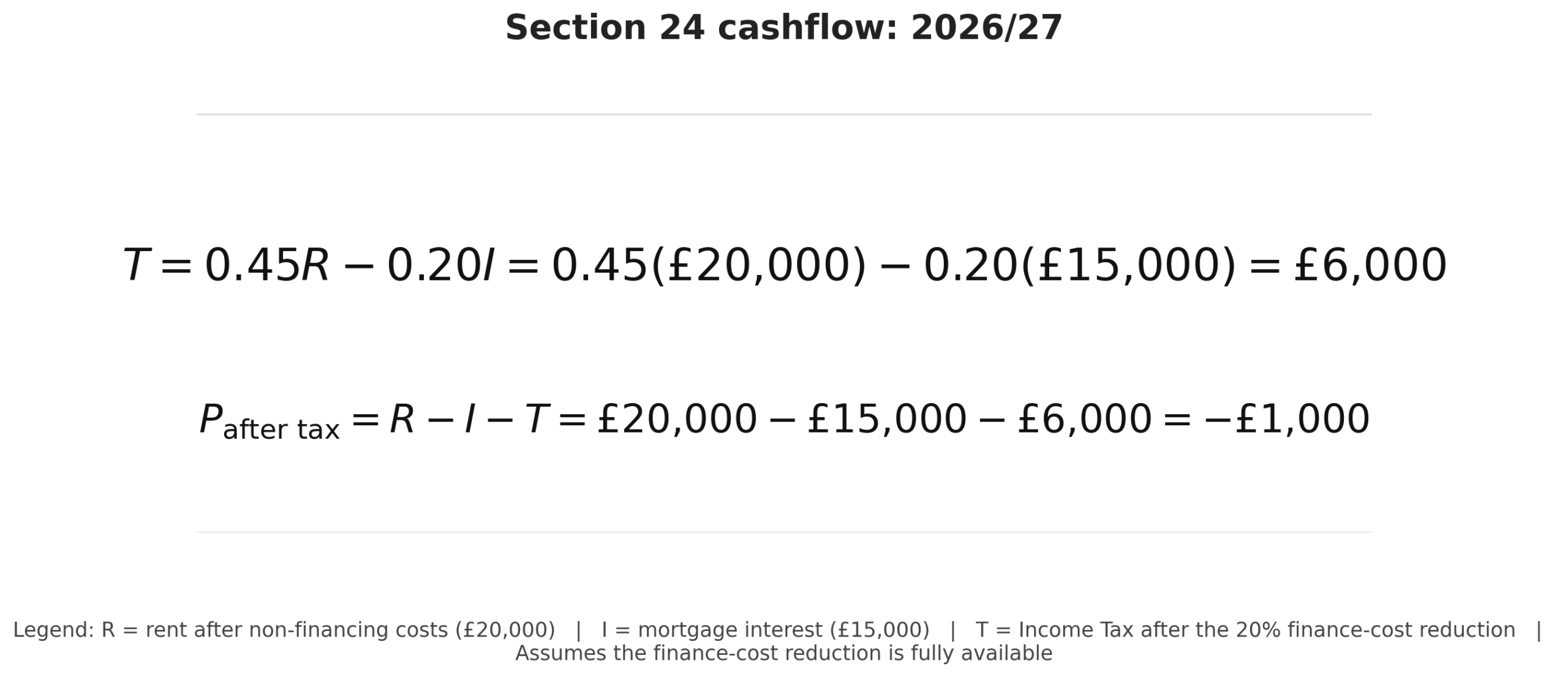
The property made £5,000 before tax. It lost £1,000 after tax. The effective tax rate on the real profit was 120%.
This is not a typo. It is a policy outcome!
From 6 April 2027, England, Wales, and Northern Ireland get separate property-income rates of 22%, 42%, and 47%. For me, the relevant number is naturally 47%.
One small mercy: the final policy also raises the finance-cost tax reduction from 20% to the 22% property basic rate. The Section 24 gap therefore remains 25 percentage points instead of widening to 27.
The same example for 2027/28 becomes:

The after-tax loss is now £1,100. The effective tax rate on the £5,000 economic profit is 122%.
Because both rates rise by two percentage points, the extra £100 tax in this simple example is exactly 2% of the genuine £5,000 profit.
That is almost elegant.
Only a government could preserve a tax distortion with such immaculate symmetry.
Refinance, repay, or run away
So, as we’ve seen I still own two investment properties. Both need mortgage decisions within the next 12 months, which is far from ideal timing.
My pointless-commuter-town terrace has reached the stage where the mortgage must be replaced or paid off. Paying it off would improve the cashflow, but a 22% tax credit is better than no tax credit at all.
The London property is the ex-local-authority freehold house in Tower Hamlets, currently let to Ukrainians.
Tower Hamlets treats it as an HMO because it is occupied by three sharers, even though it is let jointly as a normal house. My existing lender tolerated this by grandfathering the loan. Ordinary best-buy lenders are not so relaxed.
This makes the refinance expensive. It also makes the sale price more theoretical than any figure suggested by Zoopla.
Problem child
Who is the natural buyer for an ex-local-authority house with licensing weirdness attached?
Not a young family wafting through the door with a scented candle and a mortgage-in-principle.
Nope – it’s another landlord.
And that landlord buyer would get today’s mortgage rates, today’s Section 24, today’s Renters’ Rights regime, today’s compliance costs, and the additional property stamp duty surcharge on entry.
Clearly the property is worth whatever price induces someone else to voluntarily inherit my problem.
I see four broad choices:
- Refinance and accept that the house is a geared long option on London.
- Repay the mortgage and own a low-yielding, unwrapped, politically exposed property bond with plumbing.
- Sell, pay the tax, and buy something sensible with what little equity is left.
- Complain, procrastinate, and call it optionality.
Reader, you know me too well.
London doubled and went nowhere
Every year in our Family Finances Annual Report, I seem to write a version of this:
The total value of property assets was marked down again, based, as usual, on the bottom of the Zoopla range. Property fell as a share of family wealth, helped by a combination of ‘property down’ and ‘other assets up’.
Whilst ‘fraction of wealth in property’ is a KPI we’re trying to manage down, I would prefer to get all of it from the ‘other assets up’ department.
According to the UK House Price Index data, the average London property cost £262,793 in April 2006.
Twenty years later in April 2026, it costs £552,655.
Excellent! London property more than doubled. Break out the prosecco and start a property podcast.
Except… the RPI measure of inflation rose from 196.5 to 414.4 over the same period. Put the April 2006 price into April 2026 pounds and we get:

So 20 years of average London capital growth, after RPI inflation: approximately minus 0.3%.
Nominally, London more than doubled. But in real terms it went slightly backwards.
British property! Now available in nominal!
At least it’s not leasehold
This is an index, not my house. It ignores rent. The April 2026 figure is provisional. RPI is not the only possible inflation measure. And individual streets, houses, and flats behave differently.
Indeed, that last point matters. In the year to April 2026, the average London terraced house rose 0.7%, whereas the average flat or maisonette fell 4.3%.
Thank God I never bought leasehold.
One of the best pieces of financial advice my father gave me 30 years ago was simply: “Never buy leasehold.”
My London house is an ex-local-authority shithole. I say that with affection, and a spreadsheet full of repairs. But it is a freehold ex-local-authority shithole.
No cladding bill. No lease extension issues. The ground rent wheeze was not my problem. There’s no mystery service charge. And no managing agent charging me £300 to reply to an email explaining why it costs £300 to reply to an email.
‘London property’ is not one asset class. A freehold house in a development constrained part of London is not the same thing as a leasehold flat in a tired block or an off-plan shoebox flogged off overseas as a portable Swiss bank account with a concierge.
That distinction is one reason I have not sold.
A long-dated option on London recovering its mind
The first decade of my investment property ownership benefitted from an enormous tailwind.
London was on a Thatcherite/Blairite tear. The City boomed. The UK was open, liberalising, financialising, and unusually good at attracting global talent and global money.
London became the de facto financial capital of Europe. We had economic growth! (Something my now-adult children have sadly never experienced.)
Alas, then came the Global Financial Crisis. Property owners ought perhaps to have learned something about leverage. Instead, interest rates collapsed and asset owners were rescued by duration.
Then came Brexit, extra stamp duty, tax creep, planning paralysis, non-dom reform, and a national agenda that shifted from ‘build, trade, and get rich’ to ‘who can we tax to pay benefits to others?’
Maybe London will eventually remember how to be London. Owning a freehold house is a long-dated option on that possibility.
It’s not my base case. It may not even be my sensible case.
But nobody is forcing the option to expire today.
Making Tax Digital: making landlords grumpy
Just when I thought one annual tax return was enough interaction with HMRC, HMRC characteristically disagreed.
Making Tax Digital for Income Tax (MTD) began on 6 April 2026 for sole traders and landlords whose qualifying gross income from self-employment and property exceeded £50,000 in 2024/25.
The threshold falls to £30,000 from April 2027 and just £20,000 from April 2028.
Affected taxpayers must keep digital records in compatible software, submit quarterly updates, and then complete their year-end tax return in that software.
HMRC has taken an annual indignity and given it seasonality.
Landlord limited
In fairness, I already keep records. I have accountants. I can use software. This will not break me.
But that is not the point.
Small landlordism increasingly resembles a business with:
- Safety and regulatory obligations
- Licensing and possession risk
- Financing risk
- Tenant risk management
- Software compliance
- Tax complexity
- Political risk
…but all without the scale, limited liability, pricing power, professional management, and/or tax treatment that could make such a business attractive.
Equity is not what Zoopla says it is
Why not sell the London house and put the proceeds into an ISA over several years?
Because I do not have the £300,000 of equity that the simple subtraction suggests.
Using the rounded numbers from last time:
- Current value: £600,000
- Mortgage: £300,000
- Apparent equity: £300,000
- Original cost: £100,000
The mortgage reduces my cash on sale. But it does not reduce the capital gain. And there’s capital gains tax (CGT) to pay.
For 2026/27, the annual exempt amount for CGT is £3,000 and the higher CGT rate is 24%.
Ignoring selling costs, capital improvements, available losses, and any reliefs, the exit looks like this:
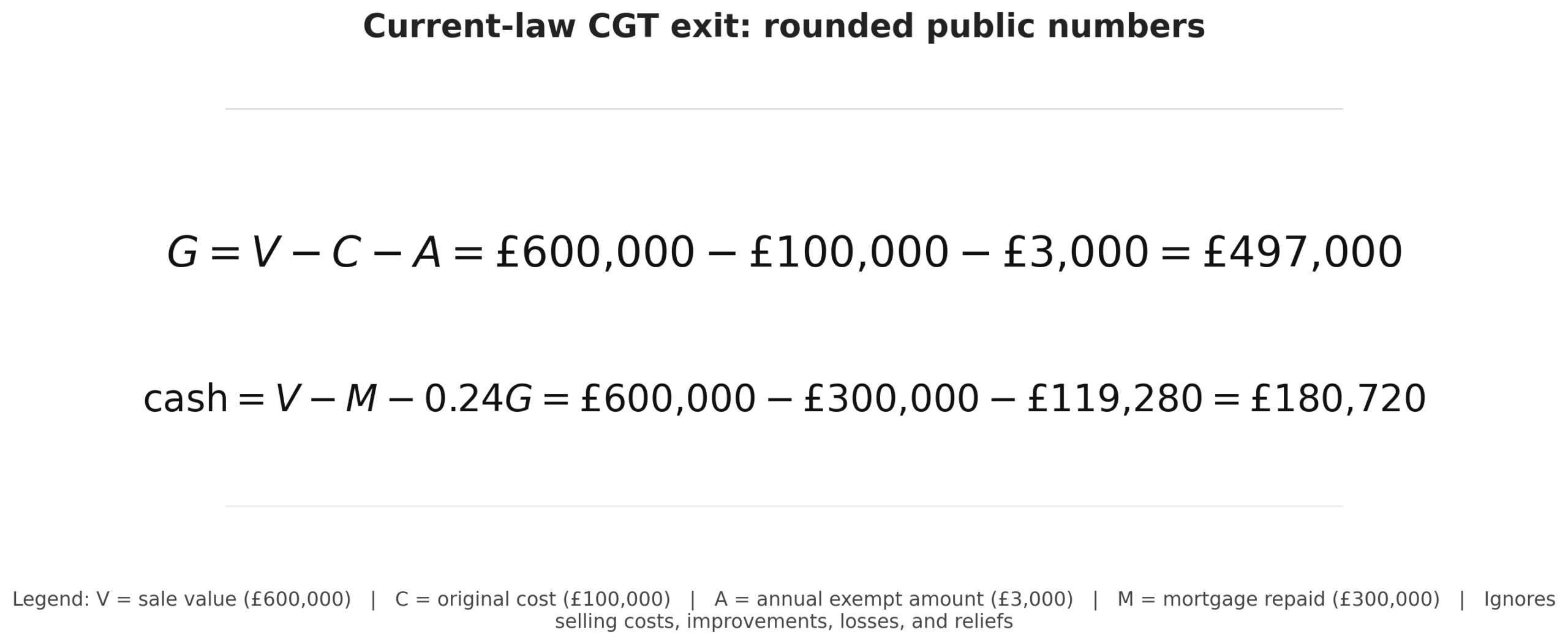
My apparent £300,000 equity becomes about £180,720 of cash – before estate-agent and legal costs.
Past-Finumus remortgaged the property to extract cash and buy more houses. He has, in effect, already eaten a large part of the cake.
Present-Finumus is left holding the plate and HMRC’s bill.
Taxing matters
This is the difference between a good historical investment and a good prospective investment. People confuse the two all the time.
It is also why CGT creates lock-in. Selling a mediocre asset crystallises a very non-mediocre liability.
Also, because this is residential property, the disposal must generally be reported and the CGT paid within 60 days of completion.
It must then appear on Self Assessment, where HMRC’s systems can renew their acquaintance and pretend not to recognise each other.
What if CGT changes?
No increase in the CGT rate on residential property has been announced. The current higher rate is 24%.
However I own a leveraged, illiquid asset pregnant with a large nominal gain and a holding period measured in governments. Regime risk is part of the investment case, whether or not it fits into a discounted-cashflow model.
Suppose – purely as a stress test – that a future government decided to align CGT with the 45% additional rate of income tax.
How ‘fairly’ would this be implemented?
With full RPI-style indexation from 1996 to May 2026, my £100,000 cost would become roughly £272,000.
Without indexation, my cost would remain £100,000.
That difference is not cosmetic:
| Scenario | Taxable gain after £3,000 allowance | CGT | Cash after mortgage and CGT |
|---|---|---|---|
| Current law: 24%, no indexation | £497,000 | £119,280 | £180,720 |
| Hypothetical 45%, full RPI-style indexation | £325,029 | £146,263 | £153,737 |
| Hypothetical 45%, no indexation | £497,000 | £223,650 | £76,350 |
The indexed version is annoying. The no-indexation version is a mugging.
Here’s the maths assuming indexation was introduced:

And if not:
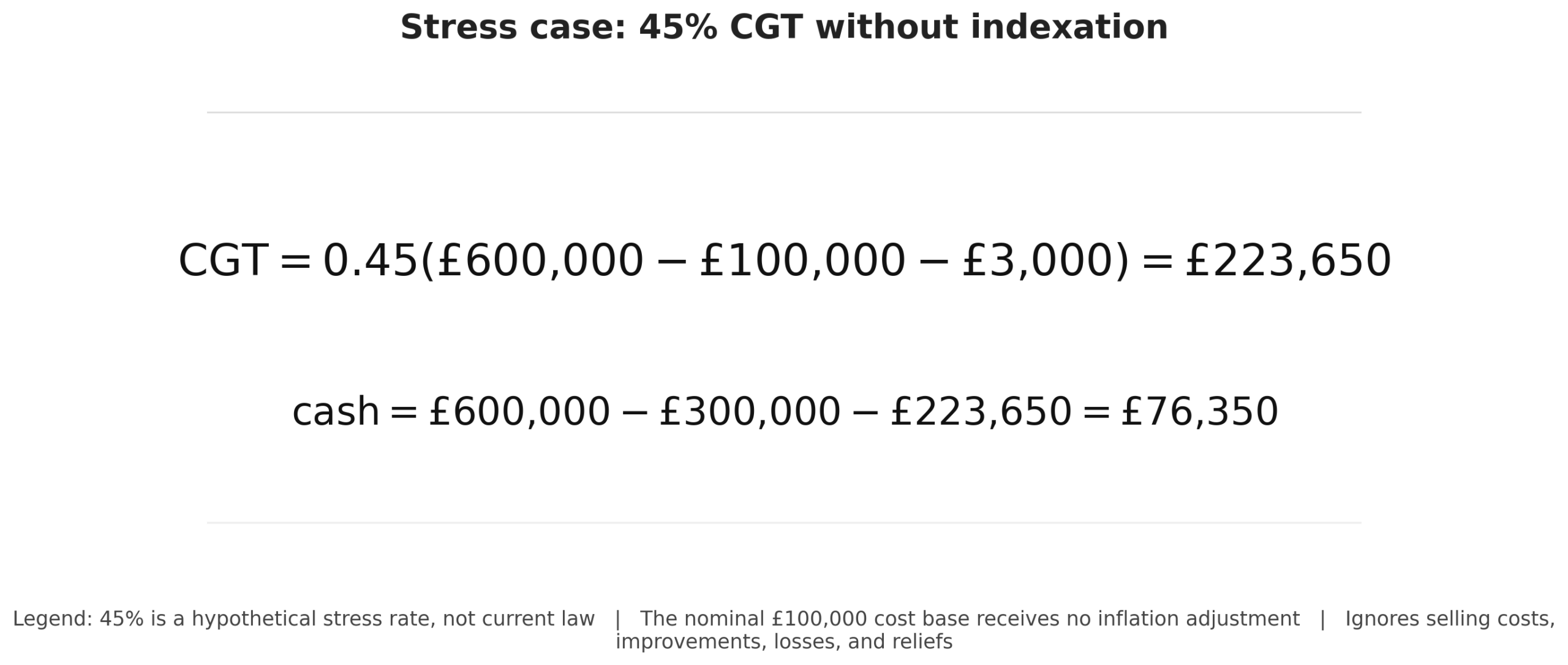
These are deliberately simplified scenarios. Actual CGT payable depends on ownership, dates, acquisition and sale costs, capital improvements, losses, and reliefs.
Get professional tax advice before doing anything expensive.
Under current rules, death itself is not a CGT disposal and inherited assets generally acquire a market-value base cost at the date of death. The estate may face IHT instead. That interaction is another source of lock-in – and another rule a future government could change.
I am not going to invent a combined future CGT-and-IHT bill to stress test. (I don’t want to encourage them.)
Hold, sell, or sulk?
So what am I going to do?
Probably some combination of hold and sulk.
The non-London property still has the same excellent tenant. I do not want to evict her. However I do not want to subsidise her forever, either. So the rent will therefore keep moving up, however reluctantly, because the alternative is to operate a small private welfare state with a damp problem.
My London house is more interesting. It is a poor-looking yield investment. It’s tax-inefficient. It has refinancing risk and local-authority weirdness. And it occupies mental space out of all proportion to its value in the Finumus household balance sheet.
But it is also a freehold house in London. Which may be a terrible reason to hold it. It may also be the only reason that has mattered for the past 30 years.
It doesn’t add up
The old buy-to-let equation was simple:
Tenant rent + mortgage leverage + time = wealth
The new equation is messier:
Rent − costs − Section 24 − tax − MTD − repairs − refinancing − tribunal delay − CGT anxiety + possible London comeback − guilt = shrug
I appreciate this new version may not catch on in personal finance textbooks.
If you’re thinking about starting from scratch, I wouldn’t bother. My returns came from buying before the boom, using leverage, enjoying falling interest rates, having inflation erode the debt – and not being wiped out by tenants, repairs, or policy at the wrong moment.
I was not clever. I was long houses, short sterling debt, and born at the right time.
A new buyer gets today’s price, today’s mortgage rate, today’s stamp duty, today’s tax rules, today’s regulation, no ISA or SIPP shelter, no liquidity, concentrated asset risk, and a lingering suspicion that the answer to every political question that asks “who should pay?” will eventually conclude “the landlord”.
Could buy-to-let still work? Obviously. Property is local. Some landlords buy well, add value, operate efficiently, or use companies sensibly. Circumstances and tax positions vary. This is a personal case study, not financial, tax, or legal advice.
But ‘buy any London property, gear it up, wait, and become rich’ is no longer an investment strategy. It’s now an historical anecdote.
Doubtless some readers in the comments will explain that all of this is a skill issue.
Fair!
Any idiot could make money in property once. Doing it under the new rules may require competence.
This is worrying.
If you enjoyed this, follow Finumus on X (Twitter) or read his other articles for Monevator.



I have sympathy for the situation but this does feel a lot like that Mad Men meme, “that’s what the money is for!”. You’re running a business. If it makes sense financially then you keep running it and accept the consequences. If it doesn’t then you sell to someone who is willing to do it.
Ouch. That’s what governments eager for cash do.
Presumably rent = unearned income in envious socialist eyes.
Benefit payments are also unearned income so what will they do about that?
Excluding pensions of course, they are just undeserved payments to a lucky generation.
As a boomer I knew all about Labour’s handy categorisation of earned and unearned income from the 70’s, as posted here before. Those with the broadest shoulders etc.
Ditto IHT.
If it’s any consolation, and it won’t be, my wife has trust income. Owing to cgt for trusts being one half of the personal allowance, and the lack of indexation, no material rebalancing is affordable.
Thank you for the post.
MTD is going to be a multi year shambles but I expect they will back pedal.
This is an excellent article, thank you for posting it.
I hold residential property and for all the reasons above in the article I would advise my kids starting out away from doing the same.
In a commercial asset management an investment portfolio often holds real estate/ property at about 10% of assets under management, primarily to provide diversification, provide real income returns and reduce portfolio volatility, as an illiquid asset that theoretically doesn’t collapse in value when stock markets crash.
My portfolio is not that large so the property part is far too large for comfortable diversification.
Using the very helpful monevator articles over the last few months, I am switching towards commodities to provide portfolio diversification with an element of real returns.
Getting out of property is the goal, just waiting to see if the next government is slightly more favorable to exiting the property market.
Keep up the great work!
So, to paraphrase Finimus:
He got in early and got lucky with falling interest rates leading to higher nominal house prices. Now the tide has turned and he’s unlucky with rising regulation and interest rates.
Presumably along the way he, like most landlords, extracted capital by re-mortgaging along the way to maintain 25% equity in the property(s). So he’s got his original investment out again anyway
Is that about right?
@Paul_a38
We all have our political views, but it’s important not to let them cloud judgement of sober reality. If we turn our opponent into an irrational monster, and we exempt ourselves from reason and fact checking, we end up in the land of bizarre extremism.
When you talk about “envious socialist eyes,” it overlooks that the really big tax change took place under George Osborne – the shift from taxing profits, to taxing turnover that Finimus explores extensively. That was essentially a 20% jump in tax for 40% taxpayers – which is most working-age landlords.
Labour’s prospective 2% rise on top of that looks relatively trivial. Unwelcome, certainly. Unwise, possibly. But conspicuously envious? Not really.
Oh those endlessly greedy, envious Tories, Paul? Oh the remarkably restrained, moderate socialists?
We should embrace the diversity of opinion that makes democracy thrive, but check it’s anchored in evidence, and in the assumption that our mainstream democratic opponents typically are honest and decent.
Hi Finumus,
Great illustration. I am a mini version of your situation and you are spot on when you mentioned “mental space”. While I too wouldn’t make a good tenant homeless, the real cost is the missed opportunities and time spent on compliance, which could have been spent on other financial market and investment opportunities
“committee meeting in your bank account.”
May I also I suggest you lookup on the RRA HHSRS inspections – the checklist is onerous and it all depends on how strict the councils where your properties are allocated want to make it.
And this was a (pre RRA) case which is worthy of some consideration:
https://assets.publishing.service.gov.uk/media/6266b3ffe90e0716945b173a/APPEAL_DECISION_-_FTT_288_Marchison_Road_final.pdf
“Be greedy when others are fearful.” We’ve all heard the Buffett quote, but of course it’s forgotten when people are actually fearful!
The anxiety is understandable, but sentiment moves in cycles. All it takes is a drop in interest rates, leasehold clarity, or a slight policy pivot for momentum to shift back. If my kids were buying age, I’d tell them to head into central London right now and snap up a discounted 2 bed flat from an accidental landlord desperate to exit.
I hold two central London flats myself (one share of freehold, one RTM). The service charges are painful – £5k and £3k – and I’d sell for decent money (and we are in control over both those service charges but that is basically what it costs these days). But right now, the threat of a long void period trying to sell in a downward market means I’m staying put. Ideally I’d like to sell to my tenants, without scaring the bejesus out of them by alerting them to my desire to sell.
What often gets overlooked is rent growth. Both flats are now comfortably past £2k/month, a milestone that felt distant a few years back. By self-managing via OpenRent, I avoid losing 10%+ to letting agents, and as many landlords exit, shrinking supply is only pushing rents higher.
Landlords might be today’s villain – much like bankers in 2008 – but things always change.
Family members moved to a different city for work reasons; they decided to let their London house rather than sell it because they might have wanted to return to it one day.
Once it was clear that the last (purportedly) Conservative government was going to raid their piggy bank I started sending them e-mails entitled The Way the Wind is Blowing I, II, III, IV, … When Labour got in I changed the title to The Way the Gale is Blowing. Eventually success: they were persuaded and sold up. Hurray!
They really shouldn’t have been fretting about a house. It’s only a bloody house, for God’s sake; it doesn’t care who owns it or rents it. What I didn’t do was suggest how they invest the loot. In the end they used it as a deposit on a house to live in now that suits them much better than the apartment they’d been renting.
I now hope I’ll never have to remind them again that house prices are not guaranteed to go up, especially if we are entering an age of rising interest rates or, perhaps, crashing economies, or both in quick succession.
Grainger at a ~40% discount to NTA could be a way to play it?
Decent scaled platform in an undersupplied market should in theory compound on earnings growth alone, call option on a re-rating
4.7% yield pays you to be patient
No admin, tenant BS or estate agents
@Aol — I made the same argument for Moguls about Mountview Estates (MTVW) back in late August 2024:
https://monevator.com/better-than-buy-to-let-members/
It’s not done much so far, roughly a 7% return with income. But under NAV and well under ‘real’ NAV, with very nearly a 6% yield.
I have a small MTVW position and have thought about doing the same with Grainger (GRI) but no move so far. Better governance though! With luck it’ll buy MTVW 🙂
The big difference is you only get the embedded leverage, versus the high but potentially lucrative BTL leverage which is really the only reason ever to do property IMHO.
Note: not investment advice to anyone reading, just my musings, do your own research and make your own decisions as ever. 🙂
So glad I got out, tenants seem to think mold in the bathroom was my fault. And the screaming banshee that was released when I put rent up by £20 a month after 8 years of no change on one of my tenants. Never again, not in UK anyway.
I bought leasehold as my first step on the ladder, it was a slight loss after you subtracted lease extension costs, service charges, conveyancing costs, and the minimal ground rent I had, but it *was* far cheaper than renting would’ve been, it improved my cashflow enough that I could eventually take the next step. Not ideal, but better than being a tenant – I wouldn’t want to be a landlord either, there’s just too many inefficiencies in the whole thing
@Finimus Do your properties have an EPC rating of C? It was the prospect of having to spend £10k, organise disruptive building work (original uninsulated attic room) with a tenant in situ and then possibly still having to apply for an exemption that was the final straw for me.
You make a perfectly valid case for why people shouldn’t do it if they don’t know what they’re doing and don’t want the hassle.
Equally, I would say there is a very strong case for it if you are willing to do the learning and work required. You can benefit from 3-4x leverage in an asset with similar historic returns to equities, without being marked-to-market. You can get significantly faster equity growth with refurbishment and value add strategies. And you can do all this in an asset class that is currently severely beaten up and under-appreciated.
You even have organisations like Resist Rent Rises encouraging spurious challenges:
https://resistrentrises.org/
“Even if you lose, by taking your rent increase to tribunal, you put off paying the higher rent until the tribunal has made a decision. That means if you challenge a £100pcm rent rise and it takes two months for your rent tribunal case to be heard, you save £200 (minus a £47 court fee if those apply to you) even if the rent tribunal decides the rent your landlord is proposing is ‘market rent’. ”
In Germany, they have CONNY which make the claim for you and charges 6x the monthly rent saving.
@Finimus
Good (but sad) article. I feel your pain. I’ve just offloaded a BTL flat I bought 26 years ago after my lovely 10 yr+ tenant eventually managed to buy their own place. The 18-24% CGT was worth paying to avoid further hassle, dodgy tenants, the crippling tax regime etc.
But, I think your calculated return is way more than double, because of leverage. From your numbers:
Original purchase price – £100k
Original investment – I’m guessing 25% – £25k, with a 75% mortgage.
Current value £600k
Growth on original investment once the original mortgage is paid back – £525k.
Okay there are buying and selling costs (remember you can deduct those for CGT calcs along with any improvements) but £525k is a pretty good return on £25k. That’s over 2000%. Over 20 years. Stellar.
It looks like you’ve extracted cash by increasing your borrowing – an additional £200k in your pocket/pension/deposit on another property? So, yes, you won’t have much left after paying off your mortgage and CGT. You could hang on or just cut and run.
Nowadays it’s professional landlords using ltd company structures who’ll make money, but only if they have decent size property portfolios to cover the accounting costs and slightly higher lending charges. But they get to offset 100% of their interest against income.
The government seem set to force old-style landlords out of the market. I’m just not sure they realise how much this’ll hurt renters.
Two decades ago when I was a tenant, I had more rights if the pint of milk I bought in the supermarket turned out to be sour, then I had about my own home where I stored the milk in the rather disgusting old fridge. The government is very very slowly and against a lot of screeching from people who got incredibly lucky rectifying that situation. Good.
I do agree about MTD though. What an absolute faff for no discernible benefit.
@Brod – Yeah – that’s about right. I’ve done fine out of it. Would I have done better if I’d put it all is stocks? Yes, much better.
@Cat – I’d forgotten about the EPC issues – they keep changing the deadlines and I keep ignoring them.
@Richard Dastardly – You self-manage via OpenRent – how does that work out for you? What do you do about maintenance?
I got very lucky with BTL. Bought in London in about 2006and lived there for about a year then moved away never to return. Rented at a decent yield with full interest relief until 2016, no voids or repairs and made 185k profit on selling (not including rental income). Due to various tax reliefs at the time and the fact it was my only property , no CGT was due. 10 years later the same flat would be lucky to get the same amount nominally, with big inflation adjusted losses. Put the profit into VWRL in 2016, so have now got a big capital gain to deal with
For many decades, the playing field was tilted in favour of property over other assets. It was a terrible policy to deliberately inflate the price of shelter. The fact that some of those policies have been reversed is something to cheer. Yet, property is still being treated as special. Primary residences are still CGT free. Only property gets an extra nil-rate band in IHT. Perhaps landlords are now being treated unfairly but they had it too easy for too long.
Given the fertility rate just hit a new low at 1.39 vs. 2.1 breakeven and the public hatred of immigrants, I don’t see where the long-term demand for UK housing will come from. I can see demand in certain areas of the UK (SE) for certain types of housing (family houses over flats). I just don’t see the overall demand. As more and more boomers kick the bucket there is going to be supply. House prices are still too high given wages and increasing longer-dated yields.
I think investing in property is the equivalent of investing in AIM small-caps. If you’re a great stock picker, you will do very well. Yet, the broad market may still be a cess pit.
I own four properties outright, 2 as residences and 2 rented. I hate property as an asset class. It’s a total PITA. I’m very happy it’s less than 10% of my net worth.
@zx – I see policies that increased house prices as increasing supply – maybe painful in the short term at the time, but in the long term should bode for cheaper housing as demand drops, as you say
@Finumus
Open Rent is a fantastic website – they hand hold you through it all, serve all the important notices and whatnot – and it’s very intuitive. And £80 ish one off fee. I now get exiting tenants to do the viewings for me. If not, then I use Viewber. If not that, then I book all the viewings in 1 block, and do it myself in a few hours – thereby also meeting the tenants myself.
Maintenance I use a handyman firm Silver Saints. And I use a keyholder service Keynest for £11 per month per flat should maintenance need access with no available tenant.
Maintenance issue from tenant comes to me, I phone Silver Saints and ask them to liaise with tenant. It’s worked well the last several years.
Not without issues or extra time, it can be more complicated than it sounds! But that’s my system and it works.
Another word on some of the original post too:
I have withdrawn all the equity I put in and invested it in index funds (thank you Monevator). So they are effectively ‘free’ properties. That doesn’t change the equity in there now though, I appreciate; and yes it’s a happy/painful paradox seeing my index funds balloon and my properties flat line.
I’m a little older now, I’m a FIRE retiree / semi retired at 38 and fully retired at 45; so I don’t have the higher tax bracket issue – but it’s approaching time for me to exit. Without my 2 flats, I would not have been FIRE so I can’t hate on them too much for a poor ten years and occasional hassle.
But I can only hold and sulk at the moment, and pray for an upturn. Otherwise I will be stuck in the trap of selling when it’s low, rather than when it’s on the up with a bright future.
The Renters Right Act I don’t think i agree on some your points. Yes tenants can take you to a first tier tribunal for a rent increase – but that would damage the relationship and I think in general it won’t happen. A landlord could retaliate in many ways. Increasing the rent once a year with 2 months notice is what I do anyway.
Wait till your council discovers selective licensing. Ostensibly an attempt improve areas with high levels of rented property; effectively another form of taxation. In 2021 £550 plus a form to fill, plus copies of all certificates etc, followed by a visit. Some very minor niggles required £200 expenditure (window restrictors, despite them being over 1200mm from floor). Quarterly landlord inspections required, plus agreement to undertake training in managing anti-social behaviour if requested. Five years later, fee now £750, with £100 discount if nothing has changed.
@Paul_a38 I believe it was Adam Smith who first identified that economic rents let landlords “reap where they never sowed” – hardly a bastion of socialism.
Tying this thread in with the weekend reading – surely the historic (mis)allocation of private capital into acquiring buy to let (and the resulting extraction of income) is partly to blame for our lack of productivity growth. Imagine if that capital had been used to either develop new housing, or new businesses?
Well written. Enjoyed some tremendous turns of phrase.
I am joining you at the Hold ‘n’ Sulk bar. Let’s drink to the success of the cash released by leverage.
“Oh dear, how sad, never mind…”.
That’s what I thought two evenings ago after I’d watched a Youtube video about several hundred brand new Teslas gathering dust in an underground car park. They couldn’t be sold because they’d received a software update that hadn’t first been declared to whoever. Or something like that. The situation, and the concerned video poster, failed to generate much sympathy. As one commenter put it…. “I’d rather have a stick of dynamite shoved up my a**e before I’d buy a Tesla…”.
I do feel that the much loved Windsor Davies “..Oh, dear..” comment may have some relevance here, particularly as it was only a considerable way into the comments that Finimus conceded that they had in fact made a pile of money from buy to lets while the going was good, and the post, complete with the mathematical formulations, was really just an exceedingly long moan now that the tax and regulatory regime had undergone a change of wind direction.
One thing that never really gets spoken about is the gross unfairness of the government effectively telling people to use property as a retirement income vehicle for decades, selling off the council house stock and not building any new homes to fuel price rises, and then turning around and squeezing people who took their advice when they reach retirement, all the while leaving corporate landlords alone. I know everyone knows that LTDs have it better but when you look at a direct comparison on a graph it really is shocking:
https://themoneycalculator.co.uk/buy-to-let-calculator
The graph at the bottom of that page lays it bare. If the rules for converting to an LTD structure were more lax there wouldn’t be such inherent unfairness in it, but as it stands it is egregious.
@alan – I don’t think the government itself told people to live off property, possibly more word of mouth and popular TV using dramatic numbers and a public preference for a tangible asset, from a time when information about index funds wasn’t around so much, fees were generally higher anyway, and interest rates falling from a high place made property look like a winner
Selling the council house stock didn’t in itself reduce housing supply – a sold house still houses a family, it just took it off government books. Housing is built privately too, if not predominantly and I think actually subsidised rent means for a private builder they couldn’t sell what they make for as much – new council housing undermines new private construction by taking the profit out of it, and endearing more people to the welfare system
Companies having an advantage over individuals – perhaps that’s wrong like many things, although individuals have advantages over companies for certain things – ie even having an ISA allowance, workplace rights, etc. It’s on us to navigate the system as best we can
Its funny how much of this resonates as I sit here in Dublin, a landlord of 24 years experience.
3-4 years into doubling down on property the IMF give Ireland a large rap on the knuckles in 2010, the rules all changed along the same lines as you describe in the UK today.
Locked into negative equityunable to sell and punitive tax treatment for 10+ years its taken that time to get property wiping its own face again. But it all resulted in an over correction here and the state still wondering what happened.
Post brexit hard times mean we see the same playbook being implemented in the UK. slowly locking you in and banking on you sitting on your illiquid asset through hard times implementing the same playbook.
If thats the case CGT will change for you too and is well up the list of targets right now.