


This is a guest article by Sam Parkinson, the creator of Pension Sprout.
A recent Monevator piece about Gen Z and pensions quoted a young reader stating flatly: “I don’t believe that I’ll be a recipient of a State Pension.”
I’ve read a lot of responses to that sort of line. Mostly they’re some variation of “don’t worry, it’ll be fine”, which is unconvincing and slightly patronising because nobody actually knows the future.
Indeed while the recently-mooted shake-up of the State Pension’s triple-lock from 2030 is pitched as making it more sustainable for the long run, some people will instead see it as proof that politicians will always be tempted to tinker it away, or at least introduce means-testing for what’s now a universal benefit.
So let’s take concerns about the future of the State Pension seriously. Because if you genuinely think the State Pension won’t be there for you, the useful question is what your alternative plan will cost you if you’re proven right. Work that out and you’ll find out what you’re really arguing about.
I run a free pension calculator, which is how I ended up doing this arithmetic in the first place.
Be warned: the number is bracing!
What you’d replace with a DIY State Pension
For the purposes of this article we’ll assume the pension triple-lock continues in its existing form. We don’t know who’ll be governing the UK in 2030 – and thus we can’t be sure if and how the triple-lock will change. Modest tweaks don’t alter the central premise, anyway.
The full new State Pension is currently £241.30 a week for 2026/27, or £12,547.60 a year (Source: GOV.UK). Call it £12,548.
We should focus on the State Pension’s specification rather than that number, though, because the specification is the expensive part:
- The State Pension is paid for life, however long you live.
- It is currently uprated every year under the triple lock, by the highest of earnings growth, CPI, or 2.5% (Source: House of Commons Library).
- You’re not relying on an insurer or an investment fund to deliver the income.
- It isn’t means-tested.
If a private company sold this as a product, it would be the most conservative one on the shelf.
The market price
The nearest alternative to the State Pension you can buy is an RPI-linked annuity.
Hargreaves Lansdown publishes best buy rates. As at 17 September 2026, a single-life RPI-linked annuity with a five-year guarantee paid £5,566 a year per £100,000 at age 65. 1
Hargreaves Lansdown doesn’t quote for age 68 – the State Pension age a 25-year-old is currently legislated to reach. Its table runs 65 then 70, at £5,566 and £6,338 respectively.
However interpolating those two numbers gives us roughly £6,029 per £100,000 at 68. (That’s my arithmetic, not a quote, so treat it as indicative.)
- Divide £12,548 by 6.03% and you get £208,000.
Thus £208,000 is what it costs, today, to buy the income the State Pension gives you, at the age you’d get it.
Note that a few weeks earlier the same table showed £5,585 at 65. The rate moved by around a percentage point over that short period, and the replacement cost by thousands of pounds with it. So please do take every number in this section as just a snapshot of one week’s pricing.
For more context, replacing the same income three years earlier at age 65 would cost about £225,000.
Or – if you’d settle for a level annuity that never rises – £156,000.
That last figure is the one people quote when they want the State Pension to look cheap. But it’s not a fair comparison, because inflation will eat a level annuity alive over a 25 year retirement.
And £208,000 is a low-ball estimate…
An RPI-linked annuity tracks RPI. But the State Pension currently tracks the triple lock, which is the highest of the three measures cited above. The State Pension has therefore generally run ahead of prices since the triple lock was introduced.
The Commons Library notes that the basic State Pension’s value relative to average earnings climbed from around 16% in the 2000s to roughly 26% under the triple lock. So an annuity that merely keeps pace with RPI is a worse product than the thing it’s replacing.
Also, RPI itself is changing.
From February 2030, RPI will be aligned with CPIH, which has historically run about a percentage point lower. Anyone buying an RPI-linked annuity today is therefore buying an index that is scheduled to become less generous within four years.
I suggest then it’s best we treat £208,000 as a floor.
What this all means if you’re 25
Here’s where the analysis gets more cheerful.
That £208,000 – in today’s money, 43 years away – is not an unthinkable number. You can achieve it through a monthly direct debit, wise investing, and a lot of patience.
How much your direct debit – your contribution – needs to be depends on what you assume about returns:
| Real return (i.e. after inflation) | Monthly saving needed from 25 |
| 2.9% a year (FCA prescribed central rate) | £205 |
| 4% a year (my calculator’s cautious setting) | £155 |
| 5% a year (moderate) | £119 |
| 6% a year (optimistic) | £90 |
That’s a spread of more than two to one – from £90 to £205 – in terms of how much you’ll need to put away each month, just from changing the growth assumptions.
It’s an open question as to what the most accurate figure is to use. Anyone giving you a single number is probably trying to sell you something!
Many happy returns?
It’s worth saying where the return assumptions in my table above sit compared to the regulator’s:
- The FCA makes providers project pensions at 2%, 5% and 8% a year, with inflation assumed at 2%.
- That is roughly 0%, 2.9% and 5.9%, after inflation.
- My calculator’s ‘cautious’ 4% therefore sits above the regulator’s central case, and its ‘optimistic’ 6% sits above the regulator’s top one.
I’d rather be upfront about this here than have it pointed out in the comments.
Again, please read the three settings as a range to think about, not a forecast.
Tomorrow’s DIY pensioner today
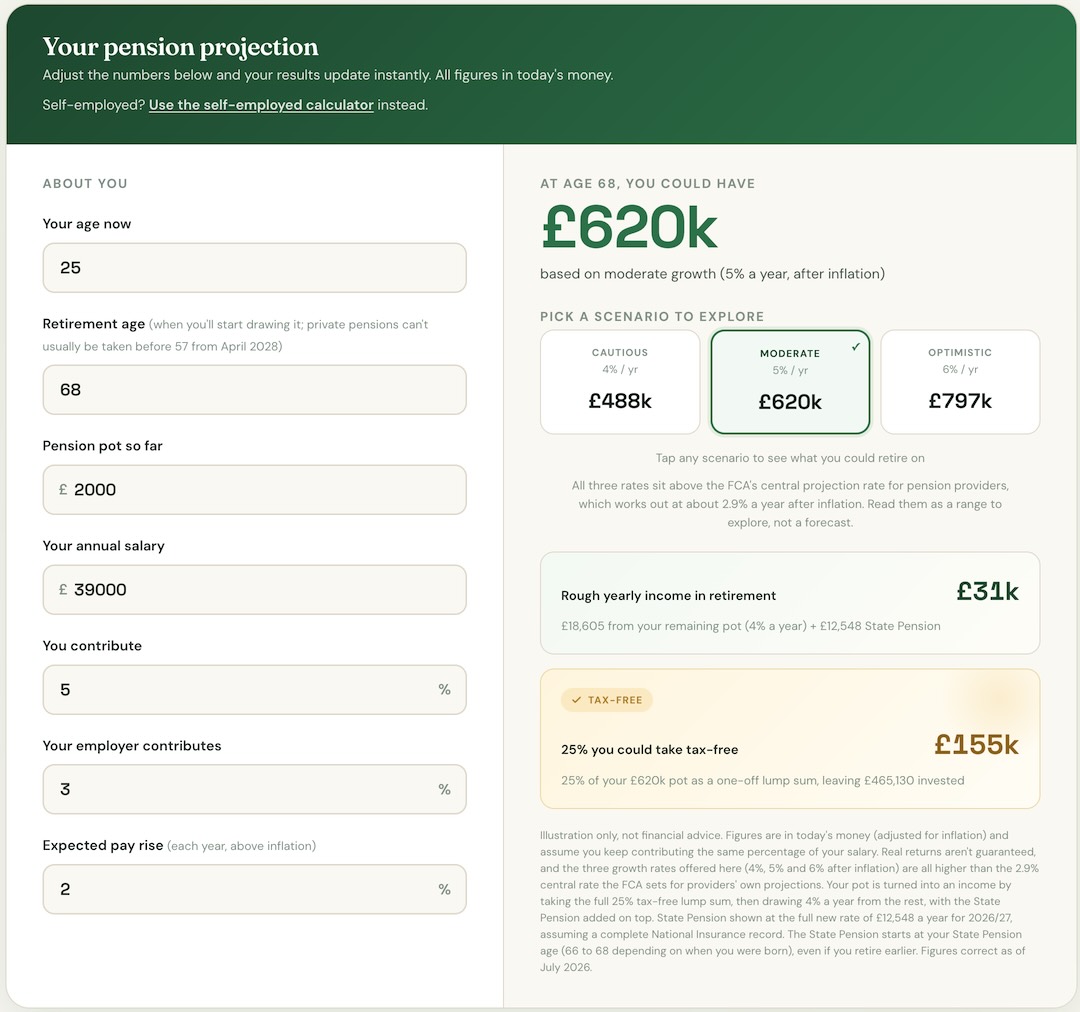
Let’s now consider a 25-year-old on £39,000 (the ONS median for full-time employees in April 2025) who pays the auto-enrolment minimum of 8%, and who retires at 68.
Firstly a few things about how my tool turns the resultant pension pot into an income:
- The calculator assumes that you take the full 25% tax-free lump sum at retirement and then draw 4% a year from what’s left.
- The resultant retirement income figure includes a full State Pension.
- Everything is in today’s money.
- The tax-free lump sum sits outside this income figure, so it would be money on top.
Here’s the money shot:
Source: Pension Sprout
A pot of £620,000 could produce a retirement income of about £31,000 a year. Of this income, £12,548 – roughly 40% – is the State Pension.
That £31,000 is the number I’d put in front of anyone who thinks the State Pension is irrelevant to them. On this central case, it makes up two-fifths of their retirement income. Moreover it’s two-fifths that’s inflation-proofed and can’t run out.
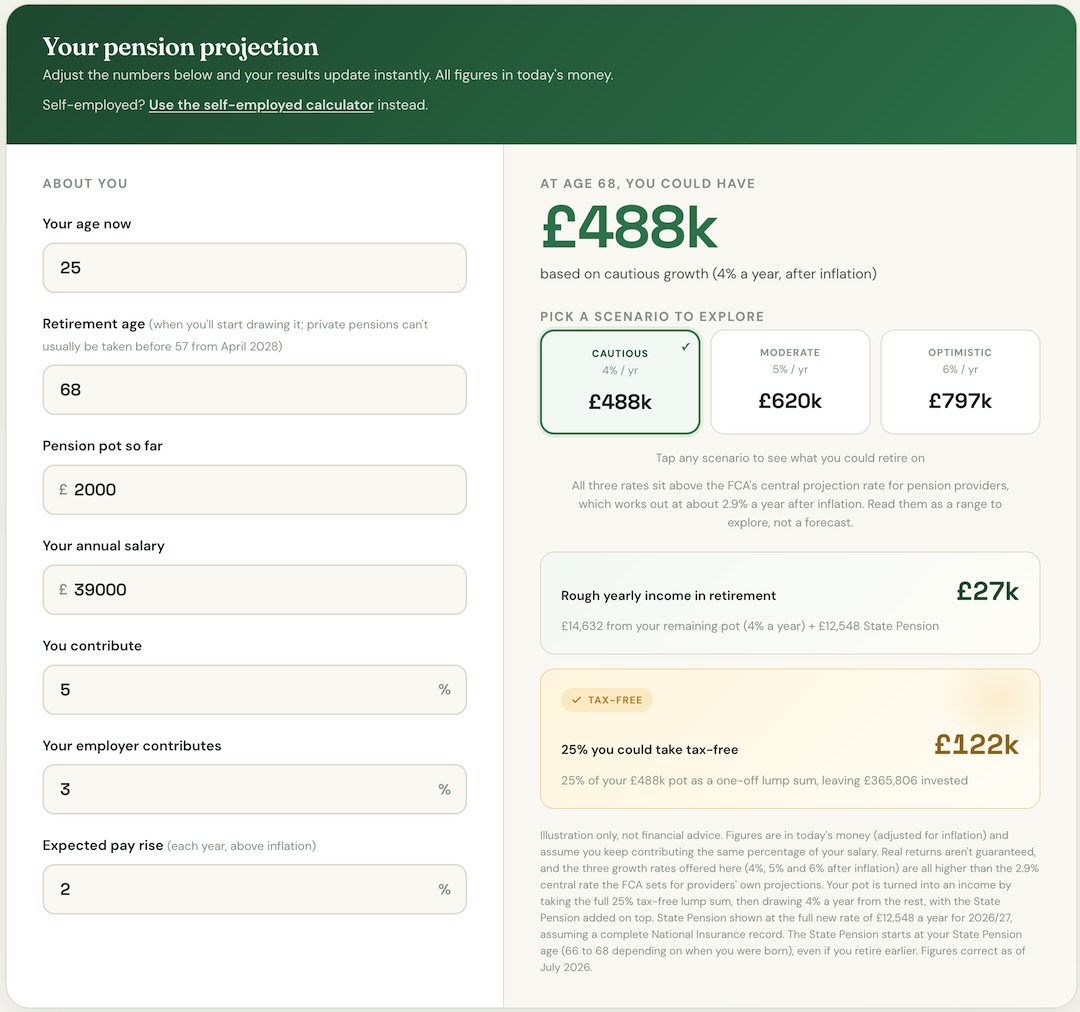
Switch the same person to the cautious 4% setting and the pot falls to £488,000:
Source: Pension Sprout
We haven’t changed the contributions, but the final sum used to buy an income is £132,000 smaller due to lower investment growth. The State Pension share of our pensioner’s resultant income climbs to 46%.
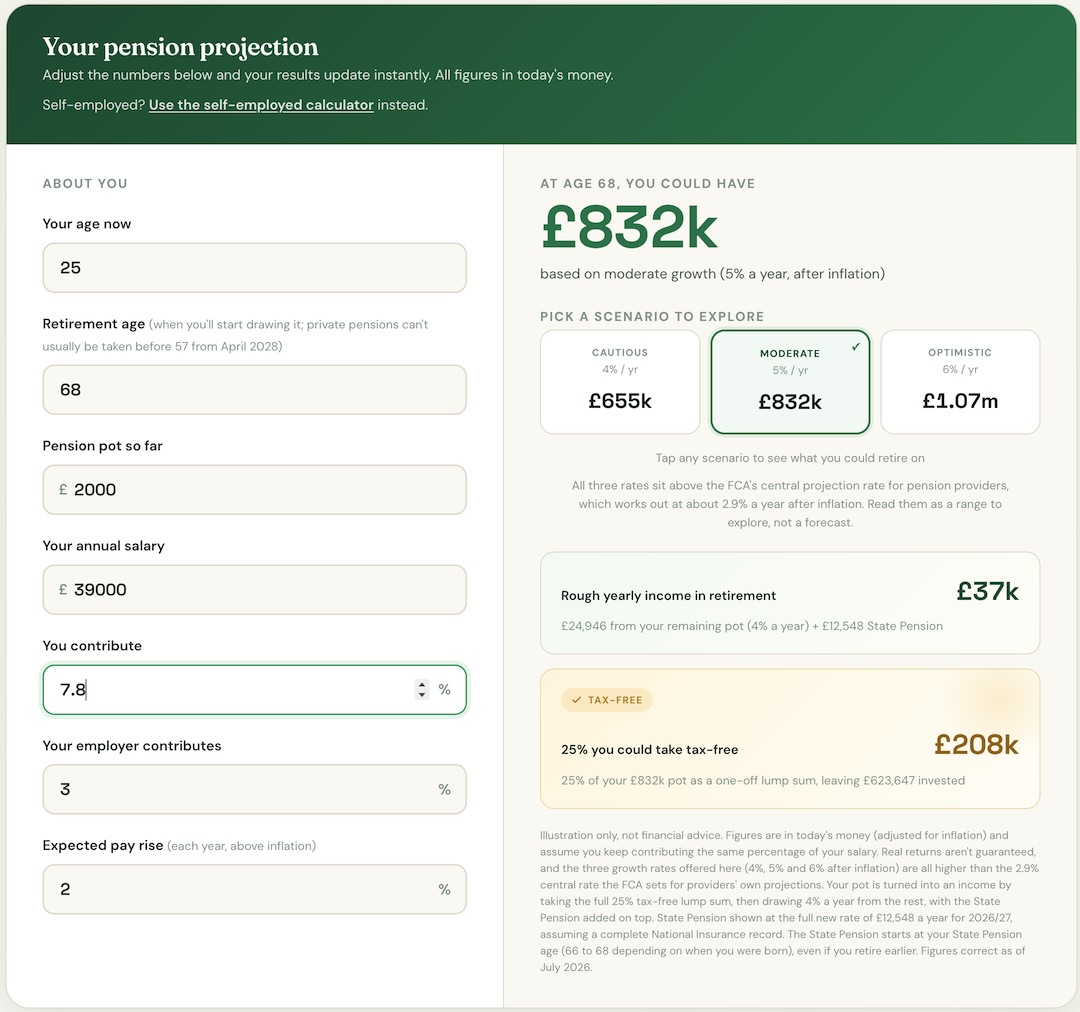
What if our 25-year-old wants to self-fund the whole thing, so that losing the State Pension entirely wouldn’t change their retirement income?
In this case they will need to lift their own contribution from 5% to about 7.8%, which takes the total from 8% to 10.8%:
Source: Pension Sprout
The higher contributions add about £212,000 to the final pot in this forecast, which covers the £208,000 extra the market would charge. It would cost around £90 a month at today’s salary, rising with pay.
I think that’s manageable beginning at age 25. (It’s brutal if you’re starting at 55 – which is a whole other lesson!)
Buying into what the government is selling
Now we get to the comparison that made me want to write this article.
You can buy extra State Pension. A year of voluntary Class 3 National Insurance costs £18.40 a week, or £956.80 for a full year. For someone who needs 35 qualifying years for the full new State Pension, one additional year adds 1/35th of the full rate.
So £241.30 ÷ 35 = £6.89 a week, or £358.50 a year, index-linked by the triple lock, for life.
Work out the implied rate:
- £358.50 of annual income for £956.80 of capital is 37.5%. That is, it pays for itself in two years and eight months.
The open market offers around 6% on the equivalent product, whereas the state charges a price that implies about 37%.
We can push this further. If you could buy all 35 qualifying years at the price of voluntary contributions (spoiler: you can’t!) then it would cost just £33,488. The annuity market will charge you around £208,000 for the same income.
On this crude but illustrative comparison, the State Pension is available at roughly a sixth of what it’s worth, which is a strange thing to describe as the benefit nobody expects to receive.
But before anyone rushes off to their online banking, some important caveats:
- You cannot buy 35 years of State Pension. You can normally only fill gaps in the last six tax years. And only years that aren’t already qualifying.
- Paying doesn’t always increase your pension, particularly for anyone with a pre-2016 record or a history of being contracted out.
- Check with the Future Pension Centre before doing anything. These payments are an easy way to waste a four-figure sum on a pension decision.
My comparison is just made to show you again what the State Pension is really worth.
So is the Gen Z reader wrong?
Not exactly, but I’d argue their fear is aimed at the wrong target.
- “The State Pension will be abolished” is a low-probability outcome. Mostly because pensioners vote.
- “The State Pension age will keep moving” is already happening in legislation.
- “The triple lock should get watered down” is now the stated goal of our prime minister. It’s previously been suggested by the OBR and various think tanks, too.
In my opinion then, it’s the risk of changes to the State Pension rather than it going away entirely that we might want to plan for.
So what would I say to a 25-year-old who doesn’t believe in the State Pension?
Fine. Work out your plan as though you’ll never get it. My sums suggest this will cost you about £90 a month on the central case. Or £206 if you use the regulator’s return assumptions instead of mine. You can make up your own mind and do the maths for yourself.
Suppose you’re wrong about the politics and the State Pension endures?
Then you’ll simply retire considerably richer than you planned. There are worse mistakes!
Just don’t confuse “I don’t trust it” with “it isn’t worth anything”.
For most of us the State Pension will be the largest guaranteed 2, inflation-linked income we will ever have.
That was why I built my calculator – to put the number on the screen so people can argue about it.
If you want to run these figures with your own assumptions, you’ll find it at Pension Sprout.
Sam Parkinson built Pension Sprout after failing to find a pension calculator that didn’t ask for his email address. Sam is not a financial adviser and none of the above is advice, just information for your ongoing research. Figures correct as at 17 September 2026. They will need rechecking against the current tax year whenever you read this.


