


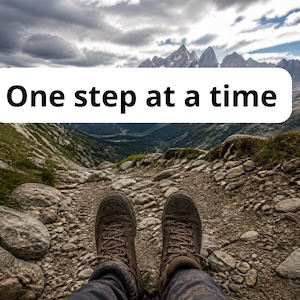
I like walking. Fortunately, so does my wife.
Our longest walk is the South West Coast Path. It took us seven years to cover all 630 miles, fitting in a week here and there while we worked full-time.
Our second longest walk is the Camino Francés, a more modest 500 miles. We completed this in one go, over a leisurely couple of months earlier this year.
Why all in one go? Because we can. We don’t have to work now.
This is why I invest.
My interest in investing is not for its own sake but because it will allow me to go for long walks. Really long walks.
Against the flow
The Camino Francés runs from the French side of the Pyrenees, through northern Spain to Santiago de Compostela in the west of the country, where traditionally pilgrims would visit the shrine of St James.
But, to the surprise, amusement – and occasionally horror – of other pilgrims, we walked it in reverse. Somehow it felt more natural to be walking away from civilisation and towards the mountains.
This meant we would typically start and end our daily walk alone but meet a lot of people going the other way around the middle of the day.
There must be a contrarian investing metaphor in there somewhere.
The cost
You don’t need the investing success of Warren Buffett to walk the Camino. It’s possible to get by on very little if you choose the right hostels.
And when your path takes you through El Bierzo, La Rioja, and Navarra you can always find a decent red to go with your paella, whatever your means.
We didn’t scrimp – I like a nice room and a decent meal after a long walk – but we still ended up spending less in those two months walking than we normally do living at home. We don’t need more money to go walking.
If my preferred pastime was motor sports or polo then I would need a very different financial plan (and probably to have worked a different career).
But it’s not. I like walking. And I’m happy about that.
The Meseta
The heart of the Camino Francés is the Meseta; a vast high plateau of beautiful monotony. If you’re going to have an epiphany on your pilgrimage, then this is where it will happen.
It took us eight days to walk across the Meseta, from León to Burgos. Plenty of time to think about life. Many of the people we met were grappling with some sort of work, relationship, or existential conundrum.
For the most part, my inner thoughts would not be of much interest to you – and may be embarrassing for me.
But I did dwell for a while on the nature of my retirement.
Retirement
I’m still uncomfortable with the word retirement. It seems too negative, like I’ve just given up. Even now, I hesitate awkwardly when people ask me what I do.
I stopped working a couple of years ago. It was the right time. I’d worked hard, done some long hours, had some success, and the joy in it was beginning to ebb.
And, of course, our investments had reached the point where paid work was optional.
I wasn’t short of advice on what I should do when I gave up work. Some of it solicited, some of it not.
One thing everyone was sure about was that I would need to keep myself busy. I should work part time, or do some consulting, or volunteer for a charity. At the very least I should keep a structured routine.
I was warned that many people became bored and depressed when they retire – and end up going back to work or spiralling down into a Cash in the Attic torpor.
But despite this advice, I didn’t take on anything new straightaway. We were already renovating a house and had just had a new grandchild. I gave myself some space (as the self-help books like to say) to think about things for a while.
I quite enjoyed that space. And then we went walking.
Out on the Meseta, I decided that I would ignore all the advice. Simply put, I really like not working. I don’t want another job, or objectives, or more dates in my diary.
The only routine I value is the simple rhythm of a long trail: walk, drink, eat, sleep.
The least important things hold my interest; the smallest things give me joy. I’m not the same person I was when I worked.
FIRE, aim, ready
Perhaps you know exactly what you’ll be doing when you finally stop work. But I’m figuring it out as I go along.
Who knows, maybe I’ll change my mind again and retrain as an accountant next year.
It’s prudent to occasionally remind yourself of your reasons for investing. It’s hard to make good investing decisions if you’re not clear on why you’re doing it.
That doesn’t mean though that you need your future mapped out in detail and set in stone.
You’ll get plenty of advice on retirement. Some you may even find useful. Feel free to discard the rest. Only you will know what’s right.
The end?
On our last day on the Camino, it rained. The beautiful views on the descent to Saint-Jean-Pied-de-Port were lost behind low cloud.
That’s part of walking. Some you win and some you lose.
The next day I started planning another walk: the Via di Francesco, from Rome to Florence through the Apennines.
I’m confident my money will last. What I don’t know is how many years of pack-carrying trail walking I’ve got left in me.
I intend to make the most of them while I can.
Buen Camino!


A pleasant meditative post for a Thursday morning, thanks!
On the subject of uncomfortable conversations about retirement, I’ve been thinking about having some business cards printed up. They will say something along the lines of “I.T. Consultant” (and little else). As boring as possible – my metric of success is if they rapidly shut down that line of conversation. If someone persists (“oh, what’s that then?”), I’ll say I cannot discuss confidential customer relationships. Even worse if they offer work, I’m busy with existing customers. I wonder if others have done anything similar?
As a newly retired person myself, I like the spirit of this piece. I also love long distance walks.
But I’m curious about how you “ended up spending less in those two months walking than we normally do living at home”. If that’s true, then it might be more feasible for me to try a walk like this.
Surely there are incremental costs, though? Accommodation is going to be an extra cost, since you don’t seem to be camping. Even budget hotels or hostels are going to mount up. Unless you are renting out your UK home while you are away and this covers the cost of the accommodation?
And it sounds like you are eating at restaurants at least in the evening. (I’m assuming supermarket picnics for lunch.) Unless you also eat at restaurants when you are at home, that is surely going to cost more than you spend on food at home?
And for the walks overseas, I’m assuming you have flight costs.
So, are these incremental costs offset by the fact that you are not doing things that you would normally be spending money on when at home? I’m curious how this could be sufficient to generate a net saving.
I’m currently on a cruise ship heading for Tilbury.
One of the talks/presentations on board by was a 72 year old who had recently walked the same 500 mile route (normal direction) over 35 days. I like the idea and can’t decide if it’s a solitary pursuit or one with friends.
He said the shared bunk rooms were around 12 euros per night on a first come first served basis. I also got the impression showers weren’t always available.
Possibly a bit austere but being a Pilgrim* should be that way.
Sounds pretty low cost to me. He did it with a tiny backpack so no extra costs for luggage taxis
* if you walk more that 100km on the route the you become a pilgrim, assuming you get enough stamps en route and pay for the certificate
> We didn’t scrimp – I like a nice room and a decent meal after a long walk – but we still ended up spending less in those two months walking than we normally do living at home.
Here for the comments, but would also be very interested in hearing more details of how this costs less than being at home.
Thanks for sharing. The Camino walk sounds class. With work and a child at school so it will take some figuring out for us, but will get there at some point.. God willing of course!
On retirement vs work, I’ve pushed past the wall of FI and get a lot of satisfaction out of what I’m doing now, also an engineer, but running my own small company and directing the R&D. Each to their own!
Also surprised TI didn’t make you fit a Proclaimers number in there.
Totally agree we need a better word than retirement. So negative, so much about withdrawal. Needs to be more about change, not lack. After all, not working because you don’t have to any more is such a positive move, right?
Nice piece. Have some longish-distance walks in my time, both solo and with friends. It is great when you get into the rhythm.
I have also struggled with the word retirement, and have focused on the “financial independence” bit. Plus I have not ‘fully’ retired – still doing the occasional piece of work when the topic is interesting and I am not busy elsewhere. I have only ever seen it as a continuation of my life path. I did this for 10 years, then this other thing for 15, another different type of thing for 20+ years, and now am transitioning to another phase of life. In each case, I was moving towards something. Frustration with the existing situation may have been the trigger, but there was always something I wanted to do that was different.
You obviously had that, or found it, and it was different to what a lot of people around you were saying/assuming. @ermine talked in one of his posts about the importance of having a hinterland. Of not being entirely defined by your job. Of wanting to free up time to do other things. ‘Retirement’ (especially FIRE) gives you space and resources to decide what you want to devote your energies to next. Retirement is just a fish slice that society inserts to split your life – now you are not working for a monthly salary; you are retired and in a completely different category. Never mind about sabbaticals, gap-years, career breaks, health scares and other things that may change whether you get that monthly pay-check earlier in life.
So yes, you are not retired. You used to do that stuff, and now you walk. May you continue to enjoy it for as long as you do.
> Out on the Meseta, I decided that I would ignore all the advice. Simply put, I really like not working. I don’t want another job, or objectives, or more dates in my diary.
Absolutely love it! So good to see someone stepping up to say “to hell” with all the FIRE advice of keeping busy, finding more stuff to do, risk of depression, etc. It never aligned with my intuition about people and myself, and always felt like another symptom of our society’s obsession with productivity. It is so amazing to have space free of objectives and just be – or walk in this case 😉 – a human experience wildly undervalued in our times. But of course everyone is different.
In any case, thanks for the piece, well done for reaching that state, reaching FI, and all the best for your future walks, sound amazing and this part of Spain is just beautiful.
Great article about what retirement means. I don’t have a problem with the word, it certainly sent a speculative recruiter packing when they phoned me. I’m 5 months in. Lots of people asked me beforehand if I had any plans. Like what I’d say. Oh, you know, volunteering, cruises. Nah, I’d reply, I’ll see how it goes. I’ve always had a lot of interests, and walking is one of them, but in reality it’s not what I do but how I do them. I’ve more time to do what I want, when I want and how I want, with no external pressures or constraints. It is bliss.
Thanks for sharing this – inspiring! My my Brit wife and I enjoy trips back to the UK to visit her mum, and usually tie in a visit to somewhere on the Continent.
The walking trip you describe sounds great. would be interesting to see if we could knock off 500 miles in a single visit, but I very much doubt we could do it via back-to-back walking days. Would love to see your itinerary with the stops and accommodations you chose.
Time became more valuable to me than money 8 years ago and I’ve never looked back. Like you, mine was definitely FIRE, aim, ready!! Can’t say there’s ever been a dull moment since. (And I quickly got over the debate about what to call it – call it whatever you want. I really don’t care anymore – I’m a time Millionaire!).
Thanks for all the kind comments!
@Ivan – My assertion on saving money is only based on how much I needed to transfer to our current account during those two months – rather than any details on expenditure – and I confess flights were paid sometime before then. We did have someone stay in our UK house – but only a poor job-hunting graduate son of a friend so the corresponding income was minimal.
But it really was cheaper. The Camino is set up for cash strapped pilgrims so accommodation and food (and especially drink!) is amazingly cheap. You often get special pilgrim meals with more wine than you can drink thrown in and many places have a kitchen you can use to cook your own dinner. And when in the UK, we regularly go to the pub and restaurants, and quite often with one of our kids (when Dad always pays!) – a lot more expensive than Camino food and drink!
But beyond that, I think the biggest saving was just not buying stuff. We pack minimally and carefully manage the weight of our packs. When you have to carry anything you buy, you tend not to buy anything – my only purchase in two months was a t-shirt! I’m ashamed by how much we normally spend in a month on stuff. Not buying stuff saves you money – and more importantly it’s purifying for the soul!
A lovely uplifting article. Thank you The Engineer
I work as hard as I always did. I just don’t get paid for it any more! I am a town councillor, I volunteer at foodbank, I go litter picking, I am a friend of the park, I manage the town website… Rather than say I am retired or have stopped working, I say that I am not in paid employment.
Keep moving -as long as you can!
Had a long (23 yrs) retirement so far -lots of long walks all over the world
Walking costs very little
A point to ponder – old age has now arrived for us and my wife not so fit for long walks
By definition one of you will fail before the other so make the most of your combined fitness while you can
Great article -good to hear a success story
xxd09
South West coastal path is your favourite? Are you Raynor Winn? Have I just inadvertently doxxed you? You should write a book or something?
I’d forgotten where the camino started, Saint-Jean-Pied-de-Port, thanks for the reminder.
It does sound great and I am in full need of this sort of pep talk at the moment.
That said, if God had meant for us to walk, he wouldn’t have invented the bicycle. I’m planning une grande boucle round France next year which will have a hendaye to girona cross pyreneean section, which will be great and terrible at same time I imagine.
I did do a bit of a road trip from Bilbao along the top then dropping down to Porto last year and it was stunning from start to finish. Lovely part of Spain.
Happy tramping!
@SueM 13, Admirable! FIRE with a purpose. I think this is the only way I could make sense of it.
I love the money articles, but I really enjoyed this for a completely different reason. More ‘The engineer’ please
“I’m planning une grande boucle round France next year”
If you don’t know it read Graham Robb’s The Discovery of France. Wonderful book.
When I applied for a wonderful redundancy/early retirement package my boss said “How will you fill your time?” I replied that I thought I might train as a Tax Inspector and terrorise my former colleagues. He then refused to support my application.
Great article, thank you The Engineer.
I also found the comments very interesting too.
To the Monevator team – more like this please!
Very enjoyable thanks! I second the idea of not taking a lot on when you first stop paid work. If you find a need to you can always add activity , but the freedom to do things like this is the essence of retirement for me.
Enjoyable story.
Good to see that it is the finance that facilitates the lifestyle not the other way around.
walk on.
This was charming, Thank you. This has been on my bucket list since watching “The Way (2010)”, which is a poignant film about a guy walking this after his son has died.
This sounds just the thing!
Congratulations!
As for alternatives to the “R” word…?
You could always respond to
“what do you do for a living?” with:
“I WON”
(Work Optional Now)
I’m planning on becoming a “Potterer”. (Def: to spend time in a relaxed way doing small jobs and other things that are not very important.)
Or perhaps I could describe myself as a Professional Investor when I’m living entirely off my savings and investments?
When I took early retirement it was interesting to see the difference in the response of my colleagues – older ones generally wondered what on earth I was going to do with my time, while younger ones were jealous that they couldn’t yet retire.
The good thing about retirement is that it allows you to allocate more time to do the things you like doing* and less to the things you don’t. It is not a competition (although it would appear that for some of the more driven parts of the FIRE community it is – good luck to them) and (thank goodness), isn’t graded or ranked.
* these can vary with mood and the weather!
@Invariant (#24) Pottering is a perfect description…
As I now live in Spain as a resident, I like their word for retirement which is Jubilación: This refers to the official act or period of stopping work permanently because you have reached the required age. It also commonly refers to the retirement. So
Estoy jubilado (I am retired) a joyous way to describe retired