I can’t think of a much trickier in-tray than that facing governor Andrew Bailey at the Bank of England right now.
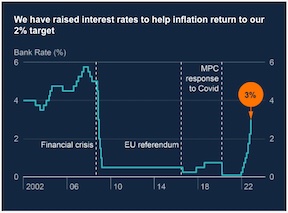
The institution he runs just hiked UK Bank Rate by 0.75% to 3% in the biggest jump for three decades.
And nobody is very happy about it.
“Too much too soon!”
“Too little too late!”
Everyone could do a better job than Bailey.
Never mind that just a month ago the Bank had to intervene directly in the market to stop a liquidity crisis in gilts cascading into the banking sector.
A mini-crisis manufactured overnight by wonks, that took less than a week to blow up.
And never mind – as many now seem to forget – that less than three years ago we faced a depression had not governments and central banks alike acted to offset the economic hit caused (unavoidably) by Covid and (perhaps over-egged) by repeated lockdowns.
Just look at where this interplay of fiscal stimulus, near-zero interest rates, economic inactivity, Brexit, and the shifting demand for goods and services has put us:
Average five-year fixed mortgage – 6% (highest for 12 years)
GBP/USD – $1.12 (down 15% over five years)
Number of UK chancellors since July 2022 – four (careless!)
10-year gilt yield – 3.5% (up 250% since the start of the year)
It’s a cat’s cradle of contradictory indicators – and it could have been worse.
Truss and Kwarteng: gone but not forgotten
In the wake of the Truss and Kwarteng mini-budget show (parental discretion advised) the market briefly expected the Bank of England to have hiked rates by as much as another 2% by now.
That fear saw banks scrambling to raise their mortgage rates, if not pull their products altogether.
Thankfully the decapitation of the Truss regime saw new chancellor Jeremy Hunt undo a lot of that damage. Rishi Sunak as prime minister has further soothed frayed nerves.
It now feels like a bad dream. We still got the same 0.75% interest rate rise that we expected before Liz Truss had ever said she’d never resign for the first time.
Except that like in some horror movie where the relieved victim wakes up from a nightmare only to discover their cat impaled on a candlestick in the living room, those higher mortgage rates have yet to drop back to where they were.
Partly as a result, some pundits now forecast house price falls of 10-15%.
And if you think that’s not so bad – overdue if anything – then be careful what you wish for.
So long and thanks for all the cheques
Because just as one does not simply walk into Mordor, one does not simply repeatedly hike rates, play musical chairs with prime ministers, and ding the housing market without consequences.
Sure enough, the Bank of England has got even gloomier about the economy.
It already thinks a recession is underway. And its chart now suggests the pain will last for two years:
The good news is the Bank’s central projection is for a shallow recession, albeit an overlong one.
The better-but-not-exactly-news-news is that – contrary to what many people now protest – if the Bank and politicians hadn’t acted in 2020, then that plunge in GDP (orange line) would have taken far longer to bounce back.
In other words, the pain we’ll suffer soon is to pay for what we avoided back then.
The Bank of England governor under fire
For me, inflation continues to be the truly perplexing puzzle.
Some left-leaning rabble-rousers economists pitch the BoE as raising rates simply to mete out justice:
If your mortgage is £100,000 that Bank of England have just signalled they want to take at least £750 a year out of your annual income to punish you for inflation. How does that make you feel? And do you agree that inflation was all your fault in the first place?
According to this fellow, Andrew Bailey actively wants to put millions out of work.
Obviously I don’t see it that way. Because I am a grown-up.
Nevertheless there is something perverse-seeming about raising rates even in the same breath as you forecast a two-year recession.
And I find the issue even more vexing because I’m seemingly one of the last people who still believes (perhaps being biased, having predicted it) that it was mostly the economic disruption caused by the pandemic and repeated lockdowns 1 – rather than solely excessive monetary and fiscal stimulus – that’s behind most of this inflation.
But whatever the origin story, at least inflation is forecast to start falling sharply, and soon:
Nevertheless on these figures as published, the Bank of England expects unemployment to climb above 6% by 2025.
Which will be miserable for anyone who loses their jobs – especially if house prices do start to fall sharply.
Indeed it’s not hard to see the potential for a fresh ‘doom loop’ where forced selling meets negative equity to make a bad situation even worse.
Think early 1990s, only with social media.
All of which is also what makes investing especially tricky at the moment, incidentally.
I’ve been getting more bullish for a while, partly because I had judged that market expectations for US rates were peaking.
But this isn’t a sunshine and roses view. Rather it’s because I think rising mortgage rates in the US have already done enough to throw that nation’s housing market into a funk.
It’s a similar story in the UK – albeit more Monty Pythonesque thanks to our political backdrop.
For me it’s a reason to avoid entirely abandoning those hated growth stocks, and to be wary of overloading on the cyclical value-style shares that have done so well since the end of 2021.
My hunch is the worst of the valuation compression is behind the growth companies, while at the same time the economic outlook is deteriorating for cheaper but less exceptional firms.
As for passive investors, no reason not to keep on trucking of course.
At least your bonds will be increasingly throwing off useful income.
Bailout Bailey?
As recently as December 2021, Central Banks didn’t think inflation would get so high, nor that they would have to raise interest rates by very much.
Low and slow was the forecast back then.
I can understand why central bankers feel they have to act tough now, given how wrong they were. But I also think a sharp pivot is increasingly more likely than not, as the cumulative effect of all this tightening adds up.
Personally, I see stagflation threatening to turn into mild deflation as becoming more of a risk than runaway inflation.
But it doesn’t have to end so bleakly either way. We could yet muddle through.
As anyone who saw the Lord of the Rings knows, it turned out you could simply walk into Mordor.
So perhaps Andrew Bailey similarly can raise interest rates, slow the economy, and then pull us up out of the descent before we dive into a really deep decline.
Bonds are among the most confusing and misunderstood of asset classes. This makes it harder to choose a bond fund suitable for your objectives and exposure to risk.
Bonds are often lazily mischaracterised as ‘safe’. They can be anything but. A major problem is the term ‘bonds’ covers a vast menagerie, running from benign to beastly. Yet the bond funds that most of us need can be boiled down to a handful of choices.
2022 has been historically bad for bonds. But we’d still argue they belong in a diversified portfolio, along with equities, cash, and perhaps gold.
It’s all part of weatherproofing your wealth against whatever economic switcheroos come next.
To choose a bond fund that’s best for your needs, you need to match their properties to your investment goals and the threats that could derail you.
The following table maps portfolio demands against the most appropriate bond fund type to fulfill the brief:
Role
Bond fund type
Diversify against deep recession
Long government bonds
Protect against rising interest rates
Short government bonds
Finance near-term cash needs
Short government bonds
Balance current risks vs reward
Intermediate government bonds
Protect vs unexpected inflation / stagflationary recession
Short index-linked government bonds
Note: UK government bonds are called gilts, and the terms are used interchangeably.
That’s the York Notes version of the story. But it’s a good idea to scratch beneath the surface to understand the pros and cons.
Long government bonds, for example, are the best defence against a classic deflationary recession. But they’re a liability in stagflationary conditions.
And while index-linked government bonds are the best protectors against a sudden flare-up in inflation, they come with health warnings. Not all index-linked bond funds are the same. Take the same care when choosing between them as with a sharp axe when chopping wood.
The rest of this post is about understanding what you’re getting into and how to avoid the big bond fund pitfalls.
Bond aid
We favour high-quality government bond funds because they’re the best diversifiers of equity risk. In other words, when equities are down a lot, these types of bonds are the most likely to be up.
By high-quality we mean funds that are dominated by government issued bonds with a credit rating of AA- and above. A sliver of BBB rated bonds in the fund is okay, too.
Short, intermediate, and long refers to the average maturity date of the bonds held by the fund.
Maturity refers to the length of time a particular bond pays interest before the issuer redeems the bond in full.
A bond fund’s average maturity – reflecting all the bonds it holds – influences its level of risk. We explained how that works in our piece on bond duration.
Here’s the cheat sheet on how average maturity influences bond behaviour:
Short bond funds
Short bonds are less volatile. That is, they experience smaller swings in value (up or down) as interest rates change.
However, that makes them less beneficial in a recession, because they don’t make the capital gains that intermediate and long bonds do when interest rates fall.
Short bonds also offer the lowest expected return over time. Less risk, less reward.
Maturities range between zero and five years. Look up your short fund’s average maturity figure on its web page. It’ll be somewhere between 0 and 5.
Long bond funds
Long bond values are the most volatile. You can experience a significant capital gain when interest rates fall, or a loss when interest rates rise.
That typically makes long bonds more beneficial in a demand-side recession.
They offer the highest expected return over time (for bonds). More risk, more reward.
Long bond funds are dominated by maturities over 15 years. Average maturity is likely to be 20+.
Intermediate bond funds
Intermediate funds are the Goldilocks helping of bonds, versus the short and long varieties.
They are somewhat risky, moderately helpful in a recession, and offer a middling long-term expected return.
Intermediate funds hold bonds across a wide range of maturities, from short to long, and everything in between.
Average maturities range upwards of 8+ to the late teens, depending on the intermediate blend you pick.
Next time might be different. We’re describing here the typical behaviour of the various bond fund types. They are not guaranteed to work this way in the short-term or during every economic event. Learn more about bonds behaving badly.
Short index-linked bond funds
Index-linked bonds offer unexpected inflation resistance that other bond types don’t have.
Unexpected inflation means high inflation that consistently outstrips market forecasts. This is the most dangerous type of inflation for equities and non-index-linked bonds (often called nominal bonds).
Index-linked bonds make payments that are pegged to official measures of inflation.
This should make them useful in stagflationary recessions that hurt equities and nominal bonds.
But you may have to stick to short index-linked bond funds for reasons explained briefly below, and detailed in our post about the index-linked gilt market’s hidden tripwires.
Young investor bond fund selection considerations
Are you a young (ish) investor who wants to guard against the threat of a deep, deflationary recession? (Think Great Depression, Global Financial Crisis, Dotcom Bust, Japanese asset price bubble).
Then long government bond funds are the best diversifiers for you.
That’s especially the case if your portfolio is heavily skewed towards equities. (Say a 70% or higher allocation.)
Diversification decrees you want the bond class most likely to profit when your big equity holding crashes. That’s long bonds.
Meanwhile a 70%-plus equity portfolio is likely to be so volatile you probably won’t much notice the relatively wild swings of long bonds on top.
Consider the long bond trade-off carefully
The opportunity: Because you won’t withdraw cash from your portfolio for 30 years or more, you can ride out capital losses should bond yields rise. But when the world is laid low by a major recession, you should capitalise on surging long bond values as interest rates tumble.
In this scenario, long bond gains cushion your portfolio from equity losses. We’ve seen bond funds do just that during past market slumps.
Later you can mobilise your bonds as a source of financial dry powder. You sell some bonds to buy more equities while they’re on sale – a technique known as rebalancing.
The threat: Long bonds can suffer equity-scale losses during periods of rising interest rates and when inflation lets rip. This risk has materialised with a vengeance in 2022.
This chart (from JustETF) shows how one long UK government bond fund has dropped 36.5% year-to-date:
Hardly an easy loss to shrug off! Even a young investor should think twice about long bonds given the current balance of risks – the strong possibility of prolonged rising inflation alongside interest rate pain.
That goes double if you’re the sort of person liable to get distressed by individual losses in your portfolio. (Versus viewing it holistically as a system of complementary asset classes that thrive and dive under different conditions.)
Intermediate high-quality government bond funds may offer a better balance of risk and reward for you.
Olderinvestor bond fund considerations
Near-retirees or retired decumulators have a trickier balancing act. That’s because you’re likely to withdraw funds from your portfolio in the near-term.
Short bond funds and/or (especially) cash won’t suffer from a rapid capital loss like long bonds can. So owning them means you’re less likely to face a shortfall that derails your spending needs.
Demand-side recessions are still a threat to a retiree’s equity-dominated portfolio. But adding long bond fund risk on top can ratchet risk to an unacceptable level when there’s less time to wait for a recovery.
Again, intermediate bond funds chart a better course between the threats of rising interest rates and insufficient diversification during a crisis.
But why not just stick to short bonds or cash?
The next chart shows why. This is how short, intermediate, and long UK government bond funds responded during the COVID crash:
As equities caved during the early days of the crisis, long and intermediate bonds spiked almost 12% and 7% respectively.
Short bonds barely registered there was a pandemic on. Cash was similarly indifferent. So while these assets didn’t lose, they didn’t counterbalance falling equities much either.
On the right-hand side of the graph, you can see long bonds came out ahead, with intermediates and short bonds in the silver and bronze positions. Just as you’d expect in a deflationary slump.
Meanwhile – in the middle of the crisis – a whipsaw effect temporarily crumpled all gilts thanks to a sell-off by large investors desperate for liquidity.
It stands as a useful reminder that our investments rarely work like clockwork during a panic.
Inflation protection
There’s no one-and-done, slam-dunk solution to inflation risk.
Anyone who fears uncontrolled, high, and unexpected inflation should consider an allocation to short maturity, high-quality index-linked bond funds.
But young investors with a long time horizon could just inflation hedge using equities.
That’s because the long-term expected returns of equities are higher than index-linked bonds, even after inflation prospects are taken into account.
Retirees, by contrast, are better diversified if their defensive asset allocation includes a slug of short index-linkers.
The twin thumbscrews of rising interest rates and inflation are torture for nominal bonds. Short index-linked bonds are better equipped to take the pain:
Blue line: This short global index-linked bond fund (hedged to GBP) has returned -1.1% since inflation took off.
Red line: Our short, nominal UK government bond fund fared worse with a -6.4% return.
Orange line: But the intermediate, nominal UK government bond fund did worse still. It took a -24% hit in the last eighteen months.
The index-linked bond fund has fared better than its two nominal bond counterparts in an inflationary environment. Just as you’d expect.
What’s surprising is that the index-linked bond fund is down at all. What happened to its vaunted anti-inflation properties?
Index-linked bonds can fall even when inflation rises
The problem is that index-linked bond fund returns are composed of two main elements:
Coupon and principal payments that are linked to inflation
Interest rates can climb so quickly that the resultant capital losses can swamp an index-linked bond fund’s inflation payouts.
This is what has happened in 2022. Hence index-linked bonds haven’t protected our portfolios nearly as well as we’d hope.
In particular, long index-linked bond funds have been absolutely awful these past six months:
The long index-linked bond fund (blue line) is down 26% vs -1.1% for the short index-linked bond fund (red line).
Why? Because the long index-linked bond fund is much more vulnerable to rising interest rates. Its underlying bonds – with their longer maturity dates – are subject to more volatile swings in value when interest rates yo-yo.
That makes a short index-linked bond fund a better analogue for inflation. Though it too suffers (smaller) temporary setbacks from rate hikes.
And because there isn’t a short index-linked gilt fund in existence, you’ll have to choose a global government bond version, hedged to the pound.
Hedging to the pound (GBP) removes currency risk from the equation.
Global government bonds or UK gilts?
You also face choosing between high-quality global government bond funds hedged to GBP or gilt funds, which are still AA- rated (at least for now).
We used to be agnostic about this choice. There are good intermediate index trackers available in both flavours.
But then this happened:
Gilts got pummeled relative to global government bonds when Truss and Kwarteng went on their bonkers Britannia bender.
UK government bonds have since climbed someway back out of the hole. Sanity has been restored, but this was a wake-up call. A stiff lesson in the danger of concentrating your risks in a single country.
We Brits proudly think of ourselves as members of the premier league of nations. So was this a one-off shocker or evidence we’re on the brink of relegation?
Your answer to that will determine whether you choose gilts or global government bonds.
Government bond funds or aggregate bond funds?
Another decision!
Aggregate bond funds cut high-grade govies by mixing in bulking agents like corporate bonds. The upshot is you gain a little yield but you give up some equity crash protection.
Crash protection from bonds is paramount in my view, therefore I favour government bond funds.
Our piece on the best bond funds includes ideas for intermediate gilt and global government hedged to GBP bond funds.
And when you do come to choose a bond fund, this piece on how to read a bond fund webpage may help.
Hedged or unhedged?
Should you choose a global bond fund, we think the argument is tilted in favour of selecting one that hedges its returns to the pound.
In other words, you’ll receive the return of the underlying investments unalloyed by the swings of the currency markets.
Bonds are meant to be a haven of relative stability in your portfolio. (Even though that hasn’t been the case for many of us in dystopian 2022.)
If you invest without hedging then you’re exposed to currency volatility – on top of whatever else might be knocking your bond investments around. Such currency moves may work for or against you. It’s lap of the gods stuff, despite what that nice man on YouTube says.
Hedging removes currency risk. Probably a good idea in the case of bonds though probably 1 a bad idea for equities.
Hedging is particularly sensible if you’re a retiree who can do without their bond fund plunging just because some loony gets installed in Number 10 and tanks the pound.
Obviously UK-based investors don’t need to hedge gilt holdings. They’re valued in pounds in the first place.
Go West, young man (or bond-buying woman)
There is a nuanced argument that younger investors might want to choose to invest in unhedged US treasuries – or at least that those young investors who are very hands-on with their portfolios could consider it.
That’s because US government bonds and the dollar often benefit from safe-haven status during a crisis. As such, returns from unhedged treasuries may temporarily outstrip any gains from gilts valued in sterling.
If they do then you can sell your treasuries and pop the proceeds into gilts, potentially adding a kicker to your overall return.
Historically, however, gilts have then reeled treasuries back in over time. So this ploy probably isn’t worth the trouble for proper passive investors.
How to choose a bond fund: model portfolios
Here’s some asset allocations devised in the light of all these ‘how to choose a bond fund’ ideas:
Young accumulators
Asset class
Allocation (%)
Global equities
80
Intermediate global government bonds (GBP hedged)
20
Long bond funds are technically the best diversifier but we think that the threat of high inflation and continued rising interest rates makes them too risky right now.
There’s a more nuanced approach that involves holding a smaller allocation of long bonds while attempting to dampen the risk with an accompanying slug of cash. Read the Long bond duration risk management section of this piece if you want to know more.
Older accumulators / lower risk tolerance
Asset class
Allocation (%)
Global equities
60
Intermediate global government bonds (GBP hedged)
20
Short global index-linked bonds (GBP hedged)
20
Equity risk is cutback while unexpected inflation protection is introduced. Note that index-linkers are nowhere near as effective as nominal bonds during a deflationary, demand-side recession.
Decumulators use cash / short government bonds for immediate needs, equities for growth, intermediates as shock absorbers, and linkers for unexpected inflation defence.
Decumulators – max diversification
Asset class
Allocation (%)
Global equities
60
Intermediate global government bonds (GBP hedged)
10
Short global index-linked bonds (GBP hedged)
10
Cash and/or short government bonds (Gilts)
10
Gold
10
This portfolio adds gold to the armoury of strategic diversifiers.
Gold isn’t an inflation hedge per se. But it has worked relatively well in two rising rate environments that have hammered nominal gilts (the 1970s and now).
“I think interest rates will continue to rise…”
Okay, if you’re sure rates are headed higher then stick to cash.
Or if bonds seem too scary at the moment then stick to cash.
But remember that ever since the Global Financial Crisis ushered in near-zero interest rates, cash has done little more than protect your wealth in nominal terms.
You’ve lost spending power after-inflation with cash, whatever your bank balance says.
Look, we get it. 2022’s historic kicking for bonds has been so savage that even ten-year returns are lousy for many funds.
But it would be bold – to say the least – to bank on a repeat performance over the next ten years.
The expected returns from cash are worse than bonds over the long-term.
Cash is not a free pass.
If you don’t believe you can predict the future course of interest rates (you can’t) then put your faith in diversification.
If you’re still not sure, maybe split the difference: some cash, and some bonds.
Take it steady,
The Accumulator
P.S. If you’d like to know more about bonds then check out these posts:
P.P.S. When we mention ‘interest rates’, we’re referring to bond market interest rates, not central bank interest rates. References to ‘yield’ mean yield-to-maturity. Please see our bond jargon buster for more.
We are saying “probably” here not because we can’t be bothered to consult a textbook, but because the case isn’t clear-cut and nobody knows the future.[↩]
War pioneer and on/off conqueror of Europe, Napoleon Bonaparte, supposedly said he’d pick a lucky general over a good one.
Investors might take the same deal.
Alas, there’s apparently no evidence that Napoleon stated the preference that’s famously ascribed to him.
Which is a shame. Trying to invade Russia in winter seems hubristic. It’d be nice to think there was some offsetting humility and self-awareness in the mix. A little balance to the man.
Of course, bloody and chaotic 19th Century battles and trading stocks at your online broker might not seem to have much in common. And that’s because they don’t.
But one thing they do share is that fortune plays a big role – especially in the short-term.
(If your experience of investing is any closer than that to getting shot at close-quarters with a musket, you might want to consider switching platforms).
Sympathy for the Devil
Indeed for some academics the jury is still out as to whether even a long-term record of out-performance can better be chalked up to luck.
Warren Buffett, they say, is just the same kind of statistical anomaly you’d expect to see if you asked a few hundred million people to flip coins and someone did a thousand heads in a row.
I don’t believe this myself. But I do accept we’ve not got much evidence to go on.
Investing in securities as we recognize it today has only been going on for a few lifetimes, and only over a limited number of economic cycles, with a very quirky sequence of returns (e.g. World War 2), and with technology and society broadly headed in a particular direction.
Would we know the name Buffett in a parallel universe where the Nazis conquered London or the semi-conductor was invented 20 years earlier?
We cannot know. But it seems unlikely.
Gimme shelter
For a less existentially taxing case study of luck at play, consider my history with Amazon shares.
As a former Amazon shareholder – and keen watcher of the technology sector – I gasped with everyone else when Amazon shares fell more than 10% on Friday.
Amazon’s market cap is over $1 trillion. Ten percent of that is real money, even for Buffett.
The stock eventually pared its losses as the day progressed and the market ripped higher, but still I couldn’t help thinking about my lucky escape. (And thanking the investing gods!)
Long-time readers may recall I sold my large – un-sheltered – Amazon holding back in February 2021.
Around that time I also disposed of a big position in a technology trust that I’d been holding forever, again outside of an ISA or a SIPP.
Why were they unsheltered, I hear you rightly ask?
Well that was a legacy of getting religion about ISAs only several years into my journey (and of pensions being unattractive alternatives, prior to the reforms).
I spent many subsequent years trying to manage down these positions, given the limited annual ISA and pension contribution allowances.
Which is why I have always been strident that you shouldn’t be as dumb as me and instead fill your ISAs to the max.
Anyway, by early 2021 I had it down to just the tech trust and the Amazon shares outside of my shelters.
These two now-huge-for-me positions lasted longest for two reasons.
Firstly they paid no dividend. Rightly or (as it turned out, given the capital gains, probably) wrongly I had prioritized dealing with un-sheltered income payers first. Not least because I hated the self-assessment paperwork.
But secondly, as time went on I knew I faced a capital gains tax bill of many tens of thousands of pounds when I did tackle them.
I’d diligently used my CGT allowances to defuse down those other holdings. So there was nothing to spare in any given year, which meant I faced the high-quality problem of ever-larger gains and a bigger nailed-on future tax bill.
After all, my Amazon stock had more than ten-bagged 1 since I bought it.
Paying taxes on investment gains savages your returns. It also feels rotten – like you took all the risk and Joe Spender down the road gets some of your gains.
Still by early 2021 the size of the position and the fact it was unsheltered was doing my head in.
So I sold: at $3,328 in old money, or $166.40 today. 2
Time is on my side
Amazon shares fell below $100 on Friday, so you can imagine my feelings. I’d dodged a more than 40% loss by dumping my shares very close to the top. I was well ahead, even after the tax bill.
Yet more evidence I’m an investing genius!
Indeed if I was another kind of commentator I’d get a dozen TikTok videos out of all this.
Alas, the real story is more edifying.
For one thing, while I was certainly worried about the frothiness in markets in early 2021, I was more focused when it came to my Amazon position on UK politics and the state of the nation’s finances.
Because while it didn’t seem like State borrowing would be a problem so long as low rates prevailed, the new Covid-era chancellor Rishi Sunak had made plain he wanted to make down-payments on the national debt.
The talk was that capital gains tax would rise.
Now, I’ve heard that such taxes are going to rise every year for as long as I’ve been investing. Platforms invariably provide quotes to the financial media every ISA season. This encourages people to put more into tax shelters, and hence increase the platforms’ assets under management.
All good fun, but not something I took very seriously.
But this year was different.
Even by early 2021 lots of people had already forgotten just how generous the State had been in supporting workers and the economy through 2020. But the fact was the bill was enormous, and it had been put on the never-never.
So I could well believe taxes would rise. Why not target investors who’d made an unexpected killing in the lockdown bubble?
I have to be humble then because I sold partly in fear of capital gains tax rises. Doubly humble, given that as things turned out the capital gains tax rise never came.
Strike one off the genius tally.
But secondly and even more candidly, if I’d held Amazon in my ISA then I’m pretty sure I would have sold it years earlier. I would never have been sat on such a big gain in the first place.
Even today I tend to turn over my portfolio fairly frequently as an active investor. (Remember my Tesla car crash?)
In those days I was much worse.
It’s not quite a bad as it might seem. My overall returns are good. Stuff I sell tends to get recycled into other stuff that does well, on average.
But at the same my returns over the years have been juiced by my stellar run with Amazon.
And the reality is that if I’d held Amazon in an ISA – especially ten years ago – I’d probably have banked my profits after the first 100% or so.
Hence leaving maybe 1,000% on the table.
Satisfaction
So there you go. As I watched Amazon tank this week (and Alphabet and Meta too, given the big position in the technology trust I’d sold at the same time) I allowed myself a smile.
Perhaps I even started to tell myself a story about how good an investor I am.
But I’d prefer to tell you something closer to the truth, which is that this time I was definitely a lucky one.
Disclosure: this article contains affiliate links to Plum. We may be paid a commission if you sign-up. This does not affect the price you pay. Also please note that the owner of Monevator is a shareholder in Plum.
Every one of us walks around with a devil on our shoulder. A little demon prodding us to buy this, splurge on that, and don’t miss out on the other.
Buy me! Buy me!
Of course in the old cartoons, there was always a counter to the tempting voice of un-reason. An opposing angel on the other shoulder, pulling Mickey Mouse back from the beer hall or Donald Duck out of the casino.
Wouldn’t it be great to have a money-conscious sidekick in real-life who also had your back? Encouraging you to save more and invest more?
Making budgeting easy?
A Plum job
Happily technology has come if not to the rescue then to the clean-up job to tackle the mindless consumerism it makes so easy.
Plum is one of several automated savings and investing apps that connect with your existing bank account. It helps you to automatically set money aside without you needing to remember, by evaluating your income and expenditure and tucking money away for you.
The Plum app boasts other features, too, including investing capabilities that even run to ISAs and pensions.
Plum also gives you an overview of all of your bank accounts – not just your main account. That’s a plus point for those of us with multiple banks to keep tabs on.
There are both free and subscription options. But the no-cost option is actually pretty capable, and the fees for the premium versions aren’t too bad at all if you’re taken with what they offer.
More than 1.4 million people already use Plum. Should you join them?
In the rest of this article I’ll look more at what Plum offers, the pros and cons, and suggest the kind of person who Plum would suit best.
Plum summary review
To cut to the chase:
Strengths
Plum is a simple-to-use savings app that’s easy on the eye
Automatically helps you to set aside money and invest
Great for beginners and those who struggle to get started with saving
Weaknesses
Interest rates are not market-leading
Monthly payment is charged for premium features
Investing fees aren’t the lowest
Plum’s fees
Savings account fees
There are no fees for Plum’s basic account.
Plum ‘Pro’ is £2.99/month, ‘Ultra’ is £4.99/month, and ‘Premium’ is £9.99/month.
All of Plum’s non-basic accounts give access to a higher interest rate for your savings.
Investing account fees
There’s a flat 45 basis points (bps) currency conversion charge for share purchases in an overseas currency, plus possible regulatory fees imposed by the SEC or FINRA.
In addition the following fees also apply:
£1/month for access to Plum’s investments, plus a 0.15% annual management fee
0.13% – 0.88% ongoing charge fees (depending on the fund)
From the moment you download Plum you’ll see a focus on making organising your personal finances as easy as possible.
But don’t confuse this simplicity-of-use with limited functionality. The Plum app packs a lot into its neat package.
All of your accounts in one place
Open banking was a game changer when it first came into play in 2018. Regulations forced financial institutions to open their data to third-party providers. The third-parties could then use that data to build new applications and services.
The idea was that open banking would encourage competition and prevent the largest providers from monopolising data.
And challenger fintechs – such as Plum – have been big winners from this greater financial transparency.
You’ll see how Plum makes use of open banking as soon as you load the app. That’s because, when you download Plum, you’re immediately invited to link to a bank account.
While not all bank accounts can be linked this way, most can, including all of the usual big-name players.
Once you’ve added your bank account, Plum will then assess your spending habits and determine how much you can set aside each month. And if you’ve got more than one bank account, you can connect multiple accounts.
Active budgeting
If you’re someone who struggles to understand where your money goes every month, Plum could help untangle your finances. That’s because Plum does an excellent job breaking down your monthly spending into categories.
If you’ve overspent on takeaways one month, you’ll soon know about it. (Even if you’ll then blame your high metabolism!)
Plum learns more about your spending habits the more you use the app.
True, these days even some traditional banks’ apps may include budgeting features. Challenger banks like Monzo and Revolut certainly do.
However I’ve yet to see a standard banking app that presents your income and outgoings quite as well as Plum.
Aside from analysing your spending habits, the app also assesses whether you’re being overcharged for your utility bills. Plum will even recommend alternative suppliers.
Note: On its website, Plum uses energy as a prime example of it can help find you a superior supplier. However given the current situation with energy prices, we’d say there’s little or no benefit from switching your supplier right now.
Is it the best idea to turn to Plum for utility recommendations?
Probably not. A traditional price comparison website might give you a wider choice of alternatives.
That said, I applaud Plum’s efforts to expose companies who take their customers for a ride.
Not everyone makes much effort to compare providers. If Plum encourages more people to shop around and switch then that can only be a good thing.
Automatic savings
This is potentially the biggest draw of Plum – a chance to set money aside without really noticing.
When you first download Plum’s app you’re given a polite nudge to set up a weekly deposit. Plum then deploys a nifty algorithm that calculates how much you can afford to put aside on a regular basis, based on your income and expenses.
You can also choose to round up your spending to the nearest £1. Buy a coffee for £2.60, and 40p will automatically be deposited for you.
Alongside its algorithm, the app also enables you to select your mood. You can choose from an ultra-aggressive ‘Beast mode’, but also more modest targets via ‘Ambitious’, ‘Eager’, or ‘Normal’.
The more optimistic your mood, the more the app will try to set aside for you.
If you’re keen, but not that keen, there are also ‘Chilled’ and ‘Shy’ options. These will aim to put aside smaller amounts for you. The app’s auto-deposit feature can be paused at any time too. Handy if you’re worried a short-term issue could prevent you setting aside what you normally afford.
Plum’s app also has a savings account feature called ‘Pockets.’ These little savings pots are handy for bucketing the money you’re putting away for something big, like a holiday or wedding.
You can withdraw from your Plum pockets as often as you like. There’s no need to lock the cash away.
You earn interest too
Plum’s Pockets pay interest on your cash balances. You earn 1.01% AER variable if you’ve a basic fee-free account.
Which brings me to my first minor disappointment with the app.
The interest rate isn’t exactly terrible. But with rates rising like there’s no tomorrow, it’s possible to open an easy-access savings account that will earn you more than double what basic Plum will pay you.
If you sign up to Plum’s Pro (£2.99/month), Ultra (£4.99/month), or Premium (£9.99/month) options, then you’ll earn a boosted interest rate of 1.41% AER through Plum’s ‘Easy Access Premium’ account (provided by Investec Bank Plc).
Better, but still not cigar-worthy.
Aside from a boosted interest rate, Plum’s upgraded plans also offer additional money management features, including ‘gamified’ deposit rules.
My favourite is the ‘1p Challenge’. This asks you to a squirrel away only tiny amounts to start with, but the amount you set aside increases gradually as the year progresses. Your sacrifices and savings snowball over the months to leave you with a tidy sum by the end. It’s a nice way to inoculate a savings habit.
Plum’s Ultra and Premium tiers also come with a debit card – only recently introduced – plus a ‘Money Maximiser’ tool, which aims to further prevent you from overspending.
Plum’s debit card isn’t anything remarkable. But it will be useful if you want to spend directly from your savings pots. Beyond Visa’s daily exchange rate, there’s also no charge for using it abroad – a decent perk.
Plum’s subscription features and benefits illustrated
Plum flavours: Click to enlarge each, click back in your browser to return.
In all honestly, I think Plum’s fee-free basic option will do for most readers. But the subscription options do offer additional features.
Scan what’s on offer to see if it’s worth ponying up. The sums being charged per month are quite modest if something especially useful to you is available.
Helpfully, Plum offers a 30-day free trial for its subscription options. This means you can give them a go without being charged.
If you do sign-up for a free trial but decide you don’t want to continue with the subscription features, make sure you cancel before the trial ends.
Investing with Plum
Aside from saving and budgeting, Plum also enables you to invest your money in a General Investing Account, ISA, or pension (see below).
Plum says its investing options are suitable for first-timers or ‘seasoned pros’.
I think though that it’s beginner investors who will be more impressed by Plum’s uncomplicated interface. I’ve never seen an investing platform that’s so straightforward to use.
And the fact that you can invest from as little as £1 is a boon for those who want to test the choppy waters of the stock market.
If you want to invest with Plum, there is a fairly limited range of options – 12 funds on most plans, or 21 on the £9.99 a month Premium plan.
These funds are rebranded offerings from the likes of Vanguard and Legal and General.
That’s reassuring in that you’re not putting your money into sub-scale funds run by a fintech start-up, but rather into funds run by industry giants. On the other hand it is an extra layer to dig through to the fund detail, if you’re so-minded.
For instance, there’s a ‘Tech giants’ fund, consisting of Apple, Facebook shares and the like. This is actually a fund called the ‘Legal and General Global Technology Trust’.
Incidentally, remember that sector bets like that one often disappoint. To put it simply, what seems like no-brainer theme often fails to live up to the hype – at least when it comes to investing returns.
The Monevator house view would be that nearly everyone is best off looking to Plum’s so-called Basic funds. These simply split your investment money between equities and bonds. There are three variations to suit your risk tolerance.
The underlying funds here are Vanguard’s LifeStrategy 20%, 60%, and 80% equity funds (with the balance being in bonds).
We’re unabashed fans of these products, which offer all most people need to get an instant and diversified portfolio.
Still, if you’re more of a naughty active investor you can choose to buy stocks through Plum instead. But note that many of the most well-known stocks are only accessible on Plum if you have a Premium account.
Once again you can set your account to invest automatically on your behalf. It works the same way as Plum’s auto-deposit offering. You’ll rely on Plum’s algorithm to invest for you, based on how much it thinks you can afford to put aside. You can also round up your spending and invest the change.
Plum seems very keen to get its customers to open an investing account. I received a notification to learn more about Plum’s investing options within just 24 hours of opening my account.
Plum pension
You can invest in Self Invested Personal Pension (SIPP) too through Plum. You can open this from scratch or else transfer in an existing pension.
If you transfer, you’ll probably have to choose to move your money into one or more of Plum’s fund range.
Plum also offers what it claims is a risk-managed AI pension service. Just tell the app your age and target retirement date and it says it will do the rest.
Various funds are on offer for SIPP investors. I perused a long-term ‘Retirement 2050’ fund, a ‘Future Planet’ fund consisting of ethical investments, and a ‘Global Equity’ fund that includes large and medium-sized companies.
Again we’d suggest keeping it simple. A big broadly diversified global equity and bond fund from Vanguard will do the trick for most.
Anything else?
The main USP of Plum is its algorithm feature. It’s impressive how much it learns about your spending habits over time.
Plum also does an effective job of communicating with you via regular, personable messages.
These notifications mainly give an overview of your spending behaviour. You can switch them off if you find it too intrusive.
User experience
While not everyone will be a fan of its purple colour scheme, the Plum app should prove a pleasure to use.
Whether you want to save, invest, view your accounts, or open a pension, Plum makes it easy.
There’s also a notification tab within the app which keeps you updated on your progress.
I’ve used Plum for a while now and I haven’t encountered any bugs.
Plum review summary
The most impressive thing about Plum is just how many features it crams into one nifty app. Whether you want to improve your budgeting, boost your savings, or see an overview of all your bank accounts, Plum delivers.
Plum makes investing easy too. Even if it isn’t the absolute cheapest platform around.
I like the fact that Plum’s basic, fee-free option has pretty much all you need. This is not a deliberately-hobbled experience.
However, this does bring into question whether it’s worth shelling out a monthly fee for the subscription features.
All in all, I really like the Plum app. True, I’m not someone who really needs help to save. (Is my wallet glued into my pocket, friends ask?) But I can certainly see myself using Plum’s personal spending insights in the future. I also liked looking at all my bank accounts in one place.
I’ll probably give Plum’s investing services a miss myself, but that’s only because I already passively invest via an established investing platform with low fees.
For investing newbies, Plum’s offering could be an attractive way to get started.
Chip and Moneybox are two apps that do much the same thing as Plum. They have their own quirks.
Have you used Plum for a while? Share your thoughts in the comments to the article below.
Like many other sites, we may be paid a small commission if you sign-up to Plum via affiliate links. This does not affect the price you pay. Our reviews are editorially independent.