≡ Menu

Review: How To Make A Million – Slowly, by John Lee

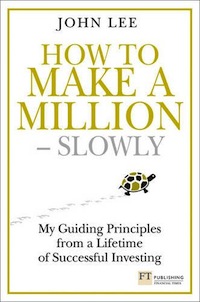
How to make a million – slowly, by John Lee, has very attractive cover art!

I suspect investors of the John Lee variety are becoming a vanishing breed. Now 71-years old, Lee grew up seeing his father sprawled on the drawing room floor, pipe in hand and fortune on the horizon, scouring defunct publications like the Stock Exchange Gazette for bargains.

“Money is not for spending, it’s for buying shares,” his late father used to say, and while Lee – today Lord Lee of Trafford – claims it was meant as a joke, he’s still followed in his father’s footsteps.

In 2003, Lee revealed to readers of his long-running Financial Times column that he was an ISA millionaire. Quite an achievement given that the maximum PEP and ISA contribution possible between 1987 and 2003 was £126,000 1 and the main market had crashed just three years prior.

What’s more, Lee’s ISAs contain just a portion of his total holdings; his writings are scattered with rueful comments about capital gains tax due outside of tax shelters. (I regularly see investors who think they are either too poor or too rich to bother with ISAs – all are wrong, unless they plan on dire long-term returns.)

Lee’s shareholdings have likely multiplied several times since 2003, too. As a long-time follower I know his favourite companies, and his particular brand of small cap share has had a splendid 2013.

Assuming he hasn’t started liquidating his assets, his portfolio must be well into the multi-million pound range by now.

Golden oldie

Lee is a wealthy investor, then, yet he’s one who doesn’t use the Internet. Who still attends AGMs and quizzes company management over British tea and biscuits. Who pours through paper-based annual reports for hidden clues to his companies’ prospects. Who doesn’t invest any of his fortune in active funds, index trackers – or overseas at all.

No, John Lee is a Lord of the Realm, a successful businessman, and a sitter-on-boards whose heart ticks fastest on discovering a small, family-run UK firm with a large cash pile and an heirless octogenarian in the chairman’s seat, pondering selling the business to the highest bidder.

He’s an old-fashioned and super-successful investor who is venerable enough to have learned the word ‘alpha’ in Greek in pre-school and for all I know takes beta-blockers for an ageing heart, but who doesn’t let either alpha or beta get in the way of his investment decisions.

Not smarter, but sexier

Given all that, plus his upbringing and his many years spent at Westminster, it’s no surprise that this is an old-fashioned book, too.

In fact, much of How to Make a Million – Slowly is plain ‘old’, full stop, as the book contains numerous reprints of Lee’s columns for the FT.

Some of these are already a decade out-of-date. Obviously they will become ever more irrelevant to modern investors over time, in terms of the facts they contain.

But the reason they’re in the book is because of the messages they convey, not the facts. 2 These messages should only become more relevant over the years, as the specifics are long forgotten and cease to cloud the picture.

And in some ways that’s true of the book itself.

You see How to Make a Million – Slowly is about as far from, say, the passive workhorse Smarter Investing as you could imagine.

Hale’s book is heavy on data, and to my mind light on charm. I’ve even told my co-blogger that I’m not sure I’d be investing if Smarter Investing was the only book on the subject I’d read.

Of course my co-blogger The Accumulator is a big fan of it partly because he believes that charm is the last thing you need when looking to secure your fortune. Rather, being beaten over the head with the key messages and a vaccination against the wiles of the financial services industry is what people need to swallow.

I agree. And yet, personally, I caught the investing bug not from the thought of a risk-adjusted well-diversified annually rebalanced 5-8% nominal return a year, but from the writings of Jim Slater, Warren Buffett, Peter Lynch, and other articulate – and undoubtedly survivorship biased – active investors.

It’s down that end of the bookshelf where Lee’s book belongs. Indeed, the whole thing reads more like a chat with an avuncular grandfather (who knows, perhaps Lee’s own father?) than a modern treatise on discovering your edge or exploring the efficient frontier.

I hadn’t met anyone who’d ever bought a share until I was into my 20s. For me, that’s a gap worth filling.

How to make a million – really?

What the book also isn’t, really, is what it claims to be in the title – or at least not exactly.

Lee does summarise his approach, which is essentially to buy small to micro-sized niche companies that you judge to be trustworthy when they’re paying a good dividend yield and look cheap on a P/E basis. Then hold for as long as you feel able.

There are only a dozen or so pages that boil down to anything like a checklist. Anyone hoping for the new Zulu Principle might be disappointed.

Nor is it, as I’ve hinted above, terrifically introspective about exactly how Lee’s gains were achieved. There is a lot of conjecture about quizzing directors and reinvesting dividends, but there’s not much questioning about risk and returns, or comparing Lee’s annual returns on a compounded basis with an appropriate benchmark.

If John Lee was Warren Buffett, no doubt some quant or academic would come along and explain it could all have been achieved by, say, borrowing money to buy a boatload of shares in a small cap investment trust or what have you (small cap ETFs not having been around for most of Lee’s lifetime, and barely today in the UK).

So let me be clear, rigour is not on offer here. Don’t buy this book expecting a formula, a secret, or even a How To plan.

Nor is this the book for you if you’ve read everything John Lee has ever written, you have a photographic memory, and you don’t want it all compiled in one convenient place (as I myself do), with a bit of intra-book repetition thrown in for good measure.

However if you want to feel like you’re spending time with a successful active investor, picking up plenty of wisdom through osmosis, and that you can learn from even his throwaway lines, then it will prove a worthwhile purchase.

If you love small caps and believe there’s more to risk than volatility – and more to judging a company than the numbers in a database – then this is absolutely the book for you.

That’s doubly true if you invest in the UK, where books by investment legends are very thin on the ground.

A book for lovers

It would be easy to follow Lee’s high dividend, low P/E approach to small caps yet be unlucky enough to invest in many more of the sort of duff shares he candidly reveals buying in his chapter entitled ‘My Mistakes’.

That’s why I stress there’s – patently, obviously – no formula to success. What cynics of stock picking might call his “special magic pixie dust” has surely made a difference to his returns. You won’t become the next John Lee purely by reading his book.

Should you try? I think Lee himself nails it when he writes:

In my view, to be a successful investor requires commitment and time, and you’re only going to put in the required effort if you find the stock market enjoyable and absorbing.

To be blunt, either you fall in love with investing – its fascination and its mysteries – or you don’t. You will know soon enough which it is.

If you don’t, there is no shame in this, just forget it – leave the investing of your money to others, either by choosing a mutual fund / investment or unit trust, or giving a stockbroker or bank discretion to handle your portfolio on an agreed basis.

I disagree with the last bit – if you don’t love investing, I suggest investing passively through trackers, rebalancing annually, and taking the other 364 and three-quarter days of the year off. There’s no need to waste money on brokers, bank managers, or expensive fund managers.

But I agree completely with the first two paragraphs.

If you do love active investing – that is, picking stocks, following companies, and trying to outdo the brightest minds in the business – then like me you’re probably already beyond help, and reading and absorbing this book will I think prove useful, as well as enjoyable.

The Accumulator asked me recently why I invest actively, given that I think most people should invest passively. I said it was because I love it. Some probing revealed that sure enough I was motivated by the possibility of doing better, but I maintain that’s a vital scoring mechanism, not a means to an end.

It’s like a game of golf. Without the chance of achieving a hole in one, golf is just a walk in the park – even if you do it for the comradeship, the challenge, fitness, or simply to get out of the house.

John Lee has done very nicely from his investing, but I suspect he would have kept it up even if he’d done half as well. His passion is what comes through most strongly in this book.

Active investing will never be a walk in the park – but for some of us the slog is the sweeter for it.

Note: You can buy How to Make a Million – Slowly right now from Amazon.

  1. According to Guy Thomas in the Lee biography in Free Capital.[]
  2. Well, and because at 145 pages How to Make a Million – Slowly is not the world’s longest book to begin with![]

{ 6 comments }

Weekend reading: Bill Gates’ recommended reads

Weekend reading

Good reads from around the Web.

Last week I offered some suggestions for investing books for Christmas presents. All those books would be great reads for you, friends, or family.

That said, one of the best investors I know claims he’s only read a couple of investing books in his lifetime, and one of those by accident!

This fellow is no intellectual slob, but he argues it’s better to read books about business and the wider world if you want to be a great investor.

Perhaps he has a point.

UK passive investors need only read Smarter Investing or Investing Demystified to be intellectually set-up for life (though sticking with Monevator for regular updates on the cheapest options – as well as pep talks on the strategy – can continue!)

Even active investors should probably read more about business than spend too much time in legendary investor worship.

I found The Snowball as interesting as anyone, but I’ll never be Warren Buffett. The Sage himself says understanding companies and being a businessman is the key to his success.

Handily enough, Warren’s pal Bill Gates has just published a list of his best reads of 2013.

Here’s a handy cribsheet, then, for those of us who want to raise our game – whether in investing terms or intellectually, or just to have something to discuss should we end up next to a billionaire on a plane!

Bill Gates’ best books of 2013

The Box by Marc Levinson

Gates says: “Makes a good case that the move to containerized shipping had an enormous impact on the global economy and changed the way the world does business.”

The Most Powerful Idea in the World by William Rosen

Gates says: “I’d wanted to know more about steam engines since the summer of 2009, when my son and I spent a lot of time hanging out at the Science Museum in London.” [Who knew?]

Harvesting the Biosphere by Vaclav Smil

Gates: “As clear and as numeric a picture as is possible of how humans have altered the biosphere.”

The World Until Yesterday by Jared Diamond

Gates: “It’s not as good as Diamond’s Guns, Germs and Steel. But then, few books are.”

Poor Numbers by Morten Jerven

Gates: “Jerven, an economist, spent four years digging into how African nations get their statistics and the challenges they face in turning them into GDP estimates.”

Why Does College Cost So Much? by R Archibald and D Feldman

Gates: “Until you get an excess supply of graduates, then you don’t really get any price competition.”

The Bet by Paul Sabin

Gates: “Sabin chronicles the public debate about whether the world is headed for an environmental catastrophe. He centers the story on Paul Ehrlich and Julian Simon, who wagered $1,000 on whether human welfare would improve or get worse over time.”

[continue reading…]

{ 5 comments }

A buying opportunity has emerged in emerging markets

Emerging markets — hung out to dry in recent years.

Ten years into my hardcore investing obsession, I’m still surprised how predictable investors can be.

Take the cycle of fear and greed, for example, and put emerging markets in for spin.

A few years ago you’d get shouted down if you suggested that unloved US and UK equities might be as good a home for your money as emerging markets.

Yet now the average investor doesn’t want to touch emerging markets with a barge pole. [Note to editor: Please insert witty comment about the indigenous boat people of an exotic island nation here.]

There are doubtless multiple reasons why emerging markets have done poorly for the past two or three years. Pundits point to inconsistent economic growth, stifled reforms, political risk, lower commodity prices, and the end of easy money.

To my eyes, though, optimism and pessimism has played its usual starring role – expressed as ever through the valuation put on traded assets like shares.

Emerging markets can go down as well as up

Immediately after the financial crisis, the West was in the doghouse while emerging markets powered ahead. Our shares were cheap on various metrics, theirs were arguably expensive.

Myopic investors made giddy by recency bias assumed this state of affairs would continue forever.

They also ignored warnings that economic growth was not a predictor of stock market returns – basically because anyone can see when a particular country is booming by reading the newspapers and watching the news.

So by the time the average investor – whether professional Gordon Gecko type or enthusiastic oik like us – arrives at a promising scene, the party is in full swing.

If you arrive late, you pay a high price to be part of the in-crowd in terms of the P/E multiples and price-to-book ratios you pay for your shares. That leaves little wiggle room for future disappointments – and sometimes mediocre returns even if things go as planned.

Beaten by the ‘broken’ USA

Since then the mood has soured on emerging markets. Yet all the problems they are said to face today existed when everyone loved them, too – at least on a longer-term perspective – as well as the opportunities.

To me, that makes emerging markets a more attractive place for my money, rather than less so.

If you’re a smart passive investor, you probably already have an allocation to emerging markets. Take this article as simply saying that when you come to rebalance your equity holdings and see that your emerging market index fund is down, hold tight and top up.

Smile inwardly! What goes around comes around. That’s exactly why you’re rebalancing, in fact.

As for us nefarious active investors, the pessimism could make for a fertile hunting ground, especially after double-digit gains in the developed world this year make some of them, notably the US, look more fully valued.

See how the soaraway S&P 500 has trounced emerging markets in 2013:

S&P 500 versus iShares Emerging Markets ETF (EEM)

S&P 500 versus the iShares Emerging Markets ETF (EEM)

The S&P 500 has beaten the iShares emerging markets ETF by more than 30% in the year to-date.

Will that stellar level of outperformance continue?

Maybe.

Will it be replayed every year for the rest of the decade?

I’ll go out on a limb and say: Not on your nelly.

We’re all in it together

The extreme case made for loading up to the eyeballs in emerging market shares never made much sense to me, even when they were doing well.

Yes, the citizens of emerging nations are mostly younger than us, and they have faster growing economies. But we were (and are) the wealthy ones, and we have plenty to sell to them, too.

The UK FTSE 100, for example, generates more than 70% of its revenues from overseas. UK consumer goods giants like Unilever (Dove, Bovril, Marmite) and Diageo (Johnnie Walker, Baileys, Guiness) get a huge proportion of their sales directly from emerging markets.

For this reason, even if the UK and US economies were doomed to decades of stagnation or worse – which I doubted then and now – it might be different for our listed companies. Not for nothing do critics of Western capitalism paint them as rapacious locusts scouring the globe for profit.

Besides, I believe the truth is a less sensational halfway house.

Western economies will grow, probably a little more slowly than in the past, and our companies will likely keep a (shrinking) technical edge over most emerging rivals. But the latter will have strong domestic demand to easily tap into.

Emerging markets as a whole will be volatile, and some will utterly disappoint, whether for economic reasons or because they’re taken out in a military coup. Or some lesser evil.

By diversifying and dripping in money over time, you’ll be able to dilute the duds and profit from those markets that – well – emerge!

Emerging market investment trusts

For my part, for 6-12 months I’ve been increasing what was a too-small allocation to emerging markets. Mainly by fiddling about with my index fund allocations but also by buying shares in relevant investment trusts.

So far it’s not been wildly successful, but this is long-term money that I add to piecemeal.

In addition, I own a couple of family-run global investment trusts that have floundered in part due to their emerging market exposure, particularly RIT Capital Partners and Hansa Trust. (The latter is mainly an idiosyncratic bet on Brazil and other emerging markets, though you might not realise that at first).

I have also put more money into companies hurt by their association with emerging markets, such as Unilever when it fell below £23.50.

When I scan some of the emerging market investment trusts, I do wonder if I should be bolder. That’s because fear and greed is doubly captured in the discounts they can trade at to their assets.

Here’s a few I’m mulling over:

Ticker Discount/
premium
Yield YTD 1
Aberdeen Asian Income AAIF +1.6% 4.0% -12%
BlackRock Latin American BRLA -10% 5.4% -19%
JP Morgan India JII  -15.5%  n/a -10%
Hansa Trust HAN -26.7%  2.0% 16%
Templeton Emerging Markets TEM -9% 1.2% -9%

Sources: AIC Stats for trust data and Google Finance for year to date returns.

Please note that I’m not recommending the trusts above as good buys. I don’t give advice, and you will need to do a lot of research yourself.

These are just a few of the trusts that I’ve been considering – and there are plenty of others to look through. In some cases there are definitely reasons to be cautious.

Finally I’ve even boldly gone beyond the pale, to Frontier Markets. Only a smidgeon invested in that, but it’s doing okay so far. It’s one for the very long-term.

Not every emerging markets investment trust looks cheap. JP Morgan Emerging Market Income (Ticker: JEMI) is on a small premium, as is Aberdeen Asian in the table above.

I suspect in today’s yield-hungry world, a 4% dividend yield trumps even fear!

For all the bulls in China

I am not claiming to have called the bottom for emerging markets, or anything like that 2. You could imagine them falling much further from grace, especially if investors weren’t being pacified by strong returns elsewhere.

But I do think they look shunned and therefore worth an extra poke.

You might be surprised how quickly sentiment can change. Fidelity China Special Situations (Ticker: FCSS) is a case in point.

  • In summer 2013, FCSS reached a low of 81p and the discount surpassed 11%.
  • Now they cost 105p to buy. That’s a 30% rise in just five months.

I’m not saying (of course!) that it’s easy or sensible to look for quick returns like that. I’m suggesting it’s a better time to buy and lock away this asset class for the long-term than it was just 2-3 years ago.

Still, the sudden reversal of opinion about China is an excellent example of just how fast people can change their minds about a particular emerging market – and how rapidly it can be reflected in share prices.

  1. Year to date.[]
  2. Especially as I’d be late on current evidence – they seemed to touch base a few months ago.[]
{ 29 comments }
Weekend reading

Good reads from around the Web.

Still to buy all your Christmas presents? You’ll get no sympathy from me if you intend to shop on foot like some Luddite from the 1980s.

Why not go the whole hog and hit the High Street on a horse?

Me, I’ve done all my Christmas shopping online via Amazon for years now, sending the bulk of it direct to my mum’s house – the scene of the annual family bust-up reunion. It’s become even easier since I joined Amazon Prime. No crowds, no packing, no delivery fees, and no worries it won’t make it on time.

So in the spirit of giving, I’ll share a few Amazon-able gift ideas with you.

Fear not! I won’t try to cherry pick the best BBC box sets or handmade soap.

Instead we’ll stick to what we know, with money and investing book ideas plundered from the many I’ve read and featured here in 2013.

Best for new passive investors

The third addition of Smarter Investing is no more exciting than versions one and two, but my co-blogger The Accumulator swears he’d never have got started in index funds without Tim Hale’s definitive and sober advice. The Bible for UK passive investors.

Best for those who should know better

Investing Demystified by Lars Kroijer is only a little less sleepy than Tim Hale’s tome, but the fact it’s a passive investing treatise written by an ex-hedge fund manager does add some extra frisson. An impressive turnaround.

Best for old-school share investors

John Lee is one of the greats of UK private investing, with the noble Lord having become famous through his FT columns – and his revelation that he was an ISA millionaire by the early 2000s through his investing results. Now we can learn how he did it in his eagerly-awaited How to Make a Million Slowly. I’m glad to report there’s even a Monevator plug on the back!

Best for value investors

I wish I’d bought the attractive hardback version of The Value Investors instead of the Kindle edition – it’s much more in keeping with this old-school method to riches. Good to dip into for a quick inspiring story about some quirky maladjusted male made good. The Asian case studies were all new names to me.

Best for investing wisdom

The Most Important Thing: Illuminated is the new version of Howard Marks’ super distillation of years of investing insights. A must-read for active investors, but in stressing just how hard it is to beat the market – and to run away from the herd –  it could also make a good read for the passive investor in your life.

Think of the children!

There’s a dearth of new books out there for newcomers to investing – a shame given that the state pension age has just been raised to 143 (or thereabouts) and half the country is in hock.

This means it is hard for me to recommend new books for disinterested nieces or nephews.

I still meet people whose life was changed by reading Rich Dad Poor Dad, and even though it’s dated, US-based, and the author is a controversial salesmen, I bet it would still work its magic. Just make sure you steer them clear of his gazillion pound follow-up courses.

[continue reading…]

{ 14 comments }