≡ Menu

Weekend reading: Can we take back control from Brexit?

Weekend reading logo

[A quick update on Brexit thoughts for those who want to reasonably discuss it. For those who don’t, please feel free to skip to the links.]

Imagine having anticipated something for 30 years, finally getting the freedom to do it, and then making a car crash out of it.

But enough about my progress as a mid-life singleton. I’m thinking here of the Eurosceptic wing of the Conservative party.

You know – those 40-odd guys who can’t muster up enough votes to unseat the UK’s most ineffectual leader since Hugh Laurie’s Prince Regent in Blackadder the Third, and yet who’ve somehow managed to send 63 million of us towards an apparently imminent impoverished future.

You might think the World Class farce we’ve endured over the past 30 months would see me smiling.

After all a second referendum is looking ever more likely, if still not odds-on.

But unfortunately, I continue to read and hear abundant evidence that most of the Leave voting contingent still doesn’t get it.

And that means despite the demographic challenges of that faction (i.e. its original margin of victory is literally dying) it’s quite possible Leave could win again.

Especially if the Remain side sticks to the previous policy of dull facts over bus-splattering bullshit fabrications.

No wonder Leave voters seem almost as angry as Remainers:

A second referendum is a horrible solution to a stupid problem, with plenty of downsides.

However from my perspective it has the minor virtue of being less terrible than all the other alternatives.

Whose Brexit is it, anyway

Can we not stop this death march? Absolutely no one seems happy with the direction of travel.

Not even the Leave voters, that’s the most galling – if unsurprising – thing.

Blogger Ermine came close to capturing this contradiction at the heart of the Leave vote with a graphic this week. Leavers are represented here by the two Mickey Mouse ears on top of the smug metropolitan elite mug:

What @ermine’s Venn diagram is missing though is the set of people who voted either Leave or Remain to make us poorer.

Perhaps that’s because it doesn’t exist – despite even the Government admitting that’s what we face.

True, a tiny set of Brexiteers have belatedly conceded that a No Deal Brexit will hit us in the national nads.

That, they now say, is a price worth paying for sovereignty / blue passports / the right to negotiate trade deals with Madagascar and Kazakhstan.

But all the leading Leave-supporting players continue to lie to the electorate.

Theresa May herself rounded off her Deal Debate Dodge by harking back to the supposed ability of Brexit to reduce the inequalities and insecurities she spoke of in the aftermath of the vote – despite almost every single analysis of Brexit showing a net negative impact, economically-speaking. 1

If you want sovereignty or fewer immigrants from Brexit, fair enough. Own that. Don’t claim the tooth fairy too.

But sadly, the very few Leavers I come across in real-life are still saying things like “The EU needs us more than we need them.”

The same EU that has run rings around us in negotiations.

The EU that has stuck firmly together, despite all forecasts to the contrary, and strangely believes more in its vision of togetherness than in the fantasies of Brexiteers.

The EU that takes 44% of our exports, while we take 8% 2 of theirs.

The roughly 450 million of them versus the 63 million of us.

The UK vs the EU is a negotiating position that only looks attractive to Tories of a certain class raised to see greatness in the self-destruction of The Charge Of The Light Brigade.

“C’est magnifique, mais ce n’est pas la guerre; c’est de la folie”. 3

Barry Barricades

What I missed when I created Barry Blimp – the archetypal Home Counties Leave voter of not inconsiderable means and more than a few years – was his zealotry.

Because I now see a big chunk of the Leave cohort want Brexit no matter what.

In fact I rather think some would enjoy it if we had ferries piled up outside Dover and food rationing at Tesco.

Obviously I feel vindicated when I think back to the insults hurled at me when I ventured my opinion on my own blog that many Leave voters didn’t know what they’d started, or that this would drag on for years.

But that’s about as satisfying as telling the person in the seat next to you that yes, you were right that the 747’s engine sounded a bit funny as the Captain shouts “Brace, brace!” over the tannoy.

There seems no good solution to this mess now. Revolutions have started over less.

(That may sound melodramatic if you don’t know your history. I suggest you Google the origins of the French Revolution, the English Civil War, or the American War of Independence before you jab your finger in my chest.)

To be clear I’m not predicting revolution – let alone hoping for it, from any perspective – but there’s got to be a non-zero chance.

Currently we are just living through a nationalist coup, and that’s bad enough.

The irony is for many on the right, Jeremy Corbyn is a revolutionary Marxist.

Politics has abandoned the center ground. As a result, lots of people are going to be very unhappy, however this turns out.

Our politicians need to get a grip, fast.

[continue reading…]

  1. Yes, a couple of things might be made better for a tiny subset of the population. But as we’ve discussed before, almost every serious economist believes those benefits would be grossly outweighed by the economic negatives. They’d be far better addressed directly via redistribution or government investment.[↩]
  2. Or 18%, in a certain light.[↩]
  3. “It’s magnificent, but it’s not war; it’s madness” – General Pierre Bosquet.[↩]
{ 131 comments }

Weekend reading: Feudal dues

Weekend reading logo

What caught my eye this week.

Hey Millennials! Top tip time! One of the best ways to improve your chances of owning your own home is to make sure you’re born into a family where your parents do, too.

Take a look at this graph charting new data from the Resolution Foundation:

As reported in the FT [Search result]:

Those with the richest parents are the most likely to own a house by the age of 30. Roughly a third of people in this category were homeowners themselves by the time their 20s were over.

They are followed not far after by those in the second two quartiles who both had about a 28 per cent chance of owning a house in their 30s.

Then, much further behind [are] those whose parents did not have any property wealth at all, who had just a 13 per cent chance of becoming a homeowner.

So there you have it – be lucky babe!

I mean it’s sweet that you’re skipping your avocado toast and all.

But as any old Barry Blimp will tell you, he too once ate an avocado in 1977, but that didn’t stop him buying a terraced house in London in the early 1980s. 1

Of course he didn’t have to pay for an iPhone or any similar nonsense.

But he would happily have gone without such frippery and stayed in counting his bedrooms for fun instead if he’d had to.

Because that’s just how tough we were back then.

[continue reading…]

  1. For barely four times his salary, compared to over 10-times today.[↩]
{ 41 comments }
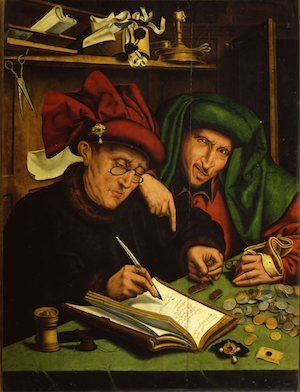
Painting: Two friends compare their investments.

Update: 5 March 2019 – Unfortunately the interactive tool from Broker Compare – that’s discussed below – is no longer supported by that company, and thus is no longer available on Monevator. The good news is our comparison table is still there to guide you through the broker maze!

Working out the best online broker or platform 1 to use in your investing can be frustrating.

Just when you have got your head around shares versus funds, corporate bonds versus James Bond, and you’re finally ready to start investing, you discover dozens of different brokers to choose from.

All have their own similar-but-different fee structures.

We have long kept track of the different broker platforms and what they charge via our fee comparison table.

But comparing the charges levied by say Hargreaves Lansdown with those of Interactive Investor can be fiddly work.

Details matter. Some brokers charge lower fees for trading but sting you with high withdrawals fees. Others offer cheap trading, but make additional annual charges for each different kind of account you open with them – once for an ISA and again for a SIPP. There may be entry and exit fees, too.

You also need to compare fixed annual platform fees – for instance £15 a quarter – with the alternative method of levying a percentage fee – say 0.25% year – on your investment pot. Which is more cost effective for you?

What’s more, the winner of this equation will probably change as your nest egg grows! You’ll need to run the numbers every few years to keep your costs as low as possible.

Get tooled up to compare investing platforms

If you find all this fun then you’re in the right place. We’re investing nutters around here.

But most people frankly do not.

Out in the wider world, people use interactive tools to compare things like insurance products and energy bills.

Well, that is now possible with investing platforms, too.

We’re hosting an interactive comparison tool created by our partners at Broker Compare. We hope it will help casual investors get their money onto a suitable investment platform with a lot less hassle.

In fact anyone who wants to hone in fast on the best potential brokers will find it a quick way to generate a shortlist of candidates.

True, if you want to work out precisely what you’ll pay – in your specific situation – you’ll always need to do the sums for yourself.

There are just so many quirks out there, and any tool needs to make a few assumptions. Only you know exactly how you plan to invest and why.

But for many people, getting a good idea of the best platform to use quickly is the most important thing.

They’d rather know approximately what they’re going to be charged than laboriously figure out the exact costs from a dozen or more competitors.

Compare the brokers and save hundreds of pounds

Monevator regulars love to debate the minutia of different platforms with all the passionate enthusiasm of trainspotters arguing about the best non-standard railway gauges found in the wilder mountainous regions of Europe.

And long may that continue. (You’re among friends here.)

But the average person has little idea of their broker’s fees – or how what they’re paying compares to the competition.

For these people, five minutes with a comparison tool could be a quick way to save hundreds or thousands of pounds.

So what are you waiting for?

  • Try out the interactive broker comparison tool. [No longer available]

Note that just as with the price comparison websites we all use to compare energy bills or mortgages, Monevator may receive a payment from a broker that you visit or sign-up with via the table or tool. This does not affect the fees you pay – it’s made by the company to us for introducing you to their business.

Happy hunting – and let’s save some money!

  1. We tend to use the words ‘broker’ and ‘platform’ interchangeably. A broker is a stock broker – a person or company who trades and holds investments on your behalf. The platform is their website that lets you see and adjust your investments.[↩]
{ 34 comments }

How to stick to your saving goals

Much is written about how to save: “You there, you reckless spendthrift, come here and read my secret formula that will turn you into a prudent accumulator of wealth.”

Far less time is devoted to the difficulties of staying the course.

What are the techniques that will enable you to stick to your savings goals through the long days ahead? The times when your entire being just screams out for a foam-plumed latte with an extra fancy shot? Or those new shoes? Or that shiny, new car? How do you deal with the urge to splurge?

You need a defense-mechanism, my friend (and I’m looking in the mirror here).

Two tactics make the difference for me:

  1. The long-term goal
  2. My monthly savings target

The long-term goal

Knowing where I’m going helps keep my eyes fixed on the distant horizon. When I can imagine how wonderful journey’s end will be, I don’t resent every heavy plod that carries me one step closer.

My initial goal was an emergency fund. Then it became paying off the mortgage double-quick.

Other popular goals include:

  • A comfortable retirement
  • Income supplement
  • Property purchase
  • The kids’ education

Without my goal I’d have nothing to fight for. No ultimate dream that makes today’s sacrifice worthwhile.

But it’s important that dream is defined. That it’s a concrete number I can hit. Vague notions of ‘financial security’ are too woolly and abstract to sustain a long-term commitment. If the goal isn’t defined then you can’t draw psychic sustenance from beating your numbers.

Many are the days that I go into work and steel myself with the thought that the trials ahead will bring me a step closer to my endgame, provided I stick to my saving goals.

Note: Choosing too many savings goals is as fatal as failing to define any. When the enormity of the task dwarves your resources, then defeatism and failure will surely follow.

Savings targets

Stay on target

Defining your goal means setting a target. My long-term goal – financial independence and early retirement – was initially a large and distant one. A big problem can only be beaten if you break it up into many smaller problems that can be picked off one-by-one.

Creating the opportunity to win a string of handsome victories is critical to building morale, momentum, and ultimate success.

Set yourself:

  1. A yearly target
  2. A monthly target

If I can save (and therefore invest) X every month and Y every year then I’ll hit my target in W years.

Targets may have a bad rap in the NHS, but I’d never stay the course without them.

Knowing I have to hit my monthly target electrifies every spending decision I make. Every decision now has a purpose:

  • If I don’t splash out then I’ve made progress towards my goal.
  • If I do, it’s because I really want or need the thing I’ve bought.

Crucially, the target makes me think things through. I no longer make thoughtless impulse purchases that amount to money down the pan. (Well, not often anyway).

Budget control

One tool that helps me stick to saving goals is my Budget_Control spreadsheet.

It’s very simple. The spreadsheet:

Adds up income, subtracts spending, and shows what’s left.

It also sets predefined monthly limits for spending in cash and on credit cards. Knowing what those limits are – and checking how I’m doing every week using online accounts – enables me to ease off the spending throttle when I’m having a bad month.

I use monthly direct debits to siphon off cash into savings accounts and to a regular investment scheme. The Budget Control sheet enables me to watch with pleasure as that amount grows in the ‘saved’ row.

As is often noted, you soon learn to live within your new means when cash is hived off automatically. Human inertia can work in your favour!

How to use the Budget Control spreadsheet: You can download the spreadsheet via the link above. The numbers already in the sheet refer to the spending targets set for credit cards and cash. Choose your own. The cash category covers ATM withdrawals, BACS transfers or debit card payments. Most of my spending is on cashback credit cards (paid off in full every month), so most outgoings are tracked by knowing these numbers. I’m not one for painstakingly totting up every till receipt. Regular bills are paid on direct debit.

Any spare money (the surplus category in the spreadsheet) also gets saved and ultimately invested. This is a movable feast that depends on how successfully I’ve fought spending on cash and credit cards that month.

The tension between trying to stay within the spending limits and the desire to generate a savings surplus creates the drive to stick to the plan.

Tracking my saving and spending also enables me to set realistic saving goals that are within my means. Progress relies on those handsome victories referred to earlier. Constant defeat would soon stall the project.

Don’t forget too that target-adjustment will probably be required along the way as the rising tide of inflation laps at all our saving sandcastles.

Take it steady,

The Accumulator

{ 14 comments }