≡ Menu

Weekend reading: House price affordability

Weekend reading

This week’s best post from elsewhere, plus more good links from around the Web.

Anyone who read my post on house prices predictions may have sensed my enduring frustration with the London property market.

If you thought cockroaches were hard to kill, you should try stamping out house price inflation in desirable streets in Zone 2.

London prices will always be high, absent a dirty bomb. The question is are they justifiably tear-jerkingly elevated, or are they pricey even for loaded Londoners?

To investigate, I was all set to produce some pretty graphs as a follow-up. But then I noticed The Finance Blog has sprung back into life and done it for me.

I’m all about the 80/20 rule of time management, so my Post of the Week comes from the Finance blog!

Here’s its crunching of the current house-price to earnings ratio:

The bounce before the bottom?

Perhaps its wishful thinking, but to me the London ratio looks like a trend reverting to mean, interrupted by emergency interest rates in March 2009.

Alternatively, perhaps the recovery in equity markets resurrected London house prices by reflating bankers’ bonuses? I say that because the North has only flat-lined, despite the deluge of cheap money (for those who can access it).

The Finance blog also has useful graphs on affordability, and on the percentage of FTB pay that goes on a mortgage. Property addicts should go check it out.

[continue reading…]

{ 1 comment }

House price predictions 2011

House prices over the year

I thought I’d round up a bunch of house price predictions for 2011, like I did last year.

Well, obviously last year the predictions were for 2010, not 2011. They ranged from the bearish -10% of Capital Economics to broker John Charcol’s indecisive and unfeasibly bullish 4-9% rise.

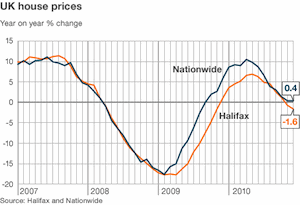
As it turned out, UK house prices fell 1.6% over 2010, according to the Halifax House Price index.

The decline left the ‘average’ UK house 18.5% cheaper at £162,435, compared to £199,766 at the 2007 peak. Quite a drop – and those are in nominal terms, too. Adjusting for inflation, the real decline will be more like 25%. 1.

The entirely honorary prize for the most accurate prediction for 2010 goes to upscale estate agents Savills, which predicted a 3% decline, easily beating the rest. Who said you couldn’t trust an estate agent?

Down your way?

Of course, you don’t need me to tell you that the ‘average’ UK house is a phantasm at the end of a cul-de-sac off the Watford Gap, and that local prices are all over the place.

Conwy in Wales, for instance, saw prices rise by 13% in 2010. In Aberdeenshire prices remain 46% ahead over five years, compared to just 1% higher for the UK as a whole.

The Halifax figures are less reliable than they once were, too, due to the mortgage drought. Here in London, many expensive homes are now purchased mortgage-free, and for the past 18 months they’ve been largely bought by upscale overseas buyers flush with a valuable currency.

That’s pushed prices in the top postcodes to all-time highs. But due to it only recording properties bought with its mortgages, you won’t find this recorded in Halifax’s index, which still has London prices well down on 2007.

Nevertheless, I like to follow the Halifax index because it’s the longest running data set. The trends all tend to converge over time, anyway.

House prices in 2011

Without further ado, here’s what the pundits predict for 2011:

Prediction Source
Jonathan Davis (HousePriceCrash.co.uk) -10% BBC News
Capital Economics -10% BBC News
Halifax -7% The Guardian
Savills -3% Savills PR
Hometrack -2% The Telegraph
Royal Institute of Chartered Surveyors -2% BBC News
Centre for Economics and Business Research 0% Daily Mail
Nationwide 0% This is Money
John Charcol (Broker) 2% BBC News

All predictions are for movement in the UK average national house price. The ‘source’ column links to where the prediction was cited. No predictions are more than a month old.

In some cases, these are summaries of more nuanced views – or more dubiously specific ones, depending on your perspective.

The Council of Mortgage Lenders, for example, offers a very detailed rationale for its forecast, which I couldn’t really summarize. Then again, its members aren’t doing much lending, so I guess it has a lot of time on its hands!

I feel prices should be going lower, but I have to be wary of my London bias. Truth is I am surprised to see prices down so much across the rest of the country. Affordability has improved in the provinces, too.

Another 10% off and I’d start wondering if it was time to load up on housebuilding shares. As I’ve written several times, I don’t think the spending cuts will be half as painful for working people as is popularly supposed, and my prediction last year that Britain had recovered is now evident on the ground.

Interest rates are still low, too, and given the way they look set to hand out big bonuses, the banks may have the money to increase the flow of mortgages.

On the other hand, my prediction of a 5% advance in prices in 2010 was well off the mark, especially as while I predicted any surprise would be to the downside, I said it would be probably be due to a shock interest rate rise. Oops!

Also, property still looks expensive by several measures. I’ll recap these ways of trying to value houses in a future post, so please do subscribe.

Where do you think UK house prices will end the year? Tell us below, with a link if it’s not your prediction. Maybe I’ll give a prize if we’re all here in 2011!

  1. Sorry, it’s late and I haven’t worked out the accurate deflated figure. 25% is a guess![]
{ 10 comments }

The UK small cap ETF that’s too big for its boots

I was one happy passive investor when Credit Suisse launched their UK small cap ETF (ticker CUKS) on the London Stock Exchange last September.

It was the first UK small cap tracker: plugging a gap in the market that denied passive investors an important route to diversification, and the potential of enhanced returns. Or so it seemed.

Sadly, now I’ve looked into CUKS, it’s not my idea of what a UK small cap ETF should be. It’s actually closer to a pricey mid cap tracker, in my opinion.

It’s the law

One of the unbreakable rules of tracker-buying is to always check the index; making sure the fund you’re eyeballing adds the exposure your portfolio needs.

In the strange case of CUKS, the benchmark is the MSCI UK Small Cap index. But what’s actually in this?

It’s worth exploring, because there’s no commonly agreed size limit for a small cap company. You can end up with some fairly big beasts falling into your ‘small cap’ index, especially if your net’s mesh isn’t very fine.

And rival UK small cap indices have very different ideas about how close to the bottom of the market they’ll go when trawling for small caps:

  • The FTSE SmallCap Index captures roughly 2% of companies in the 98th and 99th percentiles of the UK market.
  • The RBS Hoare Govett Smaller Companies Index captures roughly the bottom 10% of the UK market.
  • The MSCI UK Small Cap Index captures roughly the bottom 14% of the UK market up to the 99th percentile.

The upshot is the MSCI index is doing a lot of fishing in the FTSE 250 layer of the market. What it defines as small cap, many UK investors think of as mid cap. And that could mean some major overlap if you’re already holding FTSE 250 funds.

CUKS mostly fishes for firms in the depths of the mid cap FTSE 250

What’s more, CUKS has a TER of 0.58% – more than double the 0.27% TER of HSBC’s mid cap FTSE 250 index fund (which can be bought sans trading fees).

So the key question is: how much small cap coverage am I getting from CUKS that I can’t get from a FTSE 250 tracker?

In my opinion, not enough.

X-Ray vision

Morningstar’s Instant X-Ray tool enables you to probe funds for overlap.

I compared CUKS with HSBC’s FTSE 250 index fund. Tellingly, Morningstar classifies both funds as mid cap. The detailed analysis of stocks held in the funds also revealed the following market cap breakdown:

Large cap Mid cap Small cap
CUKS TER 0.58% 0.92% 57.29% 41.79%
HSBC FTSE 250 TER 0.27% 4.9% 56.50% 38.59%

Morningstar Instant X-Ray analysis, January 8, 2011.

According to those stats, buying CUKS would gain me only a few extra percentage points of small cap stocks in my portfolio over a regular FTSE 250 index fund.

Yet I’d be paying more than double the TER plus trading fees for the privilege.

You can check the constituents of CUKS on Credit Suisse’s website. Go to Products > Equity > UK > CS ETF (IE) on MSCI UK Small Cap > Portfolio Structure. Most holdings are FTSE 250 firms. Fewer than a quarter are from the FTSE SmallCap or FTSE AIM All-Share, at the time of writing.

It looks like a poor deal in my book. I am prepared to pay a higher TER for a fund that tracks an index like the FTSE SmallCap. But I’m not paying well over the odds for a mid cap ETF with a small cap accent!

Take it steady,

The Accumulator

{ 8 comments }

Weekend reading: Why hold gold?

Weekend reading

This week’s best post, then some other good reads from the Web.

There is never a time when the inflation question doesn’t hang in the air like a speech bubble above the head of Charlie Brown.

But you’d have to go back to the 1980s to find a time when it was such a consistent theme in economic and business discussion, and to the 1970s to find it being talked about so regularly around the dinner table 1.

With deflation run out of town via quantitative easing, fears of inflation hold the floor. And this particular combination – inflation plus indebted governments spending money they don’t have – has been the perfect backdrop for the latest 18-month run in the decade-long gold rally.

As the post of the week, from Simple Living in Suffolk, explains:

That’s one of the beauties of gold – it has value because of what it is, not what it represents or who issued it. Time and bad government policy gnaw at the value of that twenty pound note over time, but like the Fallen, time does not age gold, nor does it turn to rust.

It is one of the last atavistic race-memories of a time when the value of currency was inherent, not symbolic, a throwback to barbarous times, of swapping animals and goods and even human beings.

The author, ermine, thinks he’s got his gold allocation wrong, and since he wants to someday barter it for ethanol, dog food, and a few feral goats come the meltdown, I’m inclined to agree.

No dusty barter-town trading post is going to swap your gold ETF for a slave girl and half a dozen kumquats in the post-ATM era. It will be shiny metal teeth and wedding rings all the way.

Of course, while I love ermine’s historical and personal perspectives, I’m not half so gloomy about the outlook myself. Provided I see some daylight in any 48 hour period, I see gold for the bauble it is.

I also happen to believe that – contrary to what the gold bugs believe – it’s the pointlessness of gold that has allowed it to become so valuable, not its incredible virtues.

When gold really was important, the US government banned private ownership of it. Now Tesco will trade your gold. Every little helps (the gold price).

Then again, I’m only human and maybe a little barbarous at heart, so I can’t help wishing I owned a Krugerrand or two. I also note that the Chinese and the Indians are still mad for the stuff.

There’s more of them than us, which is the best reason to buy gold of all.

The best of the rest of the blogs

From the mainstream media

  • Phds: Not worth the money and effort Vs Masters – The Economist
  • Young Americans: Fatter waists, thinner prospects – The Economist
  • Why the government can’t stop bank bonuses – Peston/BBC
  • Record 0% credit card terms [but watch fees] FT
  • Merryn tots up her usual bearish litany – FT
  • John Lee’s end-of-year portfolio results – FT
  • Self-assessment tax deadlines for 2011 – Telegraph
  • More UK tax scrutiny to come – Independent
  • The case for Russia and Eastern Europe – Independent
  • 5 green ways to save money – Independent
  • Self-build a home for £150,000 – Guardian

Like these links? Subscribe to get them every weekend.

  1. Not least because families don’t eat around the dinner table anymore![]
{ 9 comments }