≡ Menu

Weekend reading: What about the workers?

Weekend reading

I have been struggling for months to finish a post about wealth inequality. I’m not sure what it means that the rich are getting so much richer when most people are getting poorer in real-terms – or what, if anything, should be done about it. But I’m sure there’s something important going on.

It’s more acute in the US. According to The New York Times (from March):

In 2010, as the nation continued to recover from the recession, a dizzying 93 percent of the additional income created in the country that year, compared to 2009 — $288 billion — went to the top 1 percent of taxpayers, those with at least $352,000 in income. That delivered an average single-year pay increase of 11.6 percent to each of these households.

Still more astonishing was the extent to which the super rich got rich faster than the merely rich

In 2010, 37 percent of these additional earnings went to just the top 0.01 percent, a teaspoon-size collection of about 15,000 households with average incomes of $23.8 million. These fortunate few saw their incomes rise by 21.5 percent.

The bottom 99 percent received a microscopic $80 increase in pay per person in 2010, after adjusting for inflation. The top 1 percent, whose average income is $1,019,089, had an 11.6 percent increase in income.

These are devastating trends, but what to say about them? It’s hard to bring anything but more noise to the debate.

I extracted the angrier elements of my draft for my article about overpaid bankers, where ranting felt justified. But when it comes the wider system – where wealth accumulates not just through capital but also increasingly through network effects, enabled by technology, and where I can’t help feeling we’re at the limits of personal taxation already – it’s not clear to me what’s the solution.

Smarter people than me are also struggling with the issue.

A new article in the FT by Edward and Robert Skidelsky (the latter being nobody’s idea of a bleeding heart socialist) is one of the more thought provoking I’ve read, because it’s not so concerned with those at the top – where envy must always be suspected of adding fuel to any outraged debate – but with the millions of under- or unemployed.

The Skidelskys argue that too many people are working for too long in order to earn too much to buy stuff they don’t need. This isn’t just diminishing their own lives, they claim, but also preventing others from having an acceptable standard of living by reducing the jobs available. (That’s debatable, in my opinion).

Their solution:

We must convince ourselves that there is something called the good life, and that money is simply a means to it. To say that my purpose in life is to make more and more money is as insane as saying my purpose in eating is to get fatter and fatter. But second, there are measures we can take collectively to nudge us off the consumption treadmill.

It’s interesting that eminent economists are now reaching similar conclusions to the legions of personal finance bloggers who have arrived in recent years.

However I don’t think this will be an answer to wealth inequality.

Those who keep playing the game adroitly – and I hope to be a modest member of that club – will continue to gather wealth around them. More free time for the masses to play with their kids in the shadows of the castles of the super-rich doesn’t seem a very sustainable solution.

[continue reading…]

{ 22 comments }

The Slow and Steady passive portfolio update: Q2 2012

The portfolio is keeping its head just above water

The Euro crisis is back and this time everyone is sick to death of it. The reports I hear in the media are now intoned by glazed commentators as if they were lobotomy victims who can no longer feel the pain:

“Another day, another crisis summit. Time is running out to save the Euro, but not as fast as it’s running out for our interest in this interminable mess.”

Similarly, I scarcely felt a thing as I dialed into our model passive investing portfolio knowing that the previous quarter’s mini-surge had surely foundered on the stony reality of recent events:

  • Spain and Cyprus confirmed their entry into the Eurozone’s bailout club.
  • Double-dip recession ensnared the UK.
  • The US recovery turned to treacle.
  • The Emerging Markets slowed down in tandem with the West.
  • Japan struggled with a toxic combination of a strong currency and power cost hikes as its nuclear power stations sat idle.

Against that, petrol and commodity prices have fallen, and last week’s Eurozone agreement to directly bail out banks has helped our portfolio to keeps its nose just above water: we’re up 1.25% overall and 3.26% on the year to date.

Still, it’s obvious we’re not going anywhere while Europe lurches around like a wounded Tarantino extra who’s milking his moment.

Slow & Steady portfolio Q2 2012 update

The Slow and Steady portfolio is Monevator’s model passive portfolio. It was set up at the start of 2011 with £3,000. An extra £750 is invested every quarter into a diversified set of index funds, heavily tilted towards equities. You can read the origin story and catch up on all the previous passive portfolio posts here.

We console ourselves that this crisis must end some day, and that for now we’re able to accumulate equities seemingly fairly cheaply, assuming the Euro mess is resolved.

Continuing to invest in bad times and in battered markets means that our equity purchases are like picking up little battery packs. They don’t do much for us now, but they do store the energy of future growth. Energy that can be released when times turn better. We just have no idea how long that might take.

A gilty pleasure

In the meantime, the bucks and heaves of the market continue to show how the discipline of strategic asset allocation helps prevent us from relying on dodgy rune reading for our investment picks.

For instance, I often hear from people how the place to be is Emerging Markets and that we’ve no business being in government bonds.

Yet since the launch of the Slow & Steady portfolio 18-months ago, Emerging Markets has been our worst performing asset. It’s down -4.31%, which is comfortably worse than our European index fund’s -2.23% decline.

And while American equity is our portfolio’s lead performer, up 11.94%, the intermediate gilt fund is our second biggest hitter at 9.06%. Gilts were also the portfolio’s only bright spot again last quarter, up 3.27%, whereas every equity fund headed south.

Not bad for a reputed ‘the only way is down’ asset class, and pretty much the complete opposite of what many were predicting 18-months ago. It’s a point worth dwelling on simply as an illustration of the reasons why I’d rather base my portfolio on sound investment theory than the noisy proclamations of supposed experts.

New purchases

Every quarter we offer up another £750 to the financial gods.

UK equity

HSBC FTSE All Share Index – TER 0.27%
Fund identifier: GB0000438233

New purchase: £145.40
Buy 42.6779 units @ 340.7p

Target allocation: 19%

Developed World ex UK equities

Split between four funds covering North America, Europe, the developed Pacific and Japan.

Target allocation (across the following four funds): 49%

North American equities

HSBC American Index – TER 0.28%
Fund identifier: GB0000470418

New purchase: £179.81
Buy 87.6705 units @ 205.1p

Target allocation: 26.5%

European equities excluding UK

HSBC European Index – TER 0.31%
Fund identifier: GB0000469071

New purchase: £145.36
Buy 35.6452 units @ 407.8

Target allocation: 12.5%

Japanese equities

HSBC Japan Index – TER 0.29%
Fund identifier: GB0000150374

New purchase: £47.92
Buy 80.3664 units @ 59.63p

Target allocation: 5%

Pacific equities excluding Japan

HSBC Pacific Index – TER 0.37%
Fund identifier: GB0000150713

New purchase: £45.22
Buy 20.5277 units @ 220.3p

Target allocation: 5%

Emerging market equities

Legal & General Global Emerging Markets Index Fund – TER 0.99%
Fund identifier: GB00B4MBFN60

New purchase: £115.14
Buy 268.0051 units @ 42.96p

Target allocation: 10%

UK Gilts

L&G All Stocks Gilt Index Trust: TER 0.23%
Fund identifier: GB0002051406

New purchase: £71.14
Buy 38.6857 units @ 183.9p

Target allocation: 22%

Total cost = £749.99

Cash = 1p

Total cash = 6p

Trading cost = £0

If you’re wondering where to place your portfolio in the wake of Interactive Investor’s fee hike then check out our no-fee broker suggestions.

A reminder on rebalancing: This portfolio is rebalanced to target allocations every quarter, mostly using new contributions. It’s no problem to do as our vanilla index funds don’t incur trading costs.

Take it steady,

The Accumulator

{ 13 comments }
Monevator Private Investor Roundup

I’m very pleased to introduce what I hope will become a quarterly feature from RIT, a late thirty-something DIY investor who does double duty as UK PF blogging’s finest number cruncher on his website, Retirement Investing Today.

Welcome to the first ever Monevator Private Investor Market Roundup. Our aim here is to provide you with a snapshot of trends in many of the most important asset classes that a private investor might own.

If this roundup does its job properly, it will highlight some promising areas you can investigate further, using either the data sources cited or by other means.

If you discover something of interest or have any other feedback, please do report it in the comments below to enable all Monevator readers to benefit and learn. That way the community here will continue to grow in knowledge together.

Important: Before we get started, I must point out that what follows is not a recommendation to buy or sell anything, and is for educational purposes only. I am just an Average Joe and I am certainly not a Financial Planner.

International equities

Our first stop is to look at stock market information for ten key countries 1.

The countries we’ve chosen to highlight are the ten biggest by gross domestic product (GDP). They also represent the countries that a reader following a typical asset allocation strategy will probably allocate funds towards.

For instance:

  • If you’re a passive indexer in the UK, you may hold a portion of your assets in the Vanguard FTSE UK Equity Income Index Fund. The UK is one of the ten countries we’ve chosen to follow.
  • A UK Investor might also hold an index fund like the Vanguard FTSE Developed World ex-UK Equity Index Fund, in order to gain exposure to international equities. This fund invests 56.6% in the United States, 9.2% in Japan, 3.8% in Germany, 4.3% in France, 1.1% in Italy, and 4.8% in Canada.
  • Like a bit of spice? Then you might have invested in the Vanguard Emerging Markets Stock Index Fund. Here you will be holding 18.3% of its value in China, 14.1% in Brazil, and 6.6% in Russia.

So between those three funds alone, all ten countries are represented.

Here’s our first snapshot of the state-of-play with each country:

(Click to enlarge)

The prices shown in the table are the FTSE Global Equity Index Series for each respective country, taken on the first possible day of each quarter. 2 The prices in the table are all in US Dollars, which enables like-for-like comparisons across the different countries without having to worry about exchange rates between them.

The Price to Earnings Ratio (P/E Ratio) and Dividend Yield for each country is as published by the Financial Times and sourced from Thomson Reuters. Note that these values relate only to a sample of stocks, albeit covering at least 75% of each country’s market capitalisation.

Let’s review the data for interesting snippets:

  • Best performer: Price wise the United States is the best performer quarter-on-quarter and year-on-year, doing relatively well by falling only 6.7% and 2.1% respectively.
  • Worst performer: On the quarter-on-quarter perspective, Brazil is down a thumping 25.1%. But the year-on-year worst performer is Italy, which is down an incredible 42.3%.
  • P/E rating: When it comes to P/E ratios, the UK has best held on to its rating multiple, with a fall of 6.6%. Over a year the best performer is Italy, which has seen its P/E rating increase by 1.8%. On the downside, the quarterly and yearly losers are Japan and Russia, which have been de-rated by 22.3% and 38.8% respectively.
  • Yields: For private investors, dividends matter. Quarter-on-quarter Russia’s dividend yield has risen by 51.9%. Year-on-year it’s up a massive 105%.

With respect to P/E ratios, for the purposes of this roundup I state the ‘best’ country performer as the one with the biggest increase in P/E – or the smallest loss, if all go down in the period – and vice versa for the biggest loser.

I was in two minds about this protocol. Depending on who you are, a falling P/E ratio could be seen as a good thing, as it may mean your purchases are getting cheaper. (Value investing, anyone?) If you would like to know more about markets and P/E ratios, have a look at this post on valuing the market.

Falling prices also mean a particular market is cheaper, but that may be scant consolation if you already hold it and you’re no longer a buyer.

In fact, when I first saw Italy’s year-on-year price decline of 42.3%, I couldn’t quite believe the extent of the crash, and it encouraged me to go off and do some more research, just as I hope you will do.

The benchmark Italian Index is the FTSE MIB, which consists of 40 stocks. This Index was 20,516 on the 1 July 2011. By 28 June 2012 it had fallen to 13,421 for a fall of 35%. 3

Then there’s currency to consider. One year ago a Euro would buy you $1.45. Today a Euro only gets you $1.27, a fall of 12%.

Combine the two and you get a FTSE MIB fall priced in US dollars of 42.7%, which certainly validates the Italian fall I present today.

Longer term equity trends

To enable us to see how our ten countries are performing price wise over the longer term, I’d now like to introduce what I call the Country Real Share Price.

This takes the FTSE Global Equity Price for each country, adjusts it for inflation, and resets all of the respective indices to 100 at the start of 2008.

Here’s how the countries have performed over the four and half years since then, in inflation-adjusted terms:

(Click to enlarge)

As you can see from the graph above, when calculated in real inflation-adjusted terms, not one of the country’s markets has yet gone above its January 2008 price.

It’s the US that’s closest to getting back to that starting point. This amazes me, given all the bad news we’ve had out of America since its sub-prime crash ignited the global recession. It shows that while countries like China are the kings of the world when it comes to GDP growth, their companies are not necessarily the ones that are creating value for shareholders.

It also demonstrates that investment performance has very little to do with a country’s economic performance, at least in the short-run.

I’d suggest this is due to many factors, including the globalised nature of business today and also the perceived fair value of each country’s stock market over the period you’re measuring. China may have been expensive in 2008 and the US relatively cheap then, for instance.

Spotlight on UK and US equities

I couldn’t talk about share prices without looking at the cyclically-adjusted PE ratio (aka PE10 or CAPE). If you’re unfamiliar with these terms, you can read what the cyclically-adjusted PE ratio is all about elsewhere on Monevator.

Below I show charts that detail the CAPE 4, the P/E, and the real, inflation-adjusted prices for the FTSE 100 5 and the S&P 500 6.

US CAPE (Click to enlarge)

UK/FTSE 100 CAPE (Click to enlarge)

Takeaways:

  • Today the S&P 500 CAPE is 21.1, against a long run average of 16.4 since 1881. This could suggest the market is currently overvalued by 29%.
  • The FTSE 100 CAPE is 12.0, against an average of 19.3 since 1993. This could suggest that the FTSE 100 is undervalued by 38%.

I personally use the CAPE as a valuation metric for each of the respective share markets. Some other investors are  cynical about the usefulness of doing so.

If you’d like to know more, you may want to have a look on my blog, as I only have limited space here on Monevator.

House prices

A house is probably the largest single purchase that most Monevator readers will ever make. It’s therefore worth looking at what is happening to prices.

In the roundup I have chosen to calculate the average of the Nationwide and Halifax house price indices, as follows:

(Click to enlarge)

You can see that quarter-on-quarter we are up 1.9%, but year-on-year we are down 0.5%.

Due to the timing of when the Halifax house price index is published, my analysis could not include June, unfortunately.

I can say though that if you don’t already own a house, the month of June looks good so far – the Nationwide is reporting a £284 fall in prices to £165,738.

The next house price chart shows a longer term view of this Nationwide-Halifax average. I also adjust for the effects of inflation, to show a true historically-leveled view:

(Click to enlarge)

Real house prices are still falling, with prices now back to early 2003 levels.

Commodities

Few private investors trade commodities directly. However commodity prices will still affect you, and may also impact your investments.

A couple of examples:

  • When the WTI Spot Crude price rises, the price of the petrol you put in your car will likely rise, too. But if you also own BP shares, you could at least enjoy an increase in its share price as some consolation.
  • Commodity prices play into the expense of building a house. For instance, construction costs will certainly rise if the price of copper goes up. You might also own shares in the housebuilder Barratt. If it’s unable to pass on the increased price of copper to its customers, its share could fall.

With that in mind, let’s have a look at how commodity prices are doing. I’ve selected five commodities to regularly review. They were chosen based on them being the top five constituents of the ETF Securities All Commodities ETF, which aims to track the Dow Jones-UBS Commodity Index. 7

(Click to enlarge)

Quarter-on-quarter the top performer is copper, which is up 11.4%. Year-on-tear the honour of best performer goes to gold, which is up 5%.

In contrast, the worst yearly performer is natural gas. It’s down 41.3%.

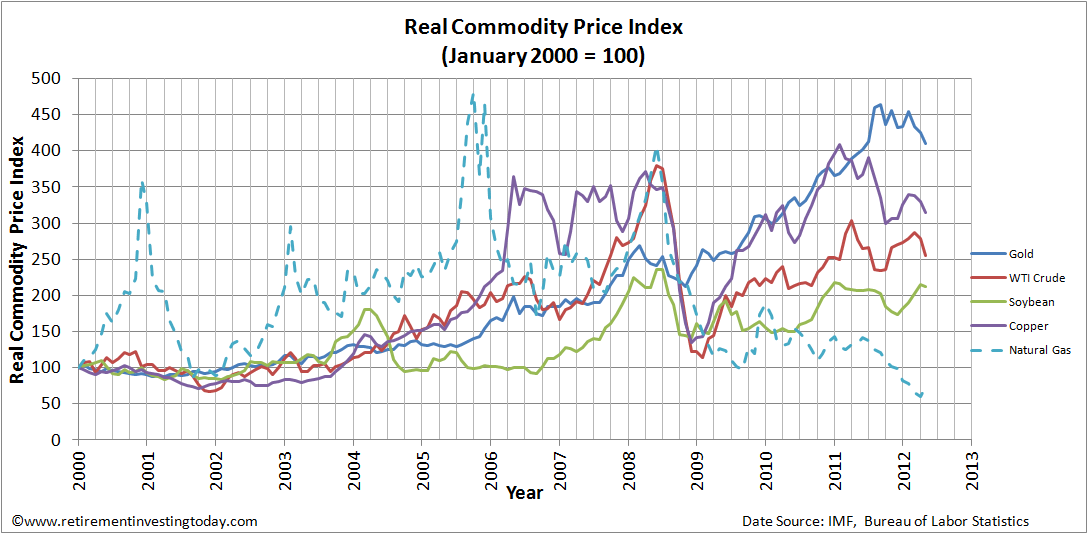
Real commodity price trends

Much like I did with equities, I have also created a Real Commodity Price Index that we can track over the long term.

This looks at commodities priced in US dollars, is corrected for inflation so we can see real price changes, and resets the basket of five commodities to the start of 2000.

(Click to enlarge)

You can see that all the commodities apart from natural gas are well above the 100 Index starting point. Gold is the star performer, having increased more than four-fold since 2000.

I should point out a common peril to anyone considering investing in or trading commodities. If you were you to choose oil as your poison, it’s extremely unlikely that you would buy a tanker loaded with oil, or even a 205 litre drum of the stuff. Instead, you would probably buy an Exchange Traded Commodity (ETC), which will likely consist of futures contracts.

It’s therefore important to understand what futures are as well as terms like backwardation and contango before you think about buying anything to do with commodities. The only exceptions I can think of are physical gold, silver, platinum, and palladium.

Wrap Up

So that’s the first Monevator Private Investors Market Roundup. Did I hold your attention for 2,000 words? I would love to know via the comments below.

Finally, as I say on my own blog, please always Do Your Own Research.

For more of RIT’s analysis of stock markets, house prices, interest rates, and much more, visit his website at Retirement Investing Today.

  1. Country equity data was taken as of the first possible working day of each month except for July 2012, which was taken on the 28 June 2012.[]
  2. Published by the Financial Times and sourced from FTSE International Limited.[]
  3. Note though that on the 29 June 2012, after this data set was compiled, the MIB did move sharply higher to 14,274.[]
  4. Latest prices for the two CAPEs presented are the 29 June 2012 market closes.[]
  5. UK CAPE uses CPI with June and July 2012 estimated.[]
  6. US CPI data for June and July 2012 is estimated.[]
  7. The data itself comes from the International Monetary Fund.[]
{ 12 comments }
Weekend reading

Some good reads from around the web.

When people discover my interest in investing, they usually express mock  horror, and ask me why the past few years of turmoil hasn’t caused me to find a new hobby and/or stash my cash under the mattress.

Partly because the last few years has been a great time to make money in the stock market, I reply.

That usually gives them pause.

Am I special? Not really. According to Morningstar, an investor in the FTSE All-Share index reinvesting dividends via this HSBC tracker would have enjoyed an annualised return of 13% over the past three years. That’s good enough to turn £1,000 into £1,444.

Of course, not all periods in the stock market are so fruitful. Over five years the annual return from the tracker is a big fat zero. Over ten years it improves to 5.47% per year, thanks to dividends.

But the past 3-4 years are definitely not a reason for concern.

What’s more, whereas some friends are horrified when they learn I’ve been regularly putting money into a market they believe has gone nowhere for a decade, I’m more horrified that they’re haven’t.

What is an average year, anyway?

Of course, I understand why they’re worried about my sanity. The financial news and the mainstream media are synonymous nowadays, with even the humblest BBC update not shy of mentioning a sharp fall in the indices.

I hear Robert Peston is so aggrieved, he’ll no longer get out of bed for less than 5% off the Dow.

Yet the volatility of recent years is not unusual – a point well made by Canadian Couch Potato this week:

You may be shocked to learn that a portfolio with equal amounts of Canadian, US and international stocks would have posted returns between 6% and 11% exactly five times in the last 42 years.

Think about that: in any given year, the chance that stock returns will be within this “normal” range was less than one in eight.

Now let’s consider the probability of more “abnormal” outcomes. If the average long-term return for stocks is 8.5%, let’s look at years where returns were a full 10 percentage points more or less than that.

It turns out that there were 11 years with losses of at least –1.5%, and 17 others with gains of at least 18.5%. In other words, the probability of a significant loss or a huge gain was 67%, or two years out of every three.

I don’t have the UK statistics to hand, but I am certain they are very similar.

[continue reading…]

{ 16 comments }