



What caught my eye this week.
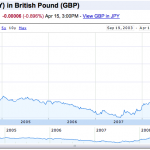
Despite all the noise about US mega-cap tech shares and the gloom around the moribund UK economy, London’s FTSE 100 index beat the hallowed US markets in 2025: 1

Source: Google Finance
These figures don’t even include dividends. Adding them in would favour the FTSE further, with its higher yield.
UK blue chips did better still when you factor in currency moves – the dollar has weakened a fair bit versus sterling over the past 12 months.
What a year for old-fashioned British stockpickers! It must have been like the 1980s all over again for the dwindling band of diehard punters who still debate Lloyds versus Tesco on trading boards such as ADVFN.
Better tell Sid
Good for them – it’s been a long time coming. The UK market had notably underperformed ever since that referendum. At times the rot has felt terminal.
We should note though that it’s only the largest UK companies that have seen a recovery so far.
Mid and small caps – which have borne the brunt of the UK market’s shrinkage in recent years, with scores of takeovers and delistings – are still floundering.
As a group, smaller companies are more sensitive to the domestic economy than are the globe-trotting FTSE big boys. Around 75% of FTSE 100 earnings are generated overseas. Hence the UK economy just isn’t major factor for them, beyond its influence on exchange and interest rates.
That said, investor perception of the UK economy does still affect how even large cap UK share prices do, because it influences, at least at the margin, the multiples of earnings or other metrics that investors will pay for UK-listed stocks. The ‘moron discount’ of recent years isn’t just a bond market feature.
Indeed while large cap UK shares have moved strongly up, I wouldn’t say that global investors are massively happier about the UK itself.
Things can only get better
Labour squandered a window where they might have put a lid on years of witless politics and told the world that Britain was back to business as usual.
Alas so far we seem to have traded chaos for incompetence.
Of course there were no quick fixes for what ails the UK, especially with Brexit now also slowly bleeding out GDP and tax revenues each year.
However Labour hasn’t done much on the slow fixes front either, except perhaps to steady the gilt market and to move a little closer to Europe.
No, I’d say that FTSE 100 stocks jumped in 2025 mostly because they were cheap.
Perhaps they were alighted upon by money looking to diversify away from the US, especially after the April tariff farrago? You’ll find no end of pundits opining so, though given the US markets still attracted plenty of money in 2025 I’m not convinced it’s a complete story.
Also, the cheapness of UK shares was hardly a secret that burst into the open last year.
As I’ve noted, UK shares de-rated after 2016. Overseas predators have been acquiring our firms for a song for years. I flagged the chance to profit from the Great British boot sale back in July 2024 and suggested more ways to profit again last summer.
TLDR: last year’s outperformance by the LSE was a long time in the making.
Loadsamoney
Not everything has worked out so far. As I said small caps have yet to participate – and yet they look the cheapest London-listed stocks of all.
Personally my portfolio was tilted towards the little guys and thus I didn’t do as well as I might have in 2025, despite my overall massive UK overweight. Maybe they’ll come good in 2026?
That’s the way of active investing. Luck and hope and perhaps a smidgeon of skill if you’re lucky/hopeful.
Elsewhere, Monevator’s preponderance of passive investors should have had yet another good year, especially with the currency moves. The seemingly unstoppable advance of global trackers might finally hit the buffers for a bit if pricey-looking US stocks ever run out of steam…but, well, everyone has been saying that for a decade.
Some kind of reckoning will very probably come due some day. It always has before. But our house view remains that nearly all investors will do best to stay globally diversified. Even if you do want to be a bit naughty and tweak your allocations in the face of a purported AI bubble or whatnot.
After all, the best-performing ‘proper’ share in 2025 – up 541% no less – calls Tokyo home. I owned precisely no shares of it in my naughty active portfolio. But perhaps your All-World index fund did?
You’ve never had it so good*
What will happen over the next 360-odd days?
Don’t ask me – or anyone else if you think you’ll get a bankable answer.
We can talk about general weather in the stock market – in the same way that we know that summer will be much sunnier than winter. But exactly how sunny or on what days the rain will fall are unknowable.
Similarly, investment return forecasts only begin to carry real weight on timescales of a decade or so.
The FTSE 100 did cross the 10,000 mark for the first time on the first trading day of the year, for what it’s worth. Which is nothing much, except that headline writers can’t wheel out the same headline twice!
Have a great weekend, and all the best with your investing and life in 2026.
*Here’s a link for anyone under-50 who doesn’t feel like they’ve never had it so good and wonders what I’m on about.
From Monevator
From the archive-ator: Three crucial tips for making New Year’s Resolutions stick – Monevator
News
Annual energy bills to fall by more than £100 in April as government removes policy costs – Sky
UK house prices unexpectedly softened in December – Nationwide
Workers hammered while pensioners benefit, says analysis – Sky
Why are young people leaving Britain to work abroad? – BBC
Plymouth led UK house price rises in 2025 – Guardian
Microwave does not make a room a flat, judge rules – BBC
The US ‘captured’ the Venezuelen president overnight – Sky

Japan’s birthrate falls to historic lows – Semafor
Products and services
Disclosure: Links to platforms may be affiliate links, where we may earn a commission. This article is not personal financial advice. When investing, your capital is at risk and you may get back less than invested. With commission-free brokers other fees may apply. See terms and fees. Past performance doesn’t guarantee future results.
The best current accounts for 2026 – Be Clever With Your Cash
Eleven expert tips for using Vinted – Which
Get up to £3,000 cashback when you open or switch to an Interactive Investor SIPP. Terms and fees apply, affiliate link – Interactive Investor
Should you regift an unwanted present? – Be Clever With Your Cash
Four mortgage and property predictions for 2026 – Which
Get up to £1,500 cashback when you transfer your cash and/or investments to Charles Stanley Direct through this affiliate link. Terms apply – Charles Stanley
UK investment platforms to cut fees ahead of stocks drive [Paywall] – FT
Homes with a sauna, in pictures – Guardian
Comment and opinion
One in a quadrillion – Fortunes & Frictions
Pray for beta, not alpha – Of Dollars and Data
Is it possible to invest ethically? – Money Changes Everything
UK pensions in 2026: what you need to know – This Is Money
Titanic inequality – A Wealth of Common Sense
What pushed this landlord into selling out of Central London [Paywall] – Telegraph
Getting a better answer to the longevity question – WSJ
Are you sure you want to leave the UK to avoid inheritance tax? [Paywall] – FT
Naughty corner: Active antics
The enshittifinancial crisis – Ed Zitron
“Why I have stopped blogging about my shares” – Maynard Paton
Is gold a hedge, a diversifier, or overpriced insurance? – Quantpedia
Can Bill Ackman’s mini-Berkshire work? – Old Rope Research
The case for Apple as an AI play – Sherwood
Kindle book bargains
How to Own the World by Andrew Craig – £0.99 on Kindle
Zero to One: Notes on Startups by Peter Thiel – £0.99 on Kindle
The Four-hour Work Week by Tim Ferriss – £0.99 on Kindle
How to Break Up With Fast Fashion by Lauren Bravo – £0.99 on Kindle
Or pick up one of the all-time great investing classics – Monevator shop
Environmental factors

Faxing Barry Blimp – Guardian
Ministers may cut clean tech mandate from new homes in England – Guardian
Meet five new species discovered in 2025 – NPR
How a community saved Mexico’s Galapagos… – Guardian
…and the rare birds making a comeback in the actual Galapagos – BBC
People who drink bottled water daily ingest 90,000 microplastic particles a year – Wired
Winter blooming in UK a visible sign of climate breakdown – Guardian
Robot overlord roundup
The shape of AI: jaggedness, bottlenecks, and salients – One Useful Thing
If this is really an AI bubble, let’s see more inflation – Sherwood
The office block where AI doomers gather to predict the apocalypse – Guardian
Humans should be ready to pull the plug on AI rights, says pioneer – Guardian
Track the latest AI news via Delta Hedge’s regularly updated thread – Monevator
Not at the dinner table
The NHS is at risk: how to save it – BBC
Brexit deepened the UK economy’s flaws and dulled its strengths [Paywall] – Economist
How the Greens plan to beat Reform at their own game – Guardian
Millions of Americans brace to start new year without healthcare – BBC
How did DOGE disrupt so much while saving so little? – New York Times
Identity mini-special
There are no pure cultures – Aeon
Number who say Britons must be born in UK is rising, study shows – Guardian
Why women on LinkedIn are masquerading as men – Washington Post via MSN
Abd el-Fattah citizenship row shows shift on questions of national identity – Guardian
Off our beat
When ‘Concordia’ returns to Great Britain – Genuine Impact
The liberation of living with less clutter – Bloomberg [h/t Abnormal Returns]
Remembering the Guinness scandal [Podcast] – A Long Time in Finance
The US must stop underestimating drone warfare – Wired
Why everybody loves Japan – Noahpinion
Random turn-of-year factoids mini-special
52 things I learned in 2025 – Kent Hendricks
52 things I learned in 2025 – Nancy Friedman
The original 52 things learned in 2025 – Tom Whitwell
52 ways to make your life easier in 2026 – Guardian
55 things learned in 2025 [Missed the memo?] – The Atlantic
And finally…
“Success was individual achievement; failure was a social problem.”
– Michael Lewis, The Big Short
Like these links? Subscribe to get them every Saturday. Note this article includes affiliate links, such as from Amazon and Interactive Investor.
- Graph below shows 12 months to 2 January 2026. Date ranges are a pain in Google these days, but I’m still fond of its clean look.[↩]




Although largely a passive investor I could never completely reconcile the wisdom to have a globally diversified equity portfolio with the fact that as a UK retiree I have liabilities in GBP. Coupled with the perception of an overvalued US market, I decided to have a strong home bias. Hence I set my equity allocation a few years back to 50:50 UK:global.
I’m allowing myself a brief moment of smugness, although fully aware this may not last.
Re the link ‘Workers hammered while pensioners benefit, says analysis’. According to the article, the workers on 50K a year being ‘hammered’ will be £505 worse off in 2031, while those lazy pensioners living it up on the state pension of £12K a year will be £306 better off. This is so shockingly unfair.
I was overweight to FTSE U.K. All Share Index, and feeling pretty happy about it, despite the small drag of the 250 and below compared to the 100.
But overall I am not optimistic, since the current lot will continue to damage the country and its economy with their heady mixture of supercilious incompetence and basic wrong-headedness until 2029.
Twenty odd years ago I transferred to a section 32, since then the original sum has grown 341%. If i had invested in the Ftse100 it would have grown 241% and if it had been possible to invest in vanguard global all share, then it would have grown by 400%. So, overall a happy outcome. Then, I thought, what would have been the outcome if I just invested in gold bullion back then and did nothing else -growth of 1360%. Still, at least I have avoided inflicting an IHT headache to my heirs!
HNY all! Typo ‘titled’ should be ‘tilted’ (your PF)?
Happy new year. Thanks for all the excellent, thought provoking articles week after week.
@Bassavoce that’s a lot of IFs 🙂
Manyard Paton’s post is incredible. It really highlights the amount of time and energy wasted to deliver sub-par performance (and to think this happens on an industrial scale too).
It’s a great reminder to just buy a global equity tracker and focus on more productive pursuits.
I’ve often wondered why people focus so much on generating alpha, or things like factor tilts – when you could probably generate more reliable long-term outperformance (relative to global equities – as the equity market generally goes up over time) by just employing a small amount of leverage (either with an increase in risk if you’re just buying more equities, or potentially a decrease in overall risk if you’re using it to introduce diversifiers).
Agree @SkinnyJames #8.
Maynard was a great writer and seems like a really nice guy. I wish him well and will miss his updates and work.
He’s being quite harsh on himself. If he went wrong anywhere it was in not diversifying between strategies: i.e. being a 100% in active stock selection.
He should IMHO have applied the Kelly criterion to size his allocation to active stock selection as an approach.
As I keep finding myself circling back to, it’s Soros all the way down in investing, i.e. it doesn’t matter how often you’re right compared with how often you’re wrong. All that matters is how much you make when you’re right versus how much you lose when you’re wrong.
Allocate 5% to an active strategy and the most you can lose is 5%. Even in the very worst case, you still have 95% of what you’d have had not trying it at all.
Contrastingly, go all in and you can get wiped out 100% of your starting capital.
The most important decision really is not how to invest or even what to invest in but exactly how much to risk when investing.
I spend more time on position sizing than any other aspect now. If a small bet goes wrong then it’s a small issue.
A 50% loss on a bet takes 100% return to get even, 80% loss a 400% return, 90% loss a 900% rise from the lows to recover.
Given the inherent asymmetry, optimising position sizing is the most rewarding use of my time.
On leverage, yes, but you can (again IMHO) only sensibly do this modestly (up to 1.3x overall at portfolio level) and, as you say in order to create space to add diversifiers (return stacking / capital efficiency), and not just for ramping up the ‘risk on’ asset class with leverage.
But the same Kelly criterion applies to outright risk on leverage systems.
If you only stake a little of the starting portfolio value (e.g. less than 5% or, for the more risk adverse, less than even just 1%; as Kelly sets the *maximum* allocation, and not what lesser % allocation is actually comfortable for you, given personal risk (in)tolerances), then definitionally you can only lose respectively at most less than 5% or less than 1% of the starting portfolio value.
You may well lose that with aggressive leverage strategies, like the example ones below, and so see your stake go to nil, but by restricting your starting capital allocation to a small part of the portfolio you ensure that even if it goes disastrously wrong in % loss terms it won’t make much difference compared to the scenario where you never tried it.
Some recent examples of crazy aggressive leverage strategies with on paper past high returns:
2020 research paper by Dr. Lewis A. Glenn: “Long-Term Investing in Triple Leveraged Exchange Traded Funds” (SSRN).
Inverteum Capital 24th March 2025 substack on the “Triple Accelerator”
The Tactical Allocation Letter substack of 9th July 2025 on rotating between UPRO (3x leveraged S&P 500 ETF), Bitcoin, and Gold.
Position sizing discipline ensures you always look down before you look up. I think that’s the only thing Maynard really (i.e. fundamentally) got wrong.
@Delta Hedge – I completley agree, I’ve dipped in and out of his writing in the past and have always enjoyed it, but having a single UK small-cap position at 38% of the portfolio was only ever going to go one of two ways!
Agreed on position sizing too – have you read Victor Haghani’s book – The Missing Billionaires? It’s quite maths heavy, but contains some interesting ways to think about this.
The Soros quote reminds me of another I like from Charles Ellis, who compares investing to tennis, where success comes from avoiding major errors rather than trying to hit brilliant winners.
Agreed though – don’t go mad with leverage, but even a small amount could make a reasonable difference over time. Thank you for the notes on the leveraged stratgies – I’ll look into those papers with interst.
Thank @SkinnyJames #10.
I must read the whole of Haghani’s book. I’ve read the opening chapter before, which is given away as a taster online, but not yet the rest.
I should emphasise that I neither recommend nor have I used any of the 3 example leverage strategies. They’re just that, some examples which I’ve come across of relatively recently written up and highly aggressive leverage strategies.
The below ‘Capital in the 22nd Century’ has been doing the rounds on inequality.
Short version: Piketty was wrong that capital accumulates at the top as capital needs labour. This allows labour to also capture its share of value. But AGI will make labour worthless so we need a wealth tax.
It’s a lot of work to understand the most liked comment but I think it’s saying if AGI is so revolutionary why would we assume we continue to use money / capital as a means of coordinating society and that money / capital is not itself transformed in which case the current concept of billionaires / wealth no longer applies.
https://philiptrammell.substack.com/p/capital-in-the-22nd-century
@SK #8
Thanks for highlighting Maynard Paton’s post and thanks to TI for including the link. I remember MP from TMF many years ago (I used to hate that site so much) and it was sobering to read how much time his blogging took and how badly his portfolio has performed. But good on him for being transparent and reflecting on this so well.
I agree that most people should just buy a tracker, but it is fun taking a more active approach to investing. Life should be about fun, but the right balance has to be struck so that we meet our financial targets as well.
PS – as an aside, I hated TMF as i found it to be overwhelmed by group think. Everything had to be explained to the nth degree and no new, risky ideas were permitted. As a new investor in my 30s, they all seemed like a grumpy lot of no it alls. Now I am an experienced investor in my 50s, I try not to zap the newbies of their enthusiasm 🙂
I’ve read `When “Concordia” returns to Britan` with incredulity. What life science cluster near Glasgow are they hallucinating? A family member with a biomedical science degree couldn’t get a job in the industry near Glasgow for months and ended up becoming a carer instead
Maybe I’m too used to pessimistic takes on the UK economy, but the article sounded very out of touch. Glad there is a UK ministry of propaganda out there
@Pikolo — I have a friend with a biomedical PhD who can’t find work currently in California…so perhaps there’s a bit of retrenchment going on everywhere? Not sure.
Re: the piece itself, well I enjoyed including something positive versus our usual (appropriately) dispiriting fare. I’ve always thought the UK had plenty going for it, alongside the ills — the trouble is we have done nothing to advance the former in the past decade and substantially bolstered the sickly qualities.
Much of the strength of the UK continues to soldier on, *despite* the best efforts of politicians and the electorate…
The Biotech job market has been difficult across the UK (and US) over the past couple of years. I used to work for a startup in Cambridge that had to axe people because they couldn’t get the next VC round. Highly qualified scientists with years of industry experience struggled for up to a year to find a new job.
It’s the usual cycle that industries go through. Companies expanded in 2020/21 when capital was abundant. Now it’s not (anywhere except AI really) and companies have to tighten their belts. Very unfortunate for those who need to find a job during this time.
And yes, the UK certainly has a strong position in the Life Sciences. The Cambridge/Oxford/London cluster of top universities, startups and big pharma is unique in Europe.
“I hated TMF as i found it to be overwhelmed by group think. Everything had to be explained to the nth degree and no new, risky ideas were permitted.”
Hehe, there still seems to be a bit of an element of that on the successor Lemon Fool forum to some extent, unfortunately (there does seem to be an ‘old guard’ who all keep soldiering on that carefully-selected individual stock picking is The One True Way), although I think most members do recognise that a broad-based funds strategy is an at least equally valid approach.
It would perhaps be good if more Monevator readers might join there (or maybe if Monevator were to have a proper forum): I have to say that I do find general forums easier to use and keep up with than comment threads scattered around, and specifically geared to, individual articles. (And Lemon Fool could probably also benefit from some new members and new thoughts itself.)